
Alex Mustard focuses his attention on that diver favourite – the sea turtle – specially the hawksbill and the green species, which are most commonly encountered. Photographs courtesy of Alex Mustard
Sea turtle photography guide: A grand total of 5,312 logged dives ago, I was lucky enough to be in South Male Atoll in Maldives. I hadn’t yet done my GCSEs, but my mind was far more focused on another exam – my first diving certification.
Although a fair few years have passed, I can remember so many details of those first few dives. Our early underwater experiences are so intense, overloading our senses with new sensations, that they leave us all with indelible memories, whether you saw whalesharks or the Canadian pond weed in Stoney Cove.
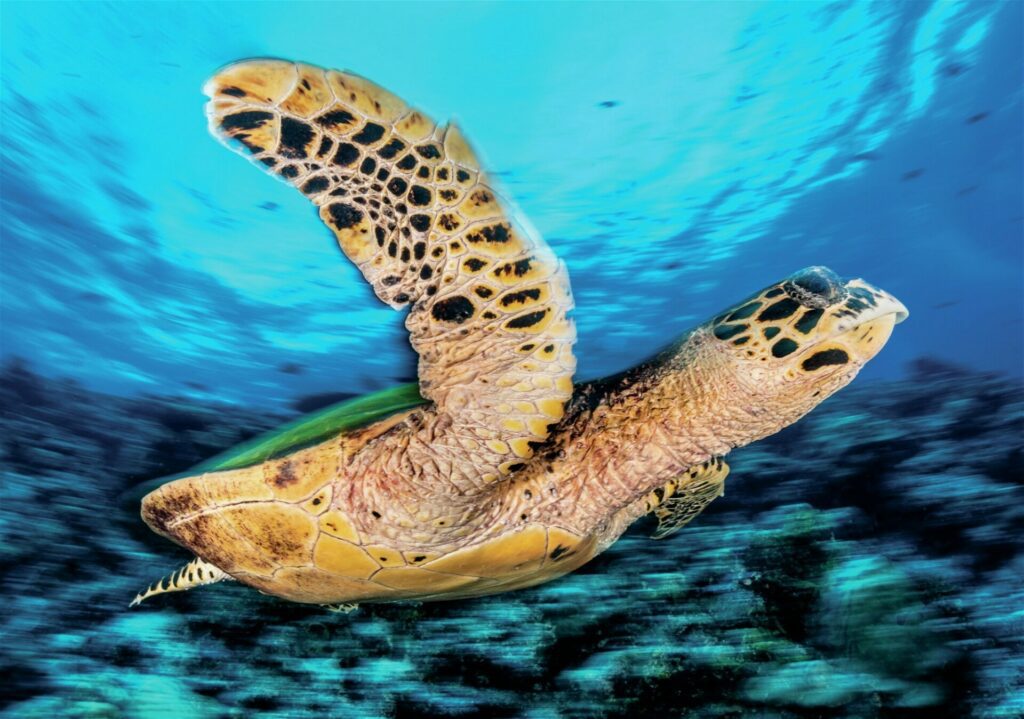
My highlight was spending my safety stop watching a hawksbill turtle, gently swimming up the drop-off. I remember being so excited after the dive, completely in awe that I’d been so close to an amazing marine reptile.
If, like me, you dive regularly in the tropics, you may have seen so many turtles that you’ve started to take them for granted.
I hope that this month’s column will redress the balance and help you capture winning shots to celebrate these remarkable creatures, that have been in the oceans since before the times of T. rex.
Hawksbill and Green Turtles – Key Differences for Photography
When it comes to turtles, our lenses are most commonly focused on two species: the hawksbill and the green.
Hawksbills are the definite reef turtle, feeding on sponges and soft corals. Although they are classed as critically endangered, a level more severe than tigers, we’re fortunate to be able to encounter them regularly, on reefs from the Caribbean and right across the Indo Pacific.
Green turtles are also found on reefs, but not everywhere. They feed on seagrass and use reefs as places to sleep and, in certain areas, to breed.
There are many well-known places for seeing lots of greens together: Sipadan Island in Malaysia, Tulum in Mexico, Marsa Alam in Egypt, Bunaken in Sulawesi, and Tenerife in the Canaries, to name just a few.
Green turtles also gather in great numbers at nesting rookeries, perhaps most spectacularly at Raine Island in the northern Great Barrier Reef, where over 50,000 fill the shallows in mating season.
Photographically, green and hawksbills offer distinct photographic opportunities, so it is valuable for your photography to be able to tell them apart. Lots of people focus on details to differentiate them.
But for me, using scale patterns to tell them apart is like saying you can tell your parents apart because one has a bigger nose! Greens and hawksbills have differences right across their bodies, and it is much better to learn recognise them because of how they look, rather than focusing on the details.
Respectful Approaches to Close Turtle Photography
Before we dive into the different photo ops, there is a valuable rule to remember for both: when you see a turtle, turn your strobes down! The reason for this is that we don’t usually jump in the water expecting to shoot turtles. We are typically shooting wide-angle scenics when we spot a shelled friend.
This is the reason that time and again I see photos of turtles completely overexposed around the face. The lightcoloured faces, chests and flippers of turtles are a lot more reflective than the reef. And if we don’t change our settings, we will over-expose them.
So, when you spot a turtle, simply remember that to reduce your strobes by a couple of clicks.
Turtles are usually reasonably easy to approach, as long as we’re respectful. Race in and we will spook them, but close the gap slowly, using a zigzagging course, so we’re not swimming directly towards them, and we will usually get in very close.
I’ve also found that if we can minimise eye contact, we will be much more likely to be successful.
Once we are close, they usually stay relaxed. They don’t mind us close, but they don’t like us closing them down, if that makes sense! Also relaxed turtles give better images.
Capturing Feeding and Behavioral Shots
I much prefer turtle shots where both front flippers are in a symmetrical position, showing it is not trying to spin around and avoid the photographer. Hawksbills feed on the reef and this is always a priority shot when I see one.
A turtle is only going to eat when it is relaxed, so these shots are a reward for that respectful approach. They eat a variety of encrusting invertebrate species, which makes for interesting images.
In the Caribbean they mainly chomp on sponges, while in the Indo-Pacific they feast more on soft corals, corallimorphs and coral polyps.
Good feeding shots don’t come instantly, so patience is crucial for following a turtle, as highlighted in this sea turtle photography guide. Stick with a feeding turtle and wait for it to feed on colourful food for more attractive images. Try to time the shots for when the mouth is open for the most drama.
Both hawksbills and greens eat jellyfish and from time to time this makes them very interested in our domeports! This provides some excellent photo opportunities with the turtle in the blue, looking straight in the lens and sometimes even with the mouth agape.
I will tip my camera upwards, so the dome catches the light and therefore the eye of the turtle.
Green turtles predominantly eat seagrass and seaweeds, which is an interesting, if messy, behaviour to capture, but not as photogenic as hawksbill feeding shots.
Also, if we encounter a green on a reef, there is no point following it hoping it will start munching on red soft corals. Fortunately, greens offer other opportunities. They have very characterful faces and portraits are easy to take when they are resting on the reef.
Classic Top-Down and Portrait Turtle Photography
The coral reef is also a good place for greens to get a clean, with algae-eating fish, like surgeonfish and blennies, picking at their shells. The best location for these shots is Hawaii, where brilliant yellow tangs act as cleaners.
But, arguably, the classic image of a green turtle is one that breaks many of the rules of portraiture, because it is shot from behind, looking down. The most-famous version of this image was a winner in the Wildlife Photographer of the Year contest and taken by Malcolm Hey in the 1990s.
At the time it was up in just about every tube station in London!
To bag this classic, remember that not all green turtles have attractive shells and if you are in a spot where there are multiple greens, invest time looking for the best shells. Usually, it is the younger turtles that have the cleanest shells with the most beautiful patterns.
The top-down shot is best taken with a non-fisheye wide angle because the distortion of the widest lenses tend to make the carapace dominate the frame with short flippers sticking out the sides. A tighter lens creates a more-attractive composition.
Finally, remember to frame your turtle against clean blue water for iconic images, a core tip in every sea turtle photography guide.

FAQs
What is Mustard’s Masterclass about?
Mustard’s Masterclass provides expert underwater photography tips, focusing on sea turtles, their behavior, and capturing stunning images.
How do I tell hawksbill and green turtles apart?
Hawksbills feed on sponges and soft corals and are reef dwellers. Green turtles feed on seagrass, rest on reefs, and are often seen in large numbers at rookeries.
How should I approach a turtle for photography?
Approach slowly using a zigzag path, avoid direct eye contact, reduce strobes, and allow the turtle to remain relaxed for natural shots.
Where are the best locations for photographing sea turtles?
Maldives, Caribbean reefs, Sipadan Island (Malaysia), Tulum (Mexico), Marsa Alam (Egypt), Bunaken (Indonesia), Tenerife (Canaries), and Raine Island (Great Barrier Reef).
What makes a top-down turtle photograph iconic?
Capturing a green turtle from above with a wide-angle lens against deep blue water showcases the shell pattern and creates a classic, award-winning composition.
This article was originally published in Scuba Diver UK #82
Subscribe today with promo code DIVE1 — enjoy 12 months for just £1!
