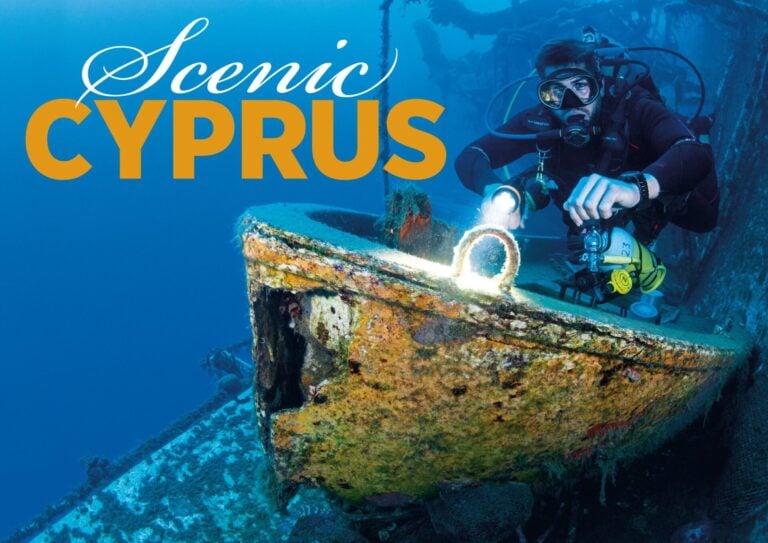
Stuart Philpott embarks on a whistlestop tour around some of the diving hotspots on Cyprus
Photographs by Stuart Philpott
Over the past few years, Cyprus has seen a steady growth in diver traffic. Sinking new shipwrecks and the addition of a Jason de Caires Taylor Sculpture Park has helped to swell numbers. Photos Socratous, the owner of Cydive, based at Paphos, recommended visiting in early November, when it was quieter and conditions were usually good for photography and, to his credit, he was spot on.
Every day we had blue skies, calm seas and crystal-clear visibility. Shock, horror – for once, I had nothing to complain about! Photos’s son, Pascal, agreed to be my guide and double up as underwater model for the duration, and Andreas Arestis – aka ‘Sausage’ – joined us as safety back-up, so all bases were covered.
The plan was to spend most of the week exploring the local dive sites and, to top off the excitement, Pascal arranged a daytrip to the MS Zenobia wreck.
A visit to Cyprus just wouldn’t be complete without visiting the Mediterranean’s top shipwreck.
I rented a car at Paphos airport and, as an added bonus, Cyprus drive on the left-hand side of the road, same as the UK.
The hotel was only a 15-minute drive away so I could have got a taxi, but having ‘wheels’ meant I was totally independent and could visit the local bars and restaurants in the evening as well as go sightseeing on my last ‘off-gas’ day.
The Roman mosaics at Kato Paphos are a definite must see, and the Edro III shipwreck is another popular tourist attraction.
Accommodation-wise, I split my week between Asimina Suites and the King Evelthon hotel. My first port of call, the five-star, adults-only Asimina Suites turned out to be an excellent choice. Offering a total of 110 rooms, it’s not too big and everyone seemed to respect peace and quiet.
Did you know?
The MS Zenobia sank on 7 June 1980, and rests on her port side between 19m and 42m. She was a Swedish built Challenger-class RO-RO ferry measuring 172 metres long. At the time of sinking she was carrying over 100 vehicles and lorries!
The buffet food was a high standard and the staff very attentive. There is an outdoor and an indoor pool available, although the outdoor pool isn’t heated so I did feel a bit chilly around the nether regions!
The bar, overlooking the bay, turned out to be the ideal place for early evening cocktails and people watching. The seafront walkway bustled with joggers in the morning, and strolling couples and families in the early evening.
Cydive was only a five-minute drive from the hotel. There were a few road works to contend with, which made following Google Maps slightly tricky, but Pascal’s other half, Sophie Pearson, worked out an alternative route for me via the Kings Avenue Mall.
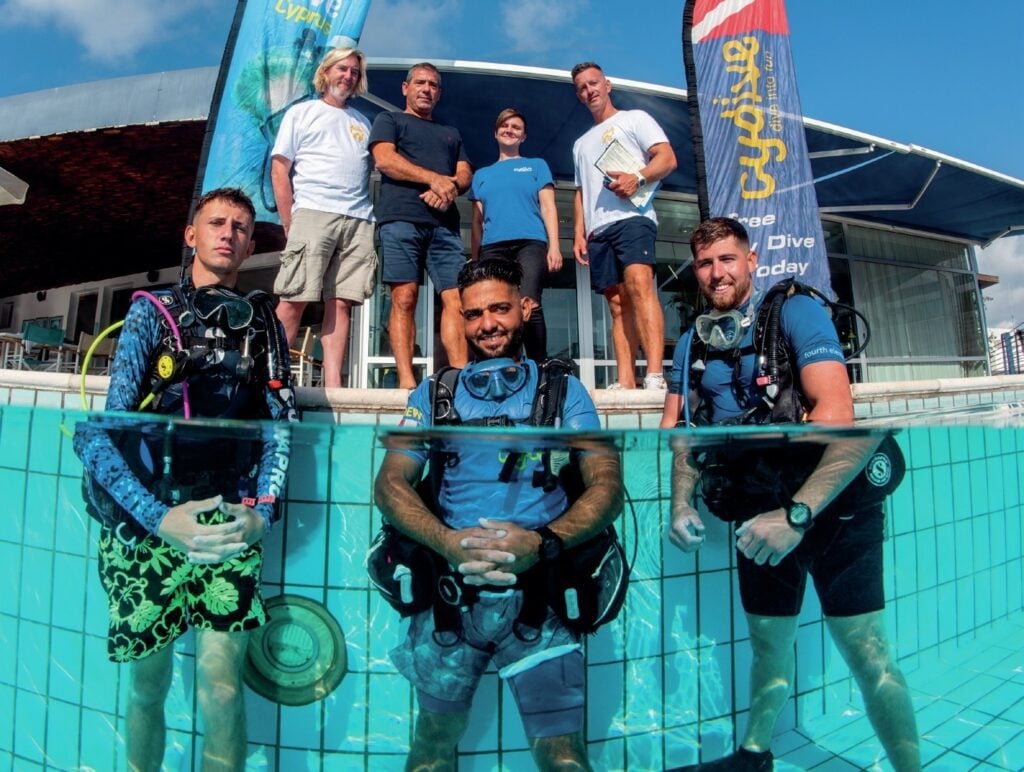
Established in 1978, Cydive is the oldest dive centre on Cyprus. Photos bought the centre in 1998 and has made some substantial improvements over the past 25 years.
With on-site swimming pool, shop, offices, classrooms, equipment rooms, changing rooms and toilets, I very much doubt there is another dive centre on Cyprus that can match the same high standard.
Photos qualified as a PADI Open Water Diver in 1991 and stopped at Rescue Diver level, preferring to focus his skills on running a profitable business. Cydive own the only custom-built dive boat in Paphos complete with brandnew twin Honda 250hp outboards.
Photos said this will be complemented by a second dive boat currently being prepared for the 2024 season.

After 35 years in the business, Photos has now passed the day-to-day running of the operation over to Pascal and Sophie. Reminiscing, Photos said that back in the mid-2000s, the PADI five-star IDC centre clocked up more than 3,500 Discover Scubas and certified over 1,000 divers every year.
Since Covid, Cydive have adopted a different philosophy, employing less staff, reducing some activities, upgrading equipment, increasing quality time with customers and allowing more time for practical sessions.
They are also in the process of creating an exciting new wreck site. Pascal said the wreck will be similar in size to the MS Zenobia. Investors have already committed €1 million to the project, which is planned to go ahead sometime in 2024.
Cydive offer around 35 dive sites, which include caves, walls, swim-throughs and shipwrecks. Some 15 minutes boat ride from the harbour is one of the most-popular shipwrecks, the Vera K, lying at a max depth of 11m.
The wreck itself is scattered about inside a crater. The most-prominent features include the bridge, engine and some of the superstructure. There is also a swim-through located on the periphery.

I wanted to try something different so, just for fun, we set up a photo-shoot of Pascal and instructor Breeze Richards sitting down having a ‘cup of tea’ on the bridge at a depth of around 8m.
This was breath-holding without using fins and scuba. Logistics turned out to be a little tricky, but the support team, Paulos Zerpteas and Sausage, were ready to pass over their alternate air sources at a moment’s notice.
The 95-metre-long, 2,500 ton cargo ship Edro III ran aground during a storm at Pegeia on 8 October 2011.
All nine crew were safely airlifted by helicopter and any pollutants removed by a salvage company. The shipwreck was left perched on the rocks and has now become a major tourist attraction. Local companies offer guided coach tours, canoe trips and its even promoted as a wedding venue!

Although her hull is mostly above the waterline, she still makes a great shallow 6m dive. I followed Pascal from bow to stern. Halfway along the hull there is a huge gaping hole where a forklift truck has spilt out of the hold onto the rocky seabed.
I took some pictures of the wheels, but didn’t venture any further inside. Pascal wasn’t sure how safe the superstructure was above us.
We carried on to the three-bladed prop which made a nice subject for a photo. I tried to get some 50/50 shots above/below the surface using my fisheye dome port and the results weren’t too bad considering the choppy sea conditions.
On the way back to the harbour we stopped off at Manijin Island. Pascal wanted to show me the popular caves and swim-throughs. The shards of sunlight breaking through the cave roof made my pictures look very atmospheric.

Midway through the week we took a break from the local sites and made tracks for the MS Zenobia. Cydive regularly organise daytrips to the wrecks located at Larnaca and Limassol. The Zen is undisputedly one of the top ten wreck dives in the world.
On 7 June 1980, the massive 172-metre-long Ro-Ro ferry capsized and sank off Larnaca. The official reason was due to a software fault in her computerised ballast tanks, but there are many rumours about her demise which all add to the mystery and intrigue.
She now lies on her port side at a maximum depth of 42m, fully laden with 104 articulated lorries and road-making machinery.

She has never been commercially salvaged, so every truck still carries its cargo. This varies from eggs, bottles and meat to children’s sweets and Persian carpets.
The Zen suits both recreational and technical diving. It’s such a huge diverse wreck some divers just spend a whole week exploring the Zen and don’t go anywhere else in Cyprus!
We made plans for two dives. On dive one we focused on the trucks still attached to the deck or lying on the seabed, and on dive two we ventured inside the bridge and upper cargo deck but no serious penetration.
As a bonus we encountered the resident loggerhead turtle who was more interested in eating sponges than worrying about me taking close-up pictures.

After five days I transferred to the 250-room five-star King Evelthon hotel. This was a totally different set up to Asimina Suites. Much bigger and better suited for families offering indoor, outdoor pool and an on-site water park.
I booked into a junior suite, which had a balcony bigger than an aircraft carrier runway. I wasn’t particularly keen on the standard buffet food, but the in-house Mexican restaurant was definitely worth a visit.
I would have eaten there every night, but was only allowed to make one booking during my stay.
The Laboe is probably one of the deepest dives Cydive has to offer.
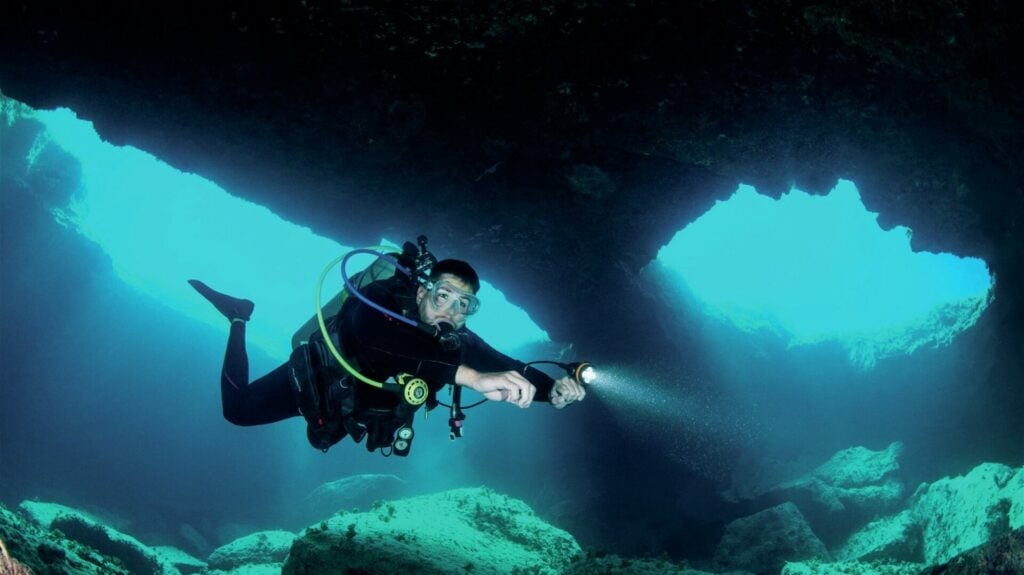
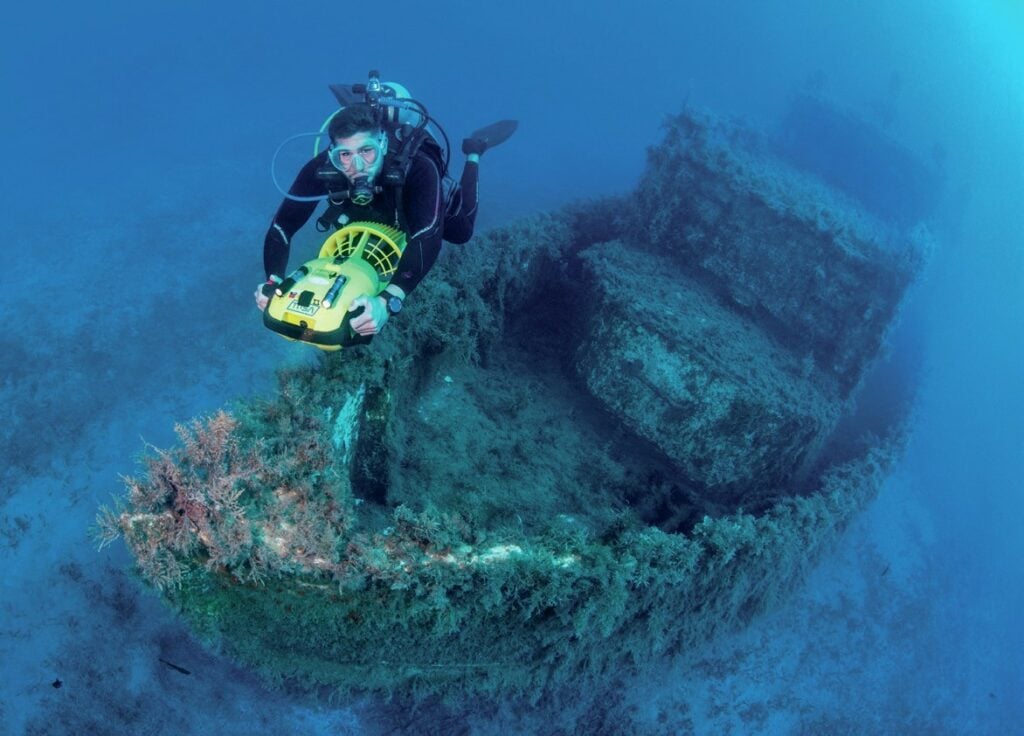
Used as a liveaboard from 2006-2014, the 21.5-metre-long vessel was finally sunk as an artificial reef project. She now sits upright and intact on the seabed at a maximum depth of 26m.
The wreck has many places to explore, including the saloon area and the engine room, but on this occasion I just wanted to get some scenic shots from the outside.
Just to make the pictures slightly more interesting we had brought along some ‘toys’ to play with including full-face masks and underwater scooters (Cydive offer PADI specialty training courses on both).
The only slight negative is the wreck is covered in a layer of fine silt. I asked everyone to be careful with their fins and ironically, it was me that touched the seabed and sent up a dense plume.
I managed to get some pictures of Pascal using a scooter modified with twin torches as ‘headlights’, and Paulos and Sausage wearing the full-face masks, and then we got consumed by the silt cloud!
We took the scooters out again for a blast around the Achilleas wreck, a 53-metre-long Greek cargo ship that exploded and sank in 1975.
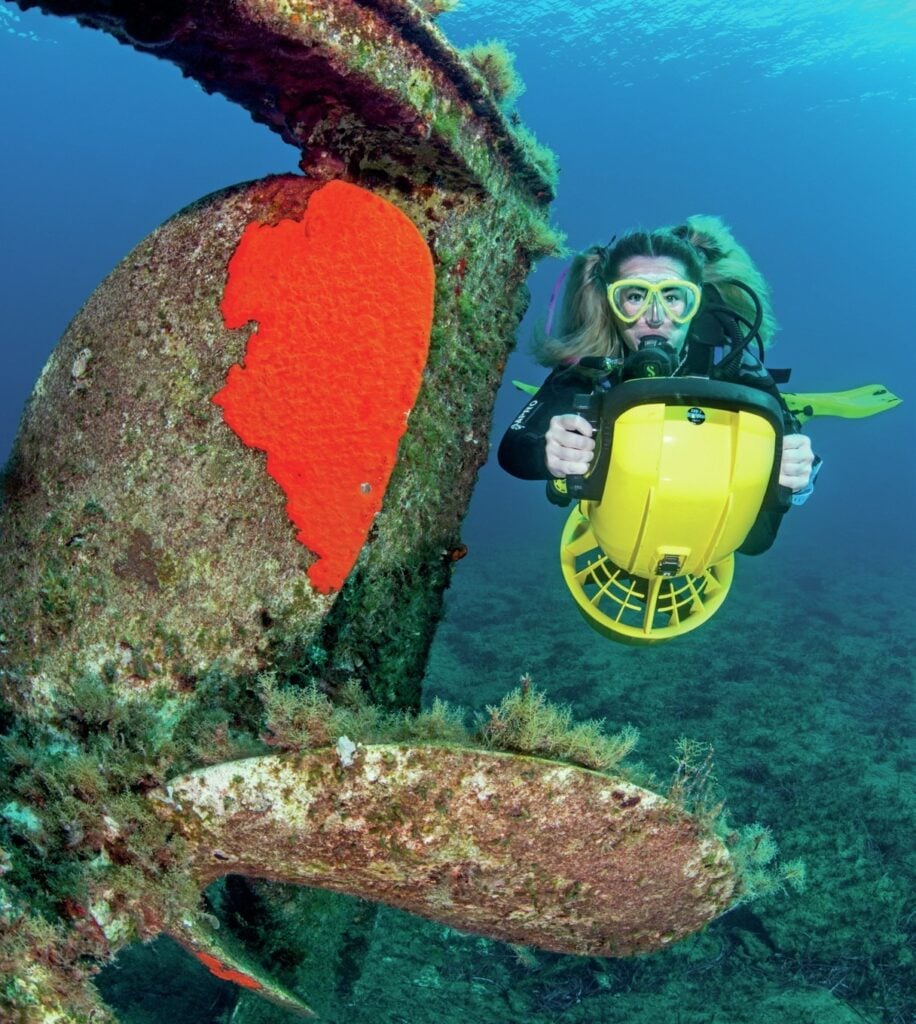
The wreck now lies at a maximum depth of 11m and has three main areas to explore – the bow, winch and stern. The most photogenic spot is the bronze prop. Pascal and Breeze did a number of formation scooter fly-bys while I took some pictures.
It was late afternoon and the fading lighting could have been better, but the colours of the yellow scooters against the bright red algae-encrusted prop blades really stood out.

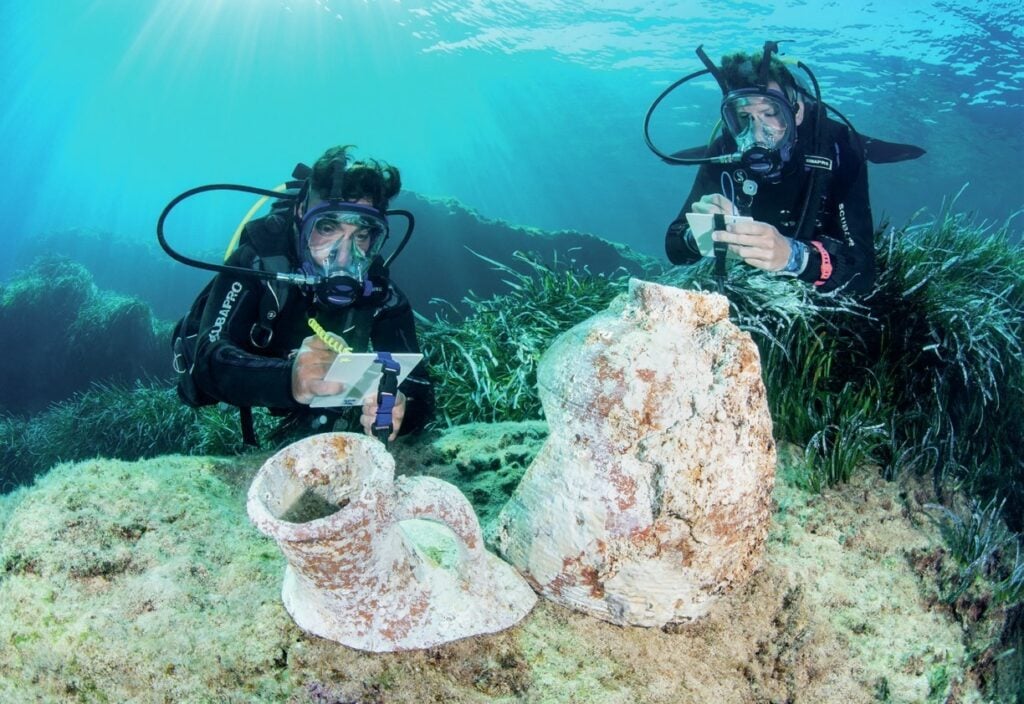
Paphos was once an ancient trading port with many sailing vessels coming and going so there is always the possibility of finding discarded amphora of some shape, size and condition lying on the seabed.
Pascal took me to a site called Amphora Caves, at a max depth of 12m. This site has a pile of broken amphora encrusted in the roof of a cave which is quite unusual. I placed a torch inside one amphora trying to create an ‘artistic’ picture but it didn’t quite work out.
There are also several swim-throughs to explore as well as the surrounding seagrass beds, which offer camouflage and protection for a variety of marine life.

Just to round off my tour, Pascal took me for a spin around the training dive site in Paphos Bay. We kitted up at the centre and it was just a two-minute walk to the steps leading down to the sea.
The main highlights were a number of anchors, a prop and some concrete balls which made up part of a reef rejuvenation project. I don’t think I recorded a depth of more than 5m throughout. For a first sea dive experience or a training dive, this was an ideal location.
I have to admit Cydive really do run a slick operation and are constantly trying to improve the facilities and the quality of service to keep their customers happy. Pascal said they had a long list of repeaters. Some would just pop by for a coffee or to use the swimming pool.
The plans for a new wreck site sounded very exciting and will undoubtably attract many more divers to the area. Hopefully I will return to Cyprus later in 2024 for an exclusive report on its sinking and carry out the first underwater tour.

This article was originally published in Scuba Diver UK #83
Subscribe digitally and read more great stories like this from anywhere in the world in a mobile-friendly format. Linked from Scenic CYPRUS