Dolphins can live to the age of 40 in the wild, so when a 15-year-old bottlenose called Zoe died on 29 April “far short of her natural lifespan”, wildlife conservation body PETA blamed regular hands-on encounters with visitors to Florida’s Dolphin Life marine park for contributing to her death.
The accusation has been firmly rejected by Dolphin Life, which has told Divernet that Zoe had “a genetic predisposition that affected her immune system, not an illness caused by interacting with humans”.
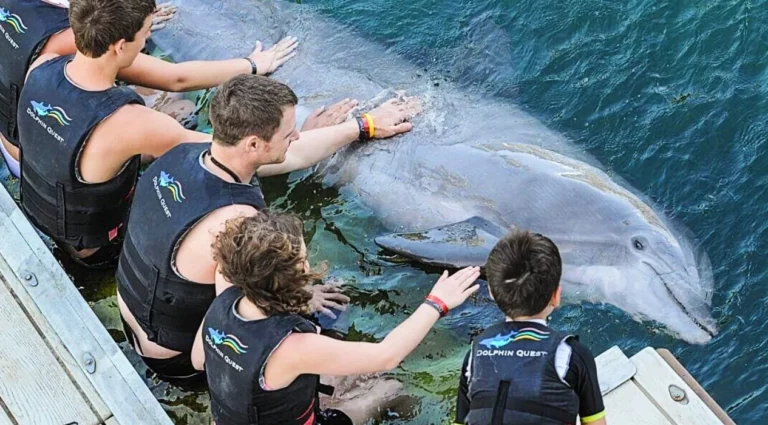
Zoe was used for swim-with-dolphins encounters at the Key Largo facility, where she had been held since 2018. According to PETA, she had sustained a gastro-intestinal infection and pancreatitis that progressed to an immune-mediated condition that results in anaemia. Such disease caused by “chronic stress, poor diet and ingestion of foreign material is common in captive dolphins”, it says.
“For a dolphin, a tiny enclosure filled with inescapable and possibly dirty, grabbing hands and who-knows-what is a recipe for sickness and death,” says the organisation’s president Tracy Reiman. “PETA is urging Dolphin Life to stop these dangerous encounters and send the surviving dolphins to sanctuaries before another one suffers and dies on its watch.”
Created by divers
Dolphin Life is a non-profit organisation created by a group of experienced marine-mammal specialists and divers, its founding director Art Cooper told Divernet. “We operate the only whale and dolphin rescue hospital covering all of South Florida,” he said. “We return every marine mammal capable of surviving on its own to the open sea.
“Dolphin Life also operates a seaside sanctuary for non-releasable marine mammals needing permanent care. Our marine habitat is a natural seawater lagoon, set a few hundred yards from the open ocean and protected from high winds and waves.
“We do not subject our animals to the noise of filters or pumps, nor do we use harsh chemicals such as chlorine or ozone. Ours is a completely natural seawater habitat.”

Wild dolphins can range up to 100km a day and dive deep with their pods, whereas in marine parks they are confined to small tanks or shallow lagoons, says PETA. It has also pointed out that Dolphin Life was cited by the US Department of Agriculture in 2023 after a guest was bitten during an encounter with two dolphins.
“Reputable animal-care facilities, such as those accredited by the Global Federation of Animal Sanctuaries, never force animals into hands-on encounters or allow visitors to touch or ride them,” says PETA.
‘Voluntary interaction’
“All animals in our care were donated from former interaction facilities or rescued from antiquated facilities that were closing operations, such as the Miami Seaquarium,” retorts Cooper. “None of the animals in our permanent care can care for themselves, nor are they legally releasable.
“All of our dolphins were former interaction participants. Our dolphins voluntarily interact with guests, which is an important form of enrichment, proven to stimulate their minds and improve their welfare.”


Cooper, a PADI Master Scuba Diver Trainer, says that Dolphin Life is “committed to limiting the frequency and number of participants to ensure that human interactions remain stimulating and playful”, with all profits supporting animal care and stranding-response hospital operations.
“No credible scientific research proves that dolphins suffer from interacting with people,” he claims. “That has been a fable told by PETA to gain emotional reactions from supporters for over two decades without any substantiation… The bottom line is that PETA has done a poor job of its homework.”
PETA’s Reiman has now written to Cooper urging him to release all the animals in Dolphin Life’s care, and accusing the facility of being out of step with modern trends.
“Nearly every major travel company, including Airbnb, Booking.com, Expedia and TripAdvisor, prohibits ticket sales to venues that offer swim-with-dolphin encounters, interactions and performances,” she points out.
Welfare problems
“Companies and consumers alike are recognising that dolphins’ complex physical and psychological needs simply can’t be met when they’re used for entertainment, and experts agree that these animals exhibit a range of welfare problems.
“Canada, France, and Mexico have banned dolphin captivity and that list will only grow. Two belugas were transferred from a marine park in China to a sanctuary in Iceland, three dolphins confined to tiny pools in Indonesia were rehabilitated and released into the sea, and the Whale Sanctuary Project is creating a sanctuary for orcas and belugas in Nova Scotia.
“Dolphin Life has the opportunity to become a leader in marine-animal welfare rather than a relic of a fading industry.”

Dolphins aren’t toys for our amusement. Life in a tank is no life at all. If this place truly cared about dolphins, they’d stop using them as props. Period.