
Kurt Storms heads to Malta for the Rebreather Forum 4 conference, but finds time to explore some of Malta’s sunken fleet of shipwrecks, beginning with the HMS Southwold
Photographs by Kurt Storms
Malta: The Perfect Opportunity for Wreck Dives
Finally to Malta, This had been in the planning stages for a while, but partly due to lack of time, it had never come to fruition. But since I was invited to represent Divesoft at the Rebreather Forum 4 event, this was an ideal opportunity to get some wreck dives in. Together with my buddy Willem, we set out to dive some deeper wrecks, including the HMS Southwold, a beautiful World War Two wreck.
HMS Southwold
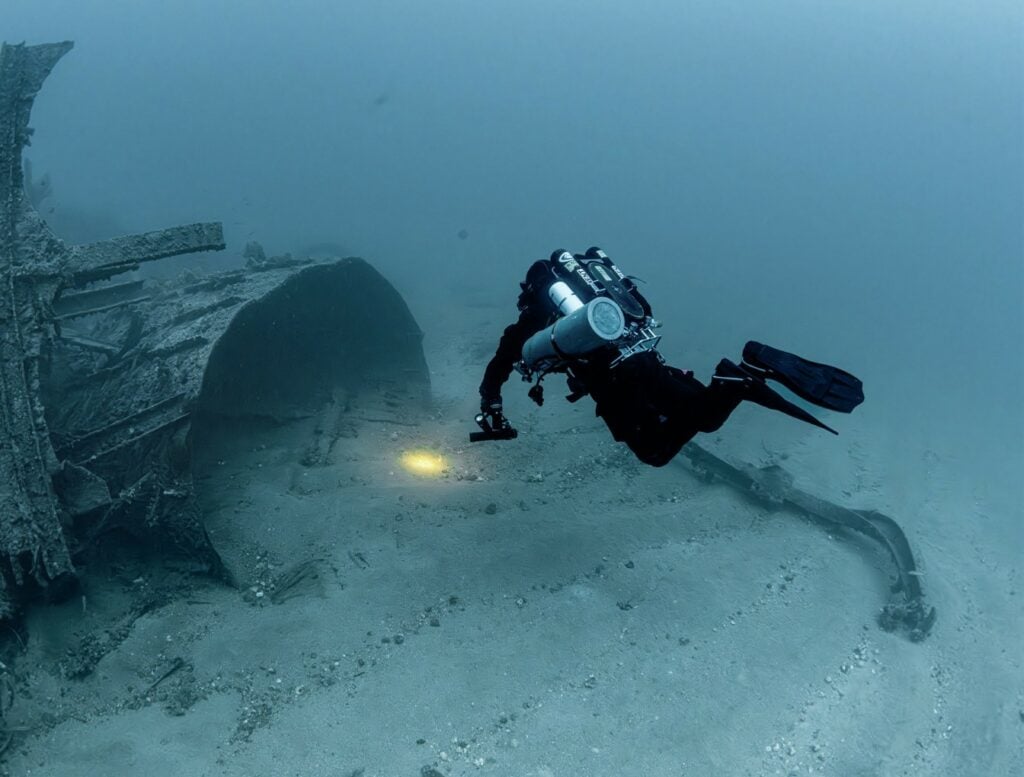
HMS Southwold consists of two sections. The bow section is the largest piece. About 40 metres long and at a depth of almost 68m, it lies entirely on the starboard side.
The stern is about 30 metres long at 74m depth, sitting upright on the seabed. The stern is about 200 metres away from the bow section, which means you have to do this wreck in two dives.
The History of the HMS Southwold
Southwold was ordered on 20 December 1939, and was built by J. Samuel White and Company of East Cowes as part of the 1939 emergency programme.
Her keel was laid on 18 June 1940 with Job number J6274, and the ship was launched on 25 May the following year. The vessel was completed on 9 October 1941.
HMS Southwold belonged to the Hunt-class destroyers. They were 86 metres long with a beam of 9.5 metres and a net tonnage of 1,050 tonnes. These ships had a top speed of 25 knots and were used for convoy escort.
HMS Southwold had a crew of 168 and had three two-barrel four-inch MK XVI guns, one on the bow and two on the aft sections.
She also carried anti-aircraft guns and antisubmarine depth charges. After she was completed, Southwold went to Scapa Flow for trials, after which she joined the Mediterranean fleet.
Between 12 and 16 February 1942, the HMS Southwold was part of the escort for convoy MW9B – this convoy failed. Of the three merchant ships, one was damaged and made it to Tobruk, but the other two sank. The Southwold and the other escorts returned to Alexandria.
On 20 March 1942, the HMS Southwold left Alexandria to be part of the convoy MW10 to Malta under the command of Admiral Philip Vian.
During the 820 nautical mile voyage to Malta, HMS Southwold was heavily attacked by Italian warships and the Luftwaffe.
Once the Southwold was located by the enemy, this was reported to the Italian Navy. The Italian Navy sent ten ships to the Gulf of Sirte (Sidra), 150 miles NW of Benghazi, on 22 March 1942 and waited for the convoy. When they were sighted, Admiral Vian knew immediately that he was not heavily outgunned.
Italian commander Iachino had the 15-inch guns of the Littorio and the eight-inch guns of the cruisers versus his six-inch and the four-inch guns on his destroyers. So the British laid a smoke screen to prevent the Italians from having good range.
They constantly stormed in and out of the smoke screen, firing damaging salvos at their superior opponents and then doubling up behind the smoke before the Italians could take range.
The fight was aborted that morning, but the Italian squadron approached again in the afternoon. This time, Admiral Vian closed the range to below 10,000 metres and dived out of the smoke screen and managed to hit the Littorio with a salvo that set the battleship on fire.
The Italians responded and the British cruiser Cleopatra was hit and severely damaged.
Did you know?
HMS Southwold was a Type II British Hunt-class destroyer built for the Royal Navy during World War Two.

A quick counterattack by the British destroyers, including the Southwold, by quickly emerging from the smoke blanket, hit the Littorio again with a torpedo and also managed to hit the cruiser Giovanni delle Bande Nere. The Italians retreated.
The battle went down in history as the Second Battle of Sirte. German aircraft took over the attacks as they were determined to prevent the convoy from reaching Malta. When the convoy was only 20 miles from Malta, the Germans sunk the Clan Campbell.
But now the convoy was within range of fighter protection from Malta, and Hurricanes and Spitfires flew out to protect the remaining ships.

On 23 March 1942, one of the merchant ships in this convoy, the Breconshire, was hit by enemy bombs and came to a halt a few miles off St Thomas Bay. The weather turned rough and the Breconshire drifted helplessly towards shore.
The crew of the Breconshire managed to anchor 1.5 miles off Zonqor Point. The next morning, 24 March 1942, the Breconshire dragged its anchors over the sandy bottom and the Southold was ordered to tow the Breconshire.
While attempting to pass a line to the disabled ship, HMS Southwold ran onto a mine near the engine room. One officer and four sailors were killed.
All power and electrical supplies failed, but the diesel generator started. The engine room was flooded, but the water in the gearbox was stopped by shoring up the bulkhead and plugging leaks.
The tug Ancient towed the Southwold, but the ship’s side plating next to the engine room split on both sides up to the upper deck. It sank and heeled to starboard and the injured were transferred to the destroyer Dulverton.
The amidships gradually sank lower and the ship began to fall into the swell. She was then abandoned and began to sink, and eventually sank in two parts.
Diving the HMS Southwold
For wreck diving, we will go by boat, using the services of Jason. His boat Delfino is a traditional Maltese vessel, fully equipped for technical divers. Jason’s knowledge of the wrecks is vast, and he has no trouble locating the deeper wrecks, and most importantly, to drop the shot line in the right place at the right time.
We are well helped by deckhand Karsten, who will stand in as support diver. This job is important – if something should go wrong during the dive, he can jump in the water with extra tanks.
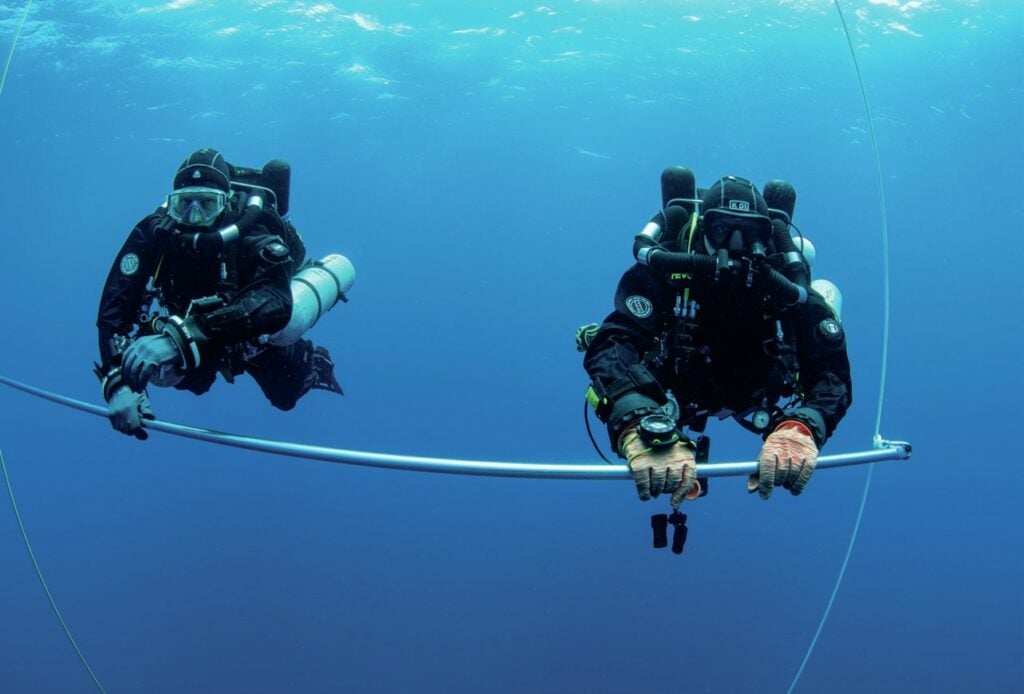
To make our deco obligations as good as possible, we will use a deco station. The last diver disconnects the deco station from the shot line so we can all do our obligations together, and Jason only has to keep an eye on the two red buoys instead of several SMBs in different places.
Doing deco at a deco station is also very relaxing for the divers. That way we have a reference to keep track of our depth. There are also spare tanks attached to it, should we have a gas problem. Today we will dive the bow of the HMS Southwold.
I will dive together with my regular buddy Wim, and I will use my Divesoft Liberty SM CCR. Wim and I jump into the water on the captain’s signal, and we float through the current to the shot line. Once there, we sign to each other to start the descent. I go first, followed by Wim.
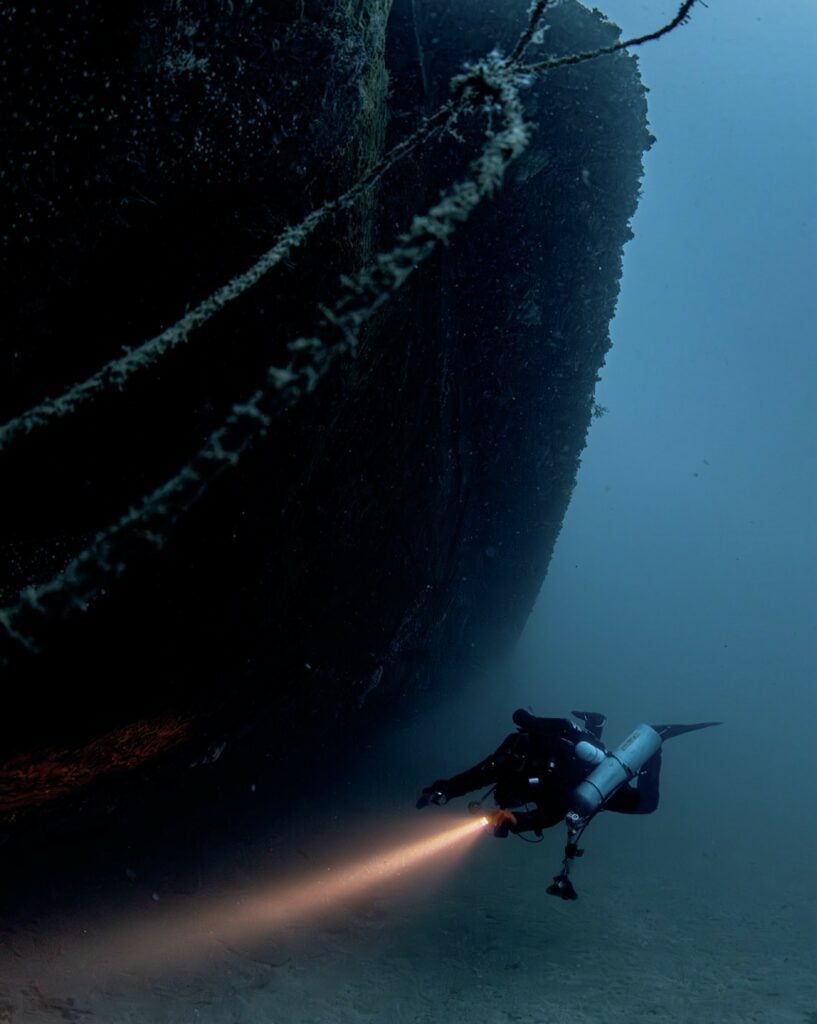
After three minutes of descending, we arrive at the wreck, where we immediately proceed to the back of the broken-off piece. We take a look inside, and do our laps. As agreed beforehand, Wim will lay some lights so that the piece of wreckage is backlit. Wow, what a tremendously beautiful wreck this is.

We find some nice empty shells, which come from the cannon a few metres away. This double cannon immediately catches the eye. It sticks out nicely, still as proud as before.
Our bottom time is not that great, we only have a 35 minute bottom time before we start our ascent back and complete our 90 minute mandatory deco stops.

But before we go back up via the shot line, I take a few more photos of the prow, which lights up nicely on its side. Satisfied with some great photos, we signal that it is now time to begin our ascent.
After completing the stops on the deco station, we emerge satisfied and Jason approaches. Karsten lowers the lift so that we get back on the ship with all our bail-out bottles without any problems.Happy as two children again, we can tick this wreck off our ‘to-do’ list.
Frequently Asked Questions (FAQs)
What is the HMS Southwold?
HMS Southwold was a Type II Hunt-class destroyer of the Royal Navy built during World War Two, now resting in two sections off Malta.
How deep is the HMS Southwold wreck?
The bow sits at approximately 68m, while the stern lies at 74m depth, making it a two-dive wreck for technical divers.
Where is HMS Southwold located in Malta?
The wreck is near St Thomas Bay, southeast Malta, lying on the seabed in two main sections about 200m apart.
What should divers know before exploring HMS Southwold?
Divers should be experienced in deep technical diving, use shot lines or deco stations, and dive with a buddy due to depth and currents.
What marine life can be seen at HMS Southwold?
While primarily a wreck dive, divers can encounter various small fish, shells, and occasionally pelagic species around the wreck debris.
How do I reach HMS Southwold for diving?
Diving operators in Malta, like Delfino with captain Jason, provide boat transport to the wreck with full support for technical divers.
What should divers know before exploring HMS Southwold?
This article was originally published in Scuba Diver ANZ #62
Subscribe today with promo code DIVE1 — enjoy 12 months for just £1!
