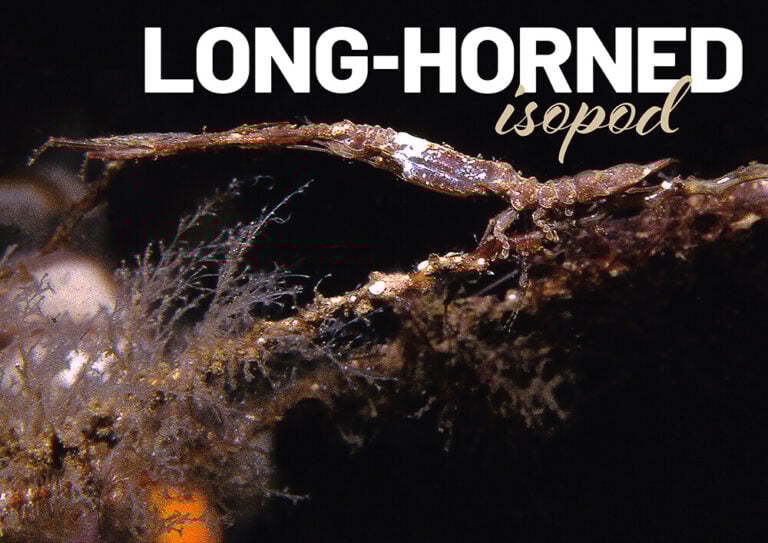
Lawson Wood gets his macro groove on to focus on the weird-and-wonderful long-horned isopod.
What Is the Long-Horned Isopod?
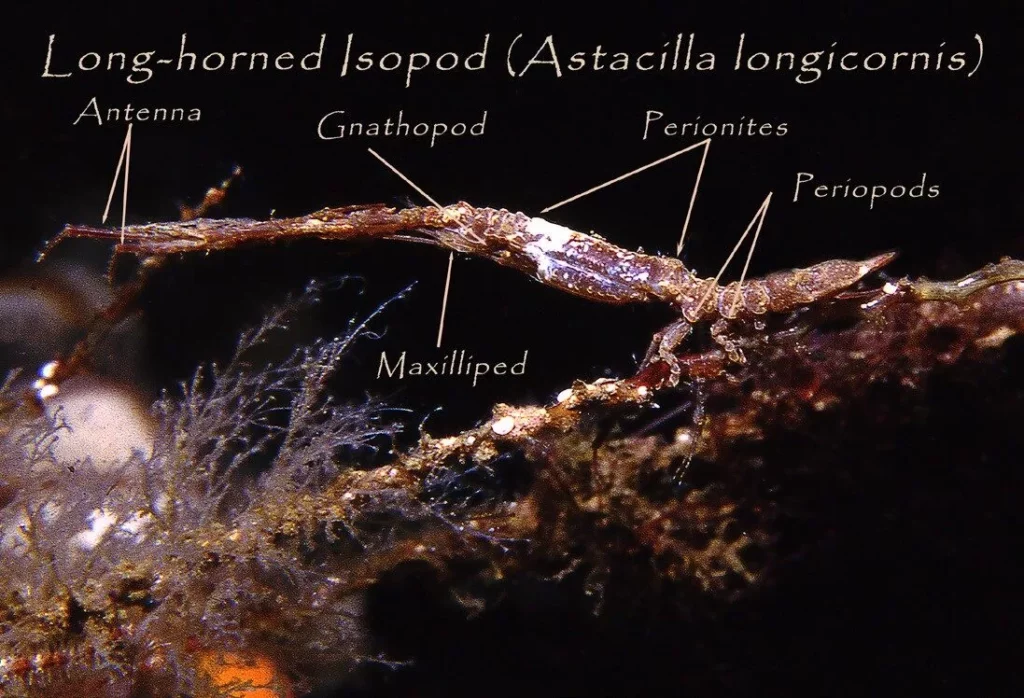
The long-horned isopod (Astacilla longicornis) is just one of several dozen similar species in the Astacilla family found worldwide. This species in particular is commonly found all around our shores, from the deepest sea lochs to a usual sublittoral habitat. It can be found on many different species of hydroid, sea pens and worm mud tubes.
The long-horned isopod was first described by George Brettingham Sowerby, a British naturalist, in 1788. Sowerby is more notably known for his book on the Illustrated Index of British Shells in 1859 (recently reprinted in 2024).
Reproduction and Life Cycle
The species is mostly gonothoric (where the young develop as either male or female) and are sexually dimorphic (males are larger than females). Leading a quite complex life, they are only able to reproduce when the female starts to moult. Males will locate a suitable partner and when the moult occurs, they are able to transfer a sperm package indirectly into the female’s marsupium. Once transferred, the female will transfer her eggs into the marsupium where they are fertilised. Eggs are brooded and hatch as manca postlarva (virtually identical to the adults, but unable to swim).
Camouflage, Mimicry and Parental Care
Once the postlarva develop into mini adults, this species is quite particular in that juveniles of many stages in size all often collect together. When the juveniles first emerge, they cling to the adult’s antennae and can form a large clump. This behaviour not only provides the young with much greater feeding opportunities in the plankton-rich current, they also closely resemble the bottle brush hydroid (Thuiaria thuja) which is one their favourite habitats for that very reason. This extended parental care is perfect camouflage against predatory species such as cod, pollock and haddock.
Where Long-Horned Isopods Are Found
They are found is most areas of the North Atlantic and also as far as the French Mediterranean and Turkey. For real boffins, a type of Foraminiferan was discovered on this species of isopod from specimens collected within the Berwickshire Marine Reserve by divers. This is a type of parasite which is chalky in structure with small protrusions and was found on antennae and other parts of the body.
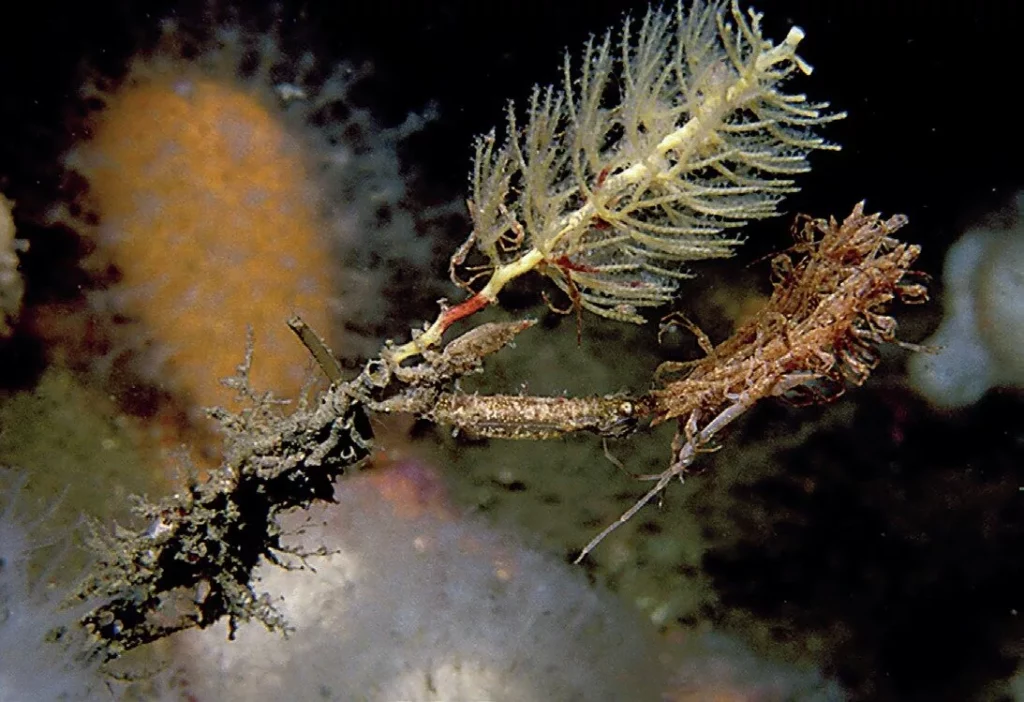
The long-horned isopod is common in the Scottish sea lochs where it is found on a variety of sea pens, particularly the tall sea pen (Funiculina quadrangularis). These kind of stick insect-looking little critters are great to find and like all macro life found around our shores, give a hint of the amazing diversity of marine life that we often completely ignore.
Frequently Asked Questions
What is a long-horned isopod?
The long-horned isopod (Astacilla longicornis) is a small marine crustacean found around UK and North Atlantic coasts, often mistaken for hydroids.
Where can long-horned isopods be found?
They are commonly found on hydroids, sea pens, and worm tubes in sea lochs and sublittoral habitats.
Why do long-horned isopods resemble hydroids?
Their shape and juvenile clustering closely mimic hydroid species, providing effective camouflage from predators.
How do long-horned isopods reproduce?
Reproduction occurs during female moulting, with eggs brooded in a marsupium and hatching as manca larvae.
Are long-horned isopods common in UK waters?
Yes, they are widespread around British shores, particularly in Scottish sea lochs.
This article was originally published in Scuba Diver Magazine
Subscribe today with promo code DIVE1 — enjoy 12 months for just £1!
