
The ship’s bell has long been the prime method of identifying a lost shipwreck. Shipwreck bells are also the trophy of desire among wreck divers the world over. Few are lucky enough to find one in their lifetime, while others have the skill and knowledge to know exactly where to look. Leigh Bishop is one man who has a number to his own credit, and here he looks into the origin of the ship’s bell as well as the drive divers have to find their ultimate prize

A Deep Dive on the Kingsbridge
My depth gauge read 90m, breathing mixed gas my equivalent narcotic depth (END) was just 35m. I knew full well what I was doing, and I knew full well where I was going. Or did I? My dive partner, Mark Bullen, is beside me as we swim along the starboard side of the Kingsbridge, a sailing ship sunk 131 years previous. Our powerful torches pick out key features that we absorb into our subconscious minds for our return in the black darkness the wreck is today blessed in.
Before long an anchor appears. How can this be? I question myself – surely, we are swimming towards the stern! We must be, as we have come from the location where I had found the ship’s bell on a previous dive, what I believe is the bow. We have to be right, I say to myself, this must be a spare anchor just stowed here. Then another anchor, and before long, a chain locker. How can this be?
Two Bells, One Wreck – A Lesson in Perspective
Mark’s light flashes frantically and he begins to squeal loudly into his rebreather loop. He’s excited, and Mark rarely gets excited. There, in among a huge pile of millstones, is yet another bell. This one was much larger than the one I had discovered. A degree of confusion sets in, although overruled by excitement as I ease Mark away from his find to photograph this prize before our visibility deteriorates.
A later return to the site in better visibility proves that the bell Mark had discovered was the bow bell, and the one I had discovered was one from the stern. My research soon discovered that a sailing vessel of this vintage would often have had two bells, at the stern and the bow.

When the Bell Makes It Back to Port — And When It Doesn’t
During the 1990s, the heyday of the technical diving revolution, dozens upon dozens of undived wrecks were being discovered and explored every year. Sailing ships were no exception, particularly There’s always a very special atmosphere when the dive boat returns to port with a bell on board. It makes for one of those rare but great wreck-diving days we all treasure. On the counter side of that, there has been the odd occasion, or two, that I can recall when the boat returns to port with silent and sad divers. On more than one occasion I have witnessed a desperate effort to recover a bell on the surface in rough seas, only for it to cut free from the lift bags and plummet back down to the seabed never to be found again.


Why Ship’s Bells Hold Such Power
Finding a ship’s bell is something very special. Some have referred to it as joining a very special club of elite divers. So, what is it about a ship’s bell that makes divers go weak at the knees, driving them to insanity in their quest to find just one in their lifetime? To answer that question is not easy as we all have different views of why we do things in life.
Having discovered numerous ship’s bells myself, I have my own answers, but I wanted to see if they were similar to others who had been in the same position I had on several very special occasions. I contacted a number of divers who, albeit no longer active in the water, were happy to hear from me. Each had their own unique story to tell when they lifted, what to them at the time felt not unlike what it must be for a footballer to lift the FIFA World Cup.
The answer all seemed to come back to the focus point that a bell plays a unique part in the history of the ship itself. At one point in time, in British waters. I became even more excited with the thought of how many of these sailing ships we had located and not returned to since its bell, and thus our quest for identification had been discovered. With a list of targets as long as our arms, it was time to retrace our steps. Sure enough, as time went on, more and more sailing ships began to reveal that elusive second bell.


Aside from sailing vessels of the 20th century, steamships traditionally have a single bell, with the odd occasion where two have been discovered. Normally, the bell is located either directly in front of the bridge, or towards the forward forecastle where the mast would have been. Never are bells located aft of the bridge on steamships. If searching for the bell, a good starting point for navigation is the engine and the ship’s boilers – forward from this point is the direction of the bridge and bow. If you end up following a prop shaft, believe me, you are going in the wrong direction. These ships were lost to the world, their lives ended abruptly only to be discovered decades later by divers who would bring them back to life. The divers who find the bell, effectively the sound, heart and focal point of these once-proud ships, are the divers who bring them to life by identifying their historical remains. Only one diver has that special moment for each wreck, and it puts them a cut above their peers for that moment in time.

Each had their own unique story to tell when they lifted, what to them at the time felt not unlike what it must be for a footballer to lift the FIFA World Cup
Identifying Wrecks — Why the Bell Matters
Of course, all shipwrecks can be identified in many ways, and very often do, but once the bell is discovered it brings positive identification. Most bells recovered will unveil the name of the ship that it is recovered from. Some have beautiful names such as Snowdrop or Marie Thereses, while others have meaningful examples like the Michael Clements, a bell named such recovered by Lymington Skipper Dave Wendes. Wendes found, upon researching the ship, Michael Clements was a chief carpenter aboard HMS Victory.
On some occasions, a ship has been discovered and identified by its bell only to confuse matters further. Sometimes ships changed hands to different companies and with it, a change of name, but often the original name remained on its bell. With that, the diver must dig much deeper into their research and discover at which point in history it took a name change – and to what.
Research dictates that the origin of a ship’s bell can be traced back many hundreds of years, with bells being used on ships as early as the 15th century. Records of epic voyages tell us about ship’s bells and how the helmsman used them to measure time in half-hour increments. The Ship’s Bell system of chimes evolved from a crude sand clock dating back to the time of Columbus. Before the advent of the chronometer, time at sea was measured by the trickle of sand through a half-hour glass. One of the ship’s boys had the duty of watching the glass and turning it when the sand had run out.

This primitive clock, sometimes referred to as a sand or sandglass clock, was an essential device for marking time at sea. Watches, or shifts, were organized into increments of four hours; a custom that is still widely used. With the sandglass at his side, the helmsman would signal the passing of half-hour increments starting with the strike of one bell at the end of the first half-hour, two at the second and so on until reaching eight bells, which signaled the end of the watch. The tradition of the sand clock continued for hundreds of years and was replaced only by the development of the mechanical clock.
A ship’s bell was also used as a warning during fog with a series of rapid, successive strokes and, at other times, as a fire signal or danger of other nearby vessels. In the case of the Titanic, icebergs.
Law, Ownership, and Responsibility
In the UK under the Military Remains Act of 1986, it is an offence to enter or tamper with any such listed wreck of war loss. With that said, it goes without saying that military wrecks are treated with respect and if their bells are discovered, they are simply photographed filmed and documented.
Despite being a prized trophy for the diver, often is the case that upon declaring the find to the receiver of wreck, the owners of the vessel could still be in business and will almost certainly want their rightful property back. This is often undertaken with a reasonable fee granted to the diver in lieu of salvage. Even if a ship is not sunk, but merely broken up, its bell often becomes a highly prized memento of service for that particular ship and frequently commands very high prices when offered for sale.
The day’s bells are brought to the surface are the days that make for the best stories in any wreck divers’ logbook. Reading through my own brings back some of the great memories from the great heyday of technical diving; fabulous memories that will remain with me forever. Often have I surfaced only to board the boat and see all the other divers huddled round an encrusted bell-shaped object. The lucky diver scraping frantically across its surface with his or her dive knife to reveal the ship’s name and make their mark in bringing history back to life.
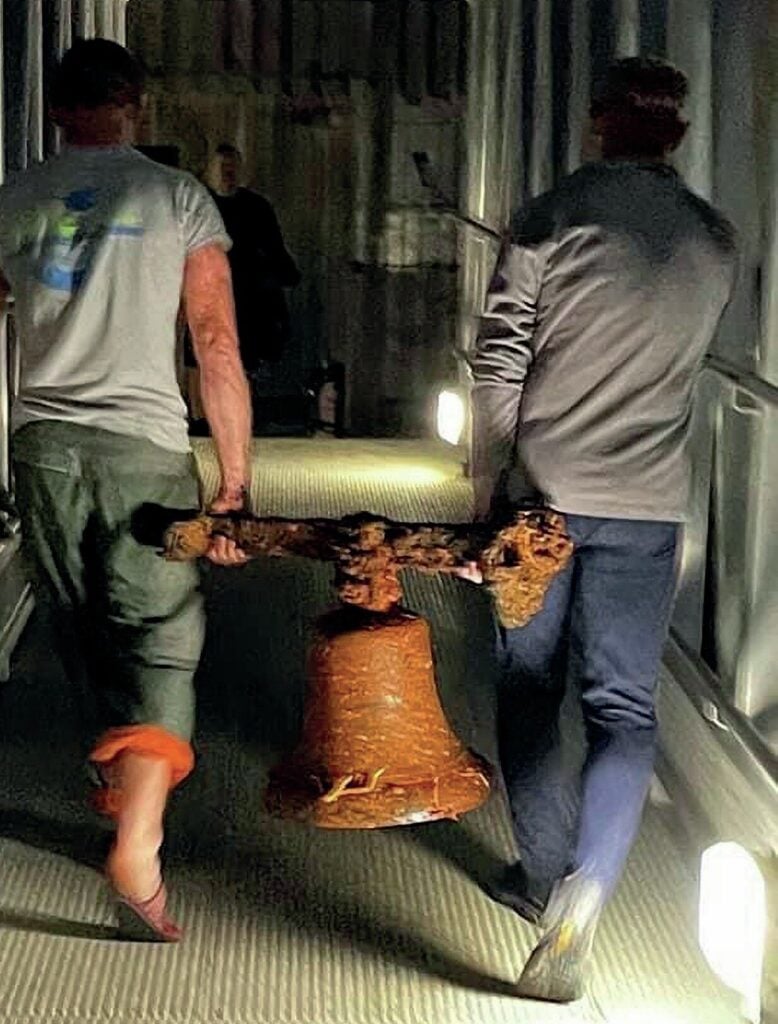
Bringing History Back to the Surface
In the UK, the Receiver of Wreck is responsible for all recoveries landed on UK soil. Remember, your find could well be someone else’s rightful property. Make sure you understand the law in terms of recovery. Don’t, however, get into the mindset that your bell is going to be taken off you the moment you enquire; the odds are it’s not. The chances are that the owner or the company of the ship you have just identified is no longer alive, or their company remains in existence. It will be your job to look after that piece of maritime history. Many people argue that these finds should be on display in museums for all to see; however, the average museum doesn’t have the room to display everything they have in storage as it is, let alone every bell a diver recovers.


Recover or Leave? A Debate That Won’t End
Many readers will be of the opinion that all artefacts should be left on the wreck for all to see, a debate that will never be agreed upon by either side that argues the case. Shipwrecks are falling apart and becoming nothing more than iron ore deposits on the seabed. Each year the ever-moving elements of nature slowly degrade and cover the wrecks we explore. All of these bells pictured in this feature would never have been seen by this readership had they not been recovered. And as the saying goes, has beauty any value unless it can be seen!
Frequently Asked Questions
Why are ship’s bells so important to wreck divers?
Ship’s bells are often inscribed with a vessel’s name, making them one of the most reliable ways to positively identify a shipwreck.
Where is a ship’s bell usually found on a wreck?
On sailing ships, bells are typically located at the bow and sometimes the stern. Steamships usually have a single bell near the bridge or forecastle.
Did ships really have more than one bell?
Yes. Many historic sailing vessels carried two bells—one forward and one aft—used for timekeeping and ship operations.
Is it legal to recover a shipwreck bell?
It depends. In the UK, recovered bells must be reported to the Receiver of Wreck, and military wrecks are protected under law and must not be disturbed.
What was the original purpose of a ship’s bell?
Ship’s bells were historically used to mark time, signal watches, warn other vessels in fog, and alert crews to emergencies.
This article was originally published in Scuba Diver Magazine
Subscribe today with promo code DIVE1 — enjoy 12 months for just £1!
This article was originally published in Scuba Diver Magazine
Subscribe today with promo code DIVE1 — enjoy 12 months for just £1!

https://www.youtube.com/watch?v=D5ISVmNv2q8