Just before the turn of the year, Italian snorkellers Gianluca Di Gioia and Peppino Fappani encountered what was reported to be a tiger shark near Marsa Alam in southern Egypt. Di Gioia died and Fappani had his arms and legs bitten while trying to help his friend, though he was soon discharged from hospital.
A month or so later, a Canadian woman lost both hands while trying to photograph what was suspected to be a 2m bull shark. She had been snorkelling in shallow water off Providenciales in Turks & Caicos.
Also read: TV review: SHARK! Celebrity Infested Waters
And in late April Israeli Barak Tzach died while swimming to capture shark footage, as he regularly did, off the Mediterranean town of Hadera, where warm water from a power station attracts dusky and sandbar sharks each winter.
After Tzach’s death, footage of which was widely shared on social media, the authorities warned people against taking to the water at Hadera.
But within days there were reported to be even more people swimming off the beach, willing to take their chances for an Instagrammable shark encounter. As a 2020 study has confirmed, far more people die taking selfies than are killed by sharks.
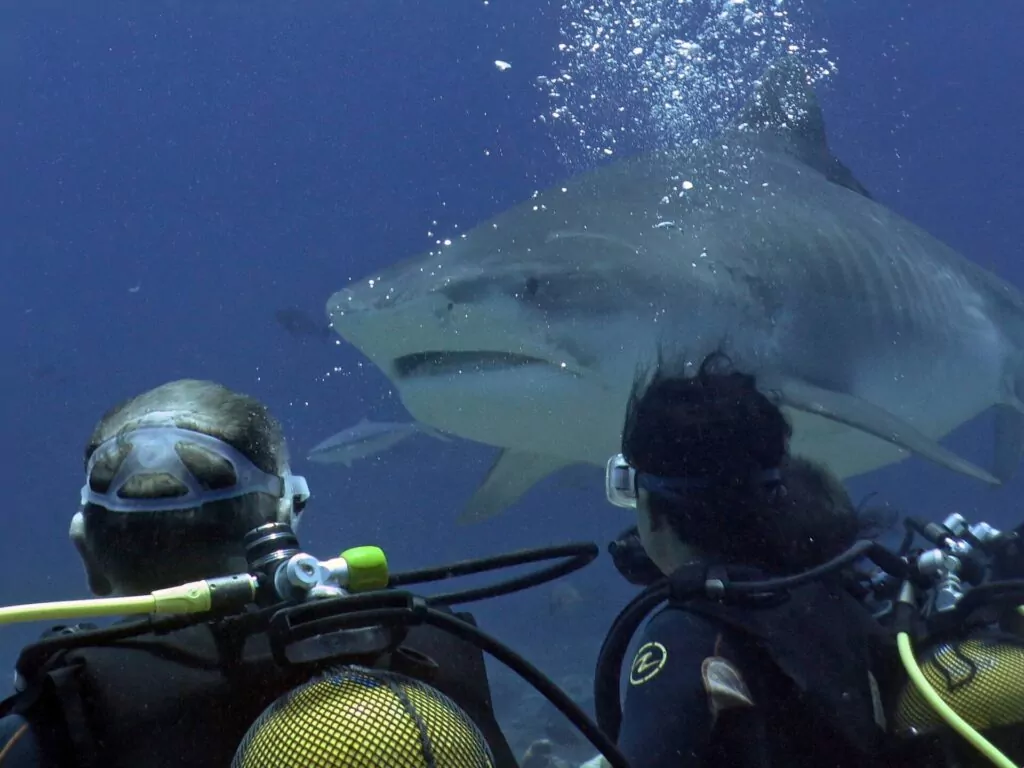
Last year saw only four fatalities from shark-bites, and it’s worth reinforcing the point that scuba divers are very rarely targets. Open-water swimmers, snorkellers and surfers – water-users at and near the surface – might on occasion have more cause for concern.
It is not suggested that in any of the cases above the victims actively provoked the sharks or interacted with them, beyond pointing their cameras. But who is to say how a shark perceives a human’s presence in its domain if caught at the wrong moment?

Shark-bite study
Tzach’s death happened to coincide with publication in the scientific journal Frontiers in Conservation of a new study of shark-bites. It was written by French shark behavioural ecologist Prof Eric Clua, with colleagues from France and the USA.
Clua’s speciality is the behaviour of large sharks in their natural environment, and his focus is on the biting of humans. He has plenty to say about the eagerness of some people to get close to sharks – or the more dangerous land animals – in hopes of sharing their exploits with friends, family or online communities.

Would-be influencers interact with different species of shark without necessarily knowing anything about their varying patterns of behaviour, he points out, whereas on land they would more readily appreciate the variation in threat level between, say, an XL Bully and a Jack Russell.
“Sharks are responsible for fewer than 10 human deaths a year worldwide, whereas dogs are responsible for more than 10,000 deaths, and are perceived positively by the public,” he says.
Shark-bites fall into six distinct categories, according to Clua, but the new study concentrates on just one of these, described as “self-defence”.
The intriguing aspect for divers is that while self-defence bites might be regarded as a reaction to provocation, and can involve not only one but repeated strikes, only rarely do they seem to be fatal.

Could it be that the bites sharks inflict when they believe that a human poses a direct threat are less damaging than those sometimes sustained by water-users minding their own business at the wrong place and wrong time?
The concept of self-defence in sharks had never before been documented in detail, say Clua and his colleagues. They carried out their multi-decade statistical study of the characteristics of shark-bites on humans in French Polynesia, drawing whatever data they could from records of experiences that historically did not define different types of bite.
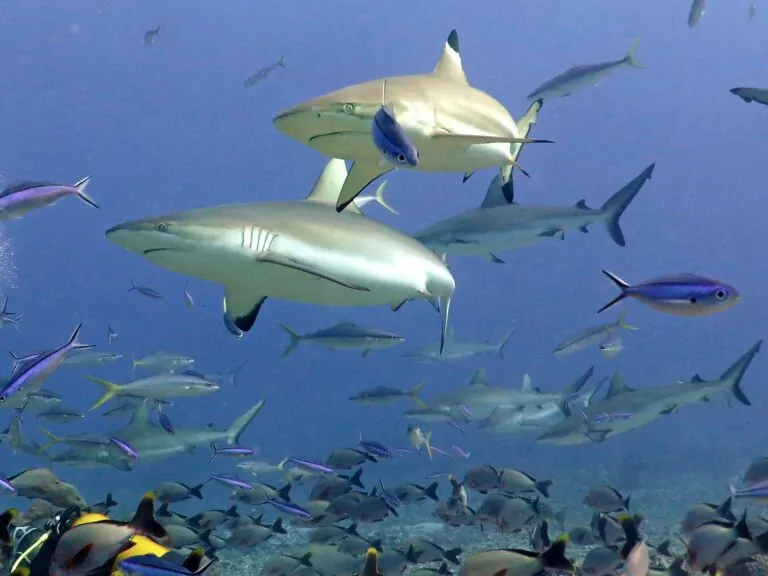
These south Pacific waters are home to more than 30 shark species, but they found that bites there were most likely to be inflicted by blacktip, whitetip or grey reef sharks or sicklefin lemon sharks, usually less than 3m long.
Rarely fatal
“Certain human activities at sea, such as fishing and particularly underwater spearfishing and the management of passive fish-traps, are associated with [the self-defence] bite,” says the team. “It is perpetrated without proportionality, often superficial with minimal tearing of flesh, and rarely fatal, except in special circumstances.”
A typical trigger for a self-defence bite might be a perceived threat from a speardiver, or a diver angling towards the shark for a better view, or trying to grab it.

Such non-lethal bites contrast with those that fall into a category such as “predation motivation”. Bites inflicted by a seriously hungry shark might be expected to involve heavy tissue-loss and very likely death brought about by the consequent haemorrhaging.
However, in none of the cases studied in French Polynesia was any bite thought to have been motivated by foraging.
Self-defence bites might tend to cause more ’superficial’ injuries but they also come unannounced, whereas certain other types of bite are preceded by the combative warning displays that experienced shark-divers come to recognise.
These might include lowered pectoral fins, body-shaking or accelerating and jerky swimming, and are a clear signal for divers to consider making a discreet retreat.

Self-defence bites come out of the blue, although “given the vital stakes the shark likely perceives for itself, these bites are sometimes delivered repeatedly,” says the study.
“But even in these cases, little tissue is usually removed. Moreover, there seems to be no proportionality regarding the nature of the initial human aggression in the severity and violence of a self-defence bite.”
Other types of bite
Apart from the self-defence/retaliation and predation/investigation categories of bite, the other four are defined as reflex/clumsiness; competition for resources; anti-predatory; and domination/ invasion of territory. Only the last two of these categories involve those tell-tale warning displays preceding the bite.
Between 1942 and 2023, 16 of 137 recorded shark bites in French Polynesia could be classed as probably resulting from a self-defence motivation. All occurred in Tuamotu in the context of shark-harpooning in fish-traps, spearfishing, shark-handling for photography, scientific sampling and tourist-based exhibitions of sharks in open-air tanks. And although these might be classified as ‘provoked’ bites, only two were fatal.
The unfortunately named Shark Attack Files database, which holds records of global encounters dating back to the 1800s, indicates that more than 300 historic incidents might be classed as self-defensive.
And it’s worth remembering that in some cases the type of animal inflicting a ‘self-defence’ bite might be not a requiem shark but a less intimidating species such as a wobbegong, with blunter dentition.
“If humans want to avoid self-defence bites by sharks, the most obvious recommendation based on our assessment is to avoid attacking or harassing these species,” says Clua.
On occasions people interfere with sharks with the best of intentions, although “wanting to help a shark in distress, in this case acting in a benevolent manner, will not necessarily be perceived by the animal in this positive way,” points out the shark profiler.
In late April a tourist and his 11-year-old son waded out to help three local men rescue a 3m great white shark stranded on a sandbank near Ardrossan in South Australia. Fortunately their kind action, which took an hour, succeeded and with no backlash, but those involved might have been unaware that a fearful shark can whip round through 180° to inflict a self-defence bite.
The three primary rescuers said that they had never even seen a beached shark before, let alone tried to rescue one. This one was possibly sick or injured.
“Such well-intentioned behaviour can expose the would-be rescuer to a self-defensive bite with neither discernment nor proportionality,” says Clua. “The most instinctive reflex for sharks will be to defend themselves and bite.”
Trigger points
Recognition of self-defence bites once again calls into question the practice of labelling all shark-bites as attacks, says Clua. “The media plays a key role in this perception, tending in the event of bites to portray sharks as the aggressor, even when humans are responsible for initiating the interaction.
“This simplistic approach damages the image of sharks and, indeed, their conservation, which relies on public support.”
Eric Clua and his colleagues want the media to stop sensationalising self-defence and other types of bite as ‘attacks’. The press, they say, could help to improve public attitudes by more objective reporting of how shark behaviour is likely to be triggered by that of humans.

A widely reported scenario such as occurred at Hadera has little to do with self-defensive bites. Clua has stated that Tzach was the victim of being too close to a feeding frenzy, probably involving several sharks.
“What makes this event so rare is that the species involved – apparently the dusky shark – is not known, despite an imposing size of up to 4m, for its ability to consider humans as prey,“ he says.
In a frenzied situation, however, any species widely considered harmless can become predatory as “the dynamics of competition between animals for access to providential food overwhelms all other considerations”.
There still has to be an initial trigger, however. Usually that is a first bite, which might be accidental and not directed at humans but provides the stimuli of blood in the water and related sounds.
However, Clua has a more concerning suggestion. “The electro-magnetic radiation from a camera may be enough to trigger an initial bite that unintentionally affects the swimmer – not initially targeted – but sets in motion the relentless process of frenzy.
“In all cases, human error is at the root of such an accident.“
Also on Divernet: WOMAN DIES FROM SHARK-BITE OFF WESTERN SAHARA, OCEANIC WHITETIP SHARK BITES COMPETITIVE FREEDIVER, ROGUE SHARKS? WHAT’S REALLY GOING ON IN THE RED SEA?, TIGER SHARK DEATH IN HURGHADA