
Why Consider a Used Drysuit
A good used drysuit is ideal for budget-conscious begineers. A less-good used suit can still be good for diving, provide DIY enthusiasts with hours of fun and keep the rest of the diving club amused. Step this way, says John Liddiard
You have finished your training and are fairly sure you want to go on diving in Britain. You need a drysuit.A used drysuit is often the smartest way to start without spending a fortune.
The cheapest option is to rent from a dive shop. At about £10 a day this soon adds up, but the shop might be prepared to do a rent-or-buy deal on one of its rental suits, or even on one from its secondhand rack. Many schools replace their suits annually, so a new crop of one-year old used drysuits comes onto the market each winter.
If you decide you don’t like the suit after a few dives, pay the rental fee and return it. If you do like it, any rent already paid could be deducted from the purchase price.
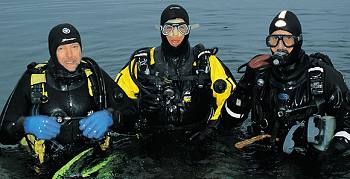
Inspecting a Used Drysuit
You can get a used drysuit for less than half the price of a new one, and it need not be falling apart at the seams. Best buy is probably the one that looks tatty but, underneath it all, is in good structural condition.
Wearing this automatically makes you look like the veteran of a few hundred dives – at least, until you get in the water.
So what must you look out for? Start with the seams. Examine them carefully to see if they are falling apart, not just on the outside but by turning the suit inside-out as well. Pay special attention to any seam in a stress point, such as under the arms or the crotch. You can always fix dodgy seams in other places, but if they look bad at a stress point, don’t buy the suit.
On a membrane suit, check the material either side of the seam. Flexing of the suit across a seam or tape can cause it to wear out here.
Examine the general condition of the material. Most suits will have some folds, but make sure there are no bad ones that may be about to wear right through.
Also look for places where a membrane suit is de-laminating, nylon is peeling free of the neoprene on a neoprene suit, or neoprene is starting to disintegrate between the two layers of nylon.
Boots, Knees, Zips, and Seals

The fronts of the legs and the boots of neoprene drysuits are especially vulnerable to this type of wear. If it is just the boots, you can always replace them, but anywhere else on the suit means that it is on the way out. If a suit is de-laminating in one place, chances are the rest of the suit will follow soon.
On the subject of footwear, ensure that the wellie-style boots fitted to most membrane suits are not badly gouged and have not worn through the outer rubber layer.
Look at the knees. If protective kneepads are gouged and scraped, no problem – you can always stick another pair on. If the gouging has reached the knees of the suit, it does not necessarily mean that the rest of it is no good, but be prepared for extensive surgery on the legs.
Check the legs just above the knees, a particularly bad stress point on neoprene drysuits. If you try to fix a split here, it will just keep re-occurring above each fix. The only solution is to replace the whole front of the leg.
The single most expensive component of a drysuit is the zip. A new one costs at least £60 plus fitting. Inspect each tooth for signs that it is about to separate from its neighbour.
When looking at the seals, bear in mind that you have to replace them anyway, probably every couple of seasons for the latex seals fitted to most membrane suits and a bit less frequently for neoprene seals. Signs of imminent failure are crazing of a latex seal where it is glued to the suit, a sticky or pocked surface, patches and small slits at the edge of the seal. Neoprene seals frequently show signs of delamination and splitting seams.
A wrist or neck seal in a bad condition is not a show-stopper, but it could affect the price you end up paying. If you are buying secondhand from a shop, it might give you a good price on new seals.
Check the positioning of the valves. Some old suits put the dump valve in the middle of the chest, which is useless. Make sure the valves will not be obstructed when you wear your BC. Moving them is relatively easy on a neoprene suit, more difficult on a membrane.
Does the inlet valve come with a low-pressure feed hose, or will you have to buy one? Cuff dump valves are cheap and easy to use for novices, but most experienced divers prefer shoulder dump valves, which are worth an extra 20.
Testing and Additional Gear
Most used suits will have a leak or two somewhere. If you get a chance to take it diving before buying, check carefully the number and size of any leaks when you take the suit off. If you have not used a drysuit before, consider that it could be your use of it that lets water in.
A more scientific method of finding leaks, and the only option open if you cannot take the suit diving first, is to use a sponge and soapy water, as you would for a punctured bicycle tyre.
Put the suit on, or block the wrist and neck seals with jam jars, saucepans, footballs and pudding basins. Inflate the suit and sponge soapy water over it while looking for bubbles. If you are wearing it you might need a friend to help you check some of the more difficult bits!
Leaks can point towards any of the problems already discussed, including material that would be better recycled as a teabag. But for a good price you might be prepared to fix a puncture or two, or accept the occasional damp patch.
New drysuits usually come with a separate hood, but one may not be bundled in with a secondhand suit. If you buy a membrane drysuit you will also need to buy a thinsulate undersuit to keep you warm.With a neoprene drysuit a one-piece fleece undersuit or woolly bear is nice, but you can get away with a set of thermal underwear and a pullover.
Frequently Asked Questions
Is it safe to buy a used drysuit?
Yes, if you carefully inspect seams, material, zips, seals, and valves. A well-maintained used suit can last many dives.
What should I check first when buying a secondhand drysuit?
Start with the seams, stress points, and overall material condition. Look for wear, delamination, or peeling.
How do I test a drysuit for leaks?
Inflate the suit and use a sponge with soapy water to check for bubbles. Alternatively, test it in shallow water before purchase.
Are zips and seals replaceable on used drysuits?
Yes. Zips are expensive but replaceable, while wrist and neck seals can be renewed every few seasons.
What additional gear might I need with a secondhand drysuit?
Membrane suits require a thinsulate undersuit, while neoprene suits may need thermal layers. Ensure valves are compatible with your BC.
Can I repair minor damage on a used drysuit?
Small punctures, gouges on knees, or worn boots can be repaired. Major delamination or stress point damage usually means the suit should be avoided.
Subscribe today with promo code DIVE1 — enjoy 12 months for just £1!
