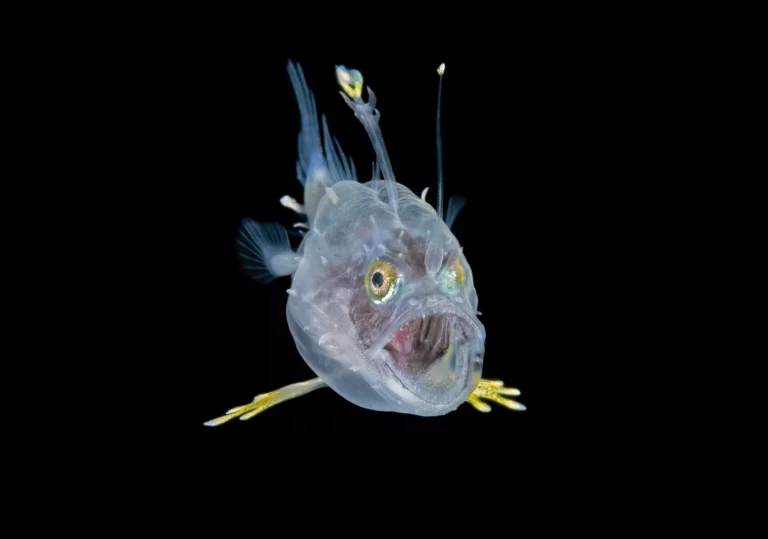
Steven Kovacs’ image Tired Fish, captured during a blackwater dive in Okinawa, has won him the Best in Show award at the Ocean Art 2025 underwater photography competition.
Kovacs spent nearly a fortnight searching for a rarely documented larval goosefish, then caught a fleeting moment as the elusive subject opened its mouth toward the camera.
The 14th annual Ocean Art event, organised by Underwater Photography Guide (UPG), saw prizes of diving holidays and equipment valued at more than US $60,000 awarded to the winners, who were selected from thousands of entries submitted by photographers across more than 90 countries. Entries were made under 14 category headings.
“These images are the result of obsession, patience and exploration,” said Nirupam Nigam, contest organiser, UPG editor-in-chief and Bluewater Photo & Travel president. “Many of this year’s winners spent weeks – or even years – chasing moments most people will never witness.
“While all great photography demands dedication, underwater photography requires a uniquely intense combination of patience, persistence and technical skill.”
The judging panel, comprising Tony Wu, Marty Snyderman, Mark Strickland and Ipah Uid Lynn, evaluated the entries according to technical, artistic and storytelling criteria. In each category four winners plus highly commended awards could be made – below are the outright winners:
Wide Angle winner: Last Light by Byron Conroy
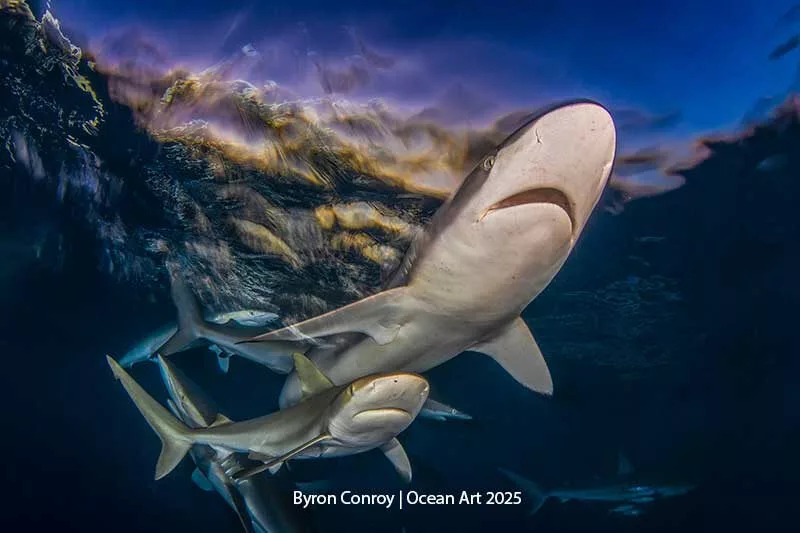
“Cuba is home to one of the last abundant populations of sharks in the Caribbean,” says Conroy, who was diving in the Jardines Del Reina marine park. “This shot was taken at sunset with these surface-patrolling silky sharks. I wanted to tell the story of the number of sharks and the healthy population and the movement as they patrol the shallow water.
“I used a slow shutter-speed to burn in the ambient light coming through the partial Snell’s window and a front curtain flash fore to freeze the sharks sharp in among the chaos of the surface movement and the sunset.”
Macro winner: Between The Polyps by Daniel Sly
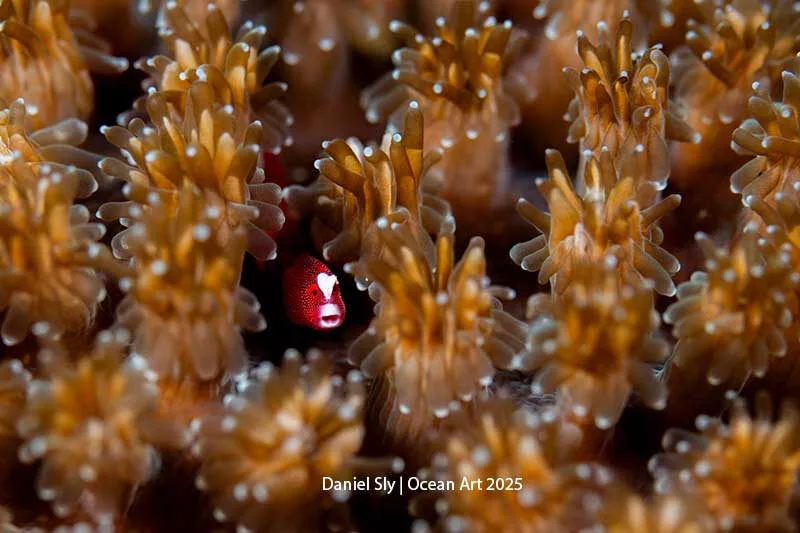
This category was particularly competitive in 2025, say the Ocean Art organisers. “Tucked deep within coral polyps above the black volcanic sand of Indonesia’s Lembeh Strait, this pughead pipefish revealed itself for only a brief moment,” says Sly.
“While not particularly uncommon, capturing a clean view of this small syngnathid’s face among the busy coral it inhabits can be a real challenge. By waiting patiently for it to edge forward into a natural gap, its wide-eyed, almost startled expression was revealed.”
Marine Life Behaviour winner: Beautiful Birth by Jeon Min Seok
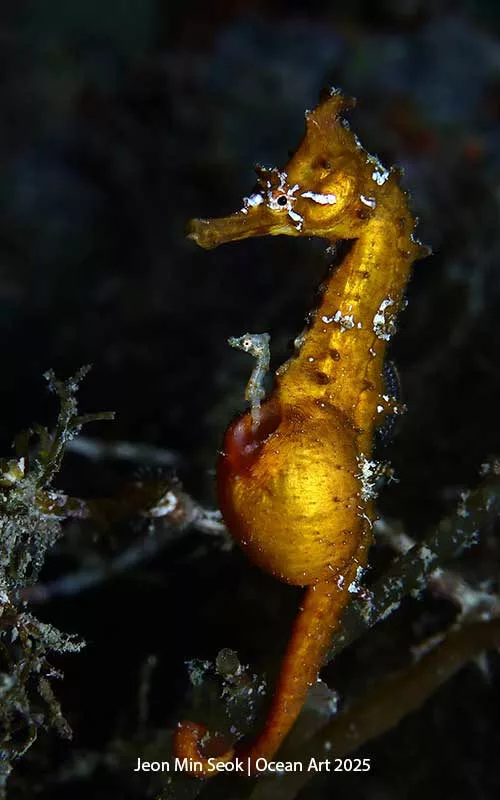
Jeon specialises in photographing seahorses in Korea. “To witness the birth of the Korean seahorse in 2022, I successfully filmed it by diving at night. However, I heard about a beach dive-site in Kumamoto, Japan where there are many seahorses and the climate is better than in Korea, so in July I contacted a local guide about filming the birth of a seahorse on a night-dive.
“Among macro subjects seahorses are relatively large and have poor vision, so I captured the moment when a baby seahorse comes out of its father’s stomach using a 35mm macro lens with a wide field of view and a continuous shooting function.
“Seahorses mate and give birth several times a year, but because it is very difficult to predict the date and time, I was able to shoot by diving between midnight and dawn.”
Portrait winner: Sea Snake Knot by Galice Hoarau
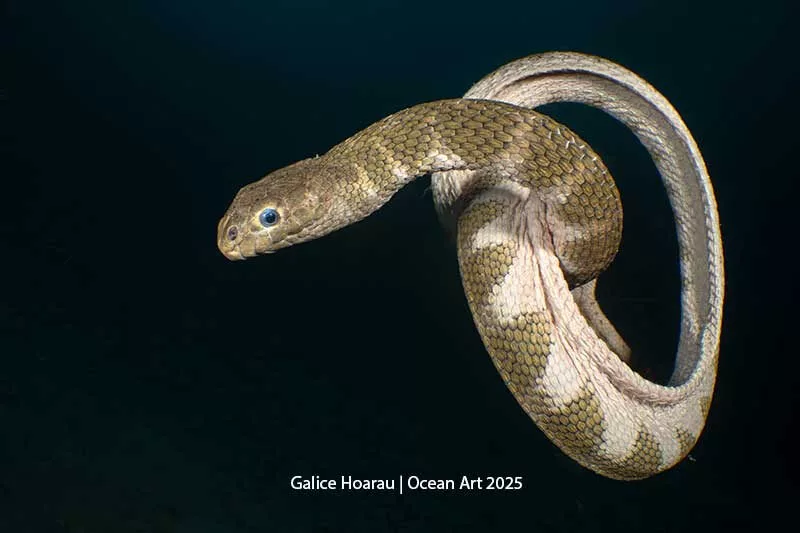
“During the dive, I noticed this sea snake’s (Hydrophis sp) unusual behaviour, at first rubbing on the sand in a vertical U, then forming a knot on itself with pieces of old skin hanging at the tail,” says Galice, who was diving in Anda in the Philippines. “It was shedding!
“Although sea snakes have been known to make these knots on themselves to help shedding their old skin, this behaviour has rarely been captured on photo.
Coldwater winner: One Way Out by James Ferrara
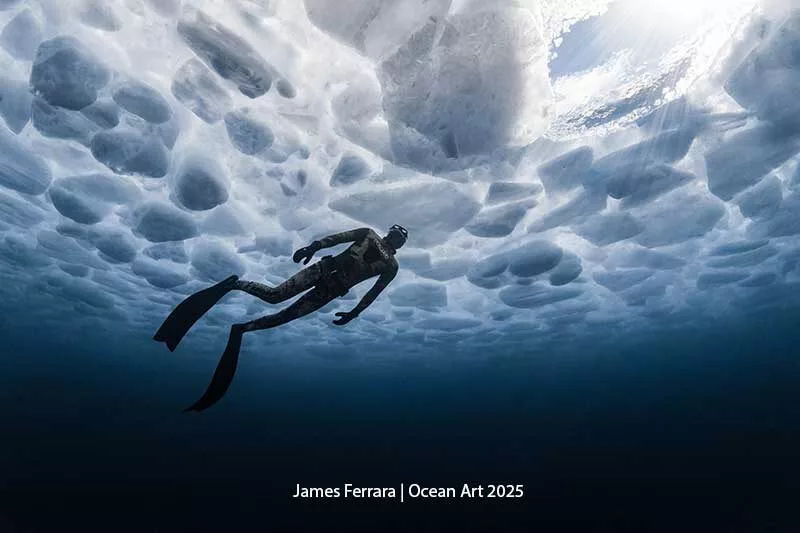
“From the surface, Lake Huron’s frozen expanse appears plain and unremarkable,” says Ferrara, who captured his winning shot at Tobermory in Ontario, Canada. “A vast, glimmering sheet of ice stretches as far as the eye can see, seemingly still and lifeless.
“Yet beneath this frozen surface lies an entirely different world – a cathedral of shifting shapes, delicate textures and intricate patterns that shimmer in the filtered light. Weather, wind and waves constantly fracture, shift and refreeze the ice, sculpting formations that are never the same twice.
“Every hole we cut into the surface revealed a new spectacle, a fleeting glimpse of an underwater landscape that feels almost otherworldly.
“My goal was to capture the freediver as though they were suspended between two worlds. Every descent demanded meticulous planning, with both of us diving on a single breath. Having proper spacial awareness was crucial, as we only had one way in and one way out.
“As I watched the diver glide through the water, their movements contrasted the geometric patterns of the ice itself. Beneath Lake Huron’s unassuming surface lies a world that is truly mesmerizing – one that invites exploration yet commands profound respect.
Nudibranch winner: True Colours by Paolo Bausani
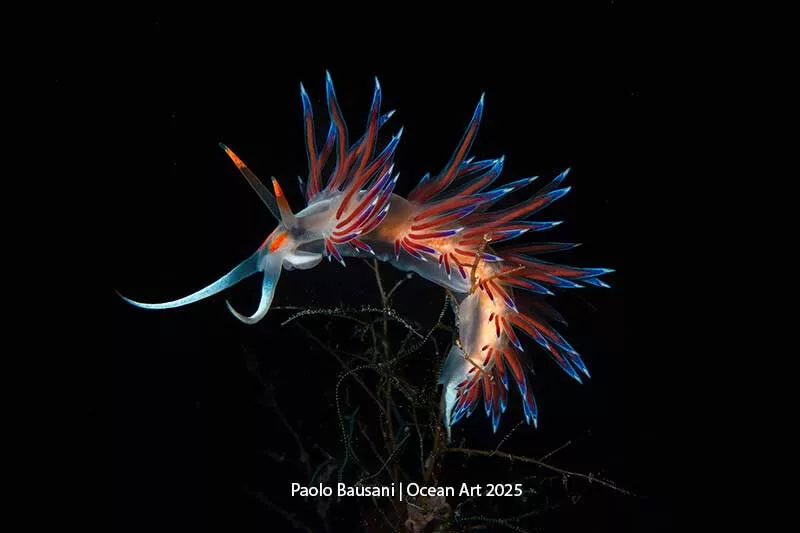
“I photographed this Cratena peregrina nudibranch while it was feeding on its preferred prey,” says Bausani – the site was the Mediterranean island of Giannutri off Italy. “It feeds on the stinging cells of a hydrozoan without suffering the venom. The ambient light combined with the strobe flash emphasised the vivid coloration of its livery.”
Blackwater winner: Tired Fish by Steven Kovacs (Best In Show)
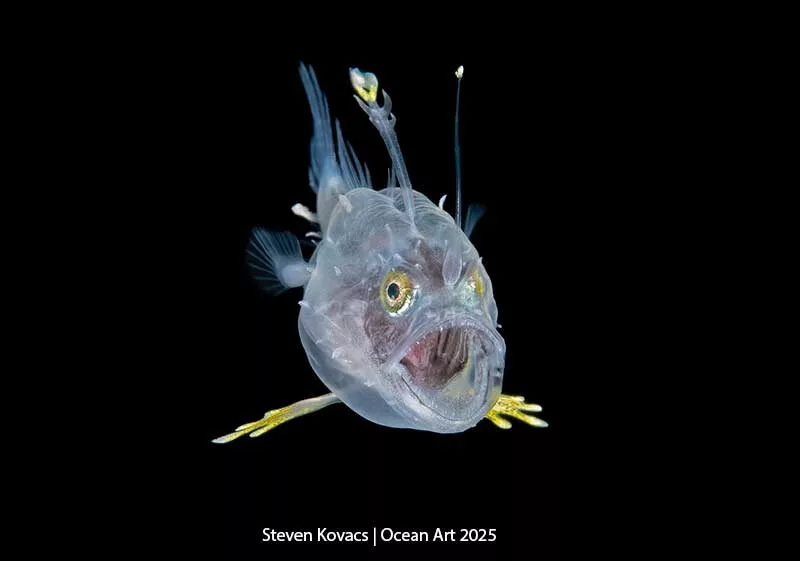
“One of my favourite subjects to encounter on blackwater dives is the goosefish, also known as the monkfish,” says Kovacs. “So when I began seeing photographs of a never-before-seen species of larval goosefish taken off Kume Island, Japan, I knew I had to visit and try to find one.
“Blackwater diving in the very deep waters off Kumejima in Okinawa is an exciting new opportunity, and although finding my target fish was a long shot, I booked an extended stay in hopes of getting lucky.
“After nearly two weeks of nightly searching and nearing the end of my stay, my elusive subject suddenly appeared. Unfortunately, this beautiful little fish turned out to be incredibly unco-operative and difficult to photograph.
“After spending some time with it, I was very fortunate that, for one brief moment, it decided to yawn while facing the camera. I somehow managed to press the shutter at that exact instant, resulting in this image.”
Underwater Conservation winner: Please Free Me by Elio Nicosia
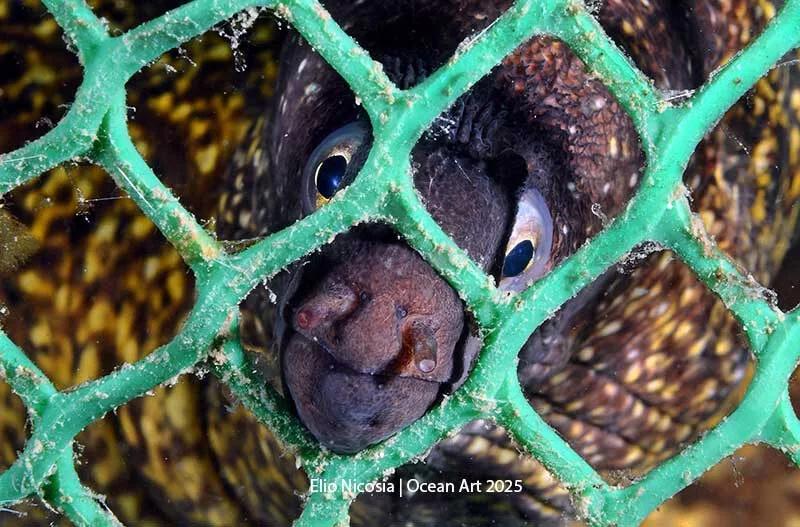
“The moray eel was trapped in an abandoned trap,” says Nicosia, who captured the shot in Syracuse, Sicily. “When it saw me, it put its nose in one of the meshes to ask for help. It was an incredible emotion. The story had a happy ending – after taking the photos, I freed it.”
Underwater Digital Art winner: Mysterious Pufferfish by Michal Stros
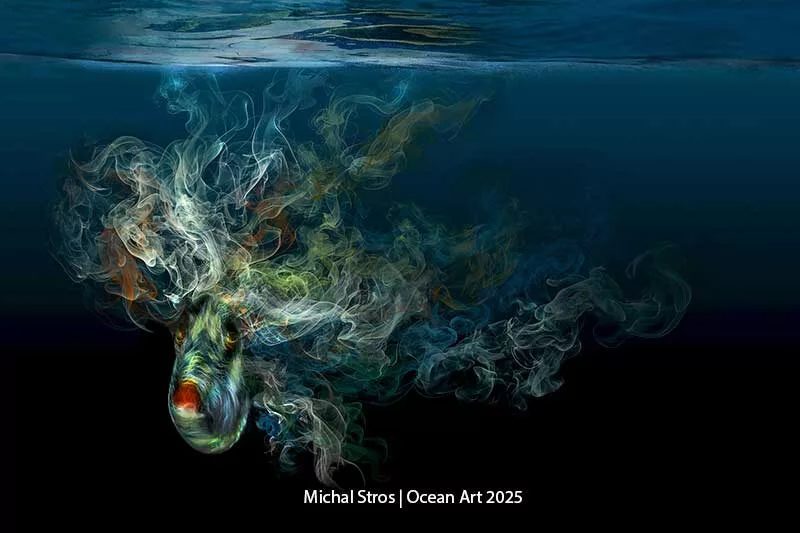
The original photograph of a Valentini pufferfish was taken near the reef off Bunaken Island in Indonesia’s north Sulawesi. “Using the Fractalius plug-in, a fractal of the pufferfish’s head was created from this image, which was then further edited with smoke brushes in Photoshop,” says Stros.
“The colourful smoke behind the fish highlights its dynamic movement and signals to potential predators that the fish is poisonous. The reflections on the water’s surface mirror the colour of the wavy smoke.”
Black & White winner: Méduse by Patrick Désormais
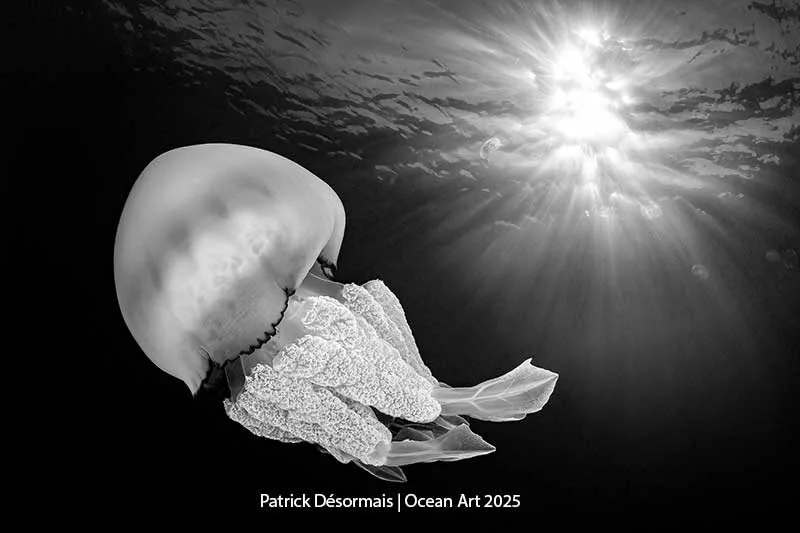
“During a dive in Zeeland [at Den Osse in the Netherlands] I encountered this beautiful Rhizostoma pulmo near the surface. It was a sunny day, and I was able to play with the sunlight to capture this photo, which showcases this magnificent 50cm jellyfish specimen.
“The black and white processing highlights the animal’s texture against the murky, dark water, creating a black background.”
Underwater Fashion winner: Angel Flying by Bruce Campbell
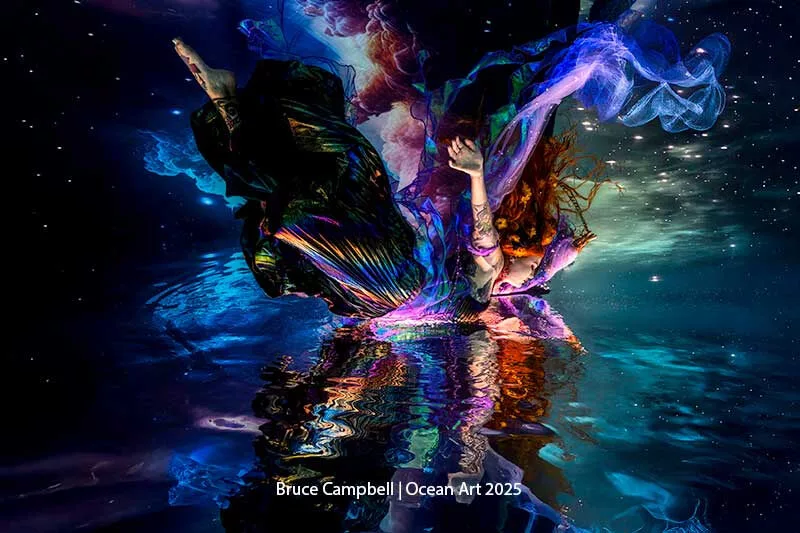
This category was judged by the newest of the judges, Canon and Marelux Ambassador, Ipah Uid Lynn. “Angel Flying was made during a brief encounter when movement, light, and position aligned without warning,” says Campbell, who was working in a pool in Florida.
“The subject’s form and motion resolved naturally in the water, offering a fleeting sense of lift and quiet that existed only for a moment before passing. There was no opportunity to adjust or repeat the scene. The image emerged through stillness and restraint – by allowing the encounter to unfold rather than attempting to direct it.
“In a space, this photograph introduces calm and elevation. Its presence draws the eye upward while maintaining a grounded sense of balance, creating an atmosphere of quiet attentiveness rather than spectacle.
“Angel Flying is a photographic work created largely in-camera during a single underwater encounter. Post-processing is minimal and deliberate, preserving the qualities shaped by water, light, and movement at the time the image was made.”
Compact Wide Angle winner: Green Turtle And Snorkellers by Haemi Cho
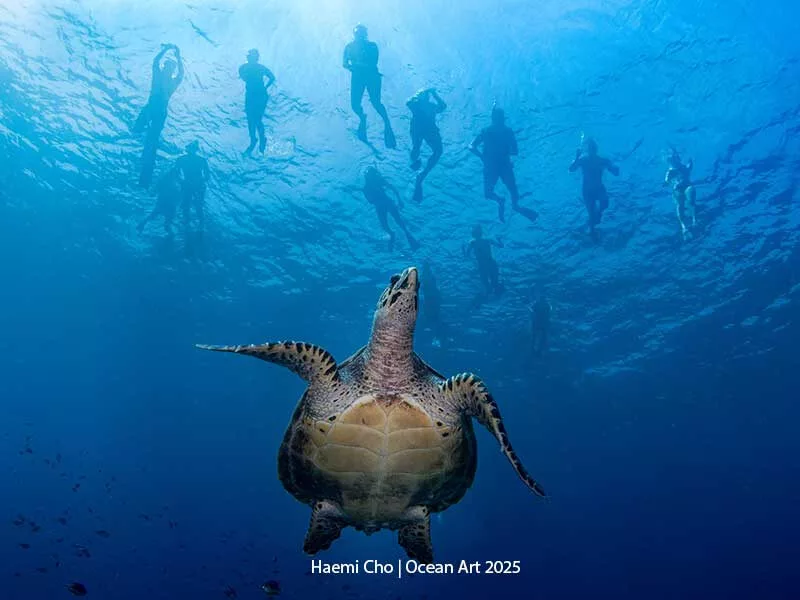
“I captured this image during a check dive at Shark Point in Komodo, Indonesia,” says Cho. “Ironically, despite the site’s name, there were no sharks to be found that day. Instead, I spotted a sea turtle rising toward the surface to take a breath.
“Above the surface, a group of snorkellers was watching the scene unfold. I instinctively captured this moment, highlighting the peaceful connection and coexistence between the marine life and the human observers.”
Compact Macro winner: Dancing On Eggs by Andrea Michelutti
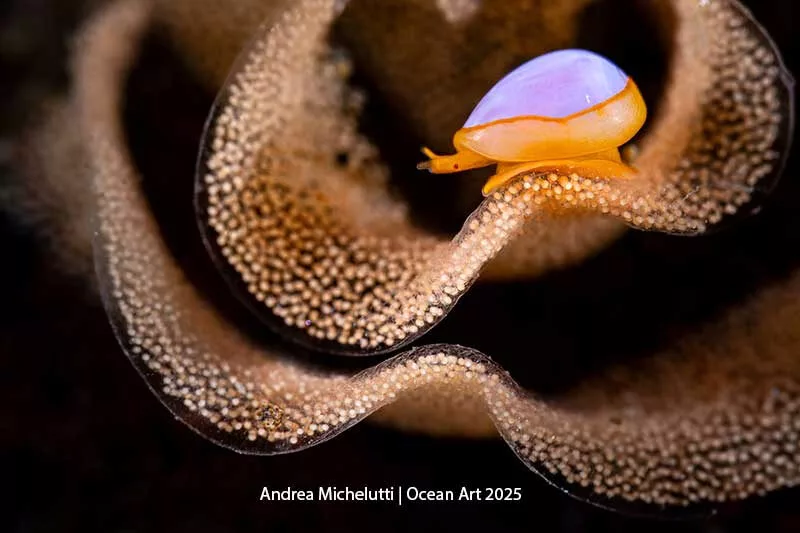
“While diving in the waters of Anilao in the Philippines, I found this super-tiny sea snail (Cystiscus minutissimus) on a ribbon of nudibranch eggs,” says Michelutti. “It measures barely 2mm, almost invisible to the naked eye, one of those miniature creatures that easily escape attention.
“What caught my attention was the contrast between its translucent, purple‑tinted shell and the soft texture of the egg spiral beneath it. A small, quiet moment that reveals how much beauty hides in the micro world of the reef.”
Taken with a Sony RX100 M7 + AOI +23 Macro, Marelux housing, two Inon Z330 strobes. f/11, 1/1000th, ISO 100 (Andrea Michelutti / Ocean Art 2025)
Compact Behaviour winner: Misfire by Jo Taylor
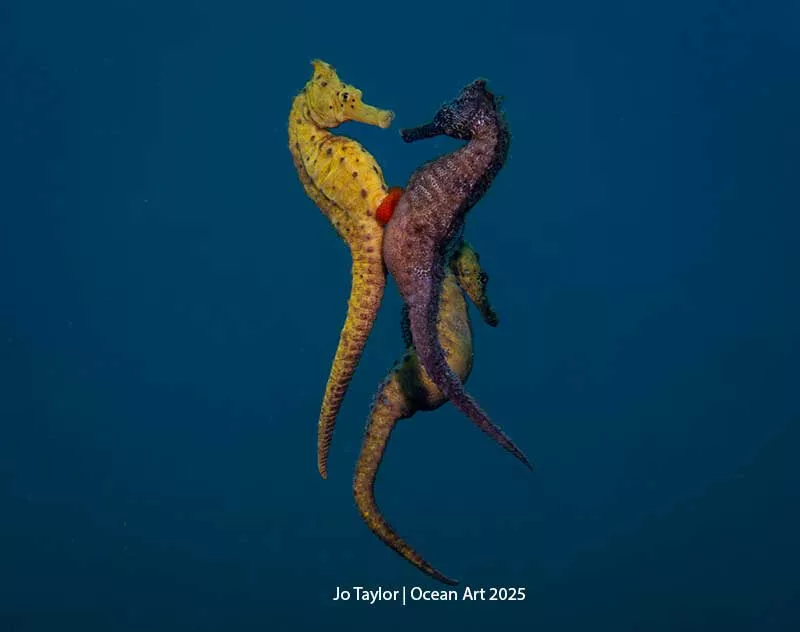
“After being relentlessly pursued by two male stallions, this large yellow female seahorse anxiously attempts to transfer her eggs to her chosen mate at the height of a copulatory rise as the contender falls away,” says Taylor.
“Mating is difficult for inexperienced seahorse pairs to accomplish successfully and many of her bright eggs were spilt in the process. I had this rare and exciting opportunity while diving in the Lembeh Strait in Indonesia. “Owing to the flexibility of compact photography, I was able to capture this special moment.”
All the Ocean Art 2025 winners and their descriptions can be found on the competition page at the Underwater Photography Guide site.
Also on Divernet: Mono goes big in Ocean Art photo contest