Inspecting a shattered ship’s bow in the English Channel resolves a 100-year-old mystery! Leigh Bishop investigates a Channel collision and dives deeper into what he says is his all-time favourite wreck dive – the Duke of Buccleugh
Photographs by Leigh Bishop
A question that incites conversation and debate among wreck divers is the old classic, ‘what’s your favourite shipwreck’? Without thinking about it, I always give a prompt and definitive answer to the question, the Duke of Buccleugh.
This classic 19th-century steamship sank after a collision in the English Channel off the Sussex coast and now lays upright at 58m depth. In her day she was a Lloyds of London class-A vessel – the best.
Having explored famous shipwrecks around the globe spanning three decades, my answer is often taken with surprise. Surely the Britannic, Lusitania, a famous Nazi wreck or even a bullion ship makes for a better dive that an old steamship? I have often asked myself the same question…
Did you know?
The Duke of Buccleugh sank with 600 tons of hand-painted Belgian china and glassware onboard, alongside 2,533 tons of iron rails and machinery.

Why the Duke of Buccleugh?
Perhaps it’s the romantic seafaring story behind her loss, or perhaps the detective work divers made on the wreck to reverse history. More so perhaps the pleasure the wreck brings to those who make the dive that I so often witness.
The holds of this wreck are jam-packed with cargo once bound for India. After a dive on the wreck, I often sit back and observe the beehive of activity as each excited diver surfaces and eagerly delves into their goodie bag to examine their recovered treasure. Some are so excited they barely find time to strip their dive gear off.
As the charter boat slowly makes its way back to shore, each diver has their own story of adventure to tell. What they saw, and what they found are hot topics. The continuous chatter and raising of voices over others to express tales of adventure make the 20- mile journey back to shore seem shorter than any other.
As the cliché goes, this story really does start ‘on a stormy night’ – this one in March 1889. Two ships collide; one of them, named after an English aristocrat, is the Duke of Buccleugh, and the other, a sailing ship named Vandalia, with a cargo full of petroleum barrels and heading for London. Shortly after colliding, the ironhulled Duke of Buccleugh sinks with her entire crew, including her captain.
The wooden hull sailing ship Vandalia is damaged but somehow survives to tell her tale, but how is it that an iron hulled steamship is sunk by a wooden-hulled sailing vessel only about two-thirds her size? How did they even collide in the first place? Questions that had in theory been put to rest would still remain a mystery for exactly 100 years.
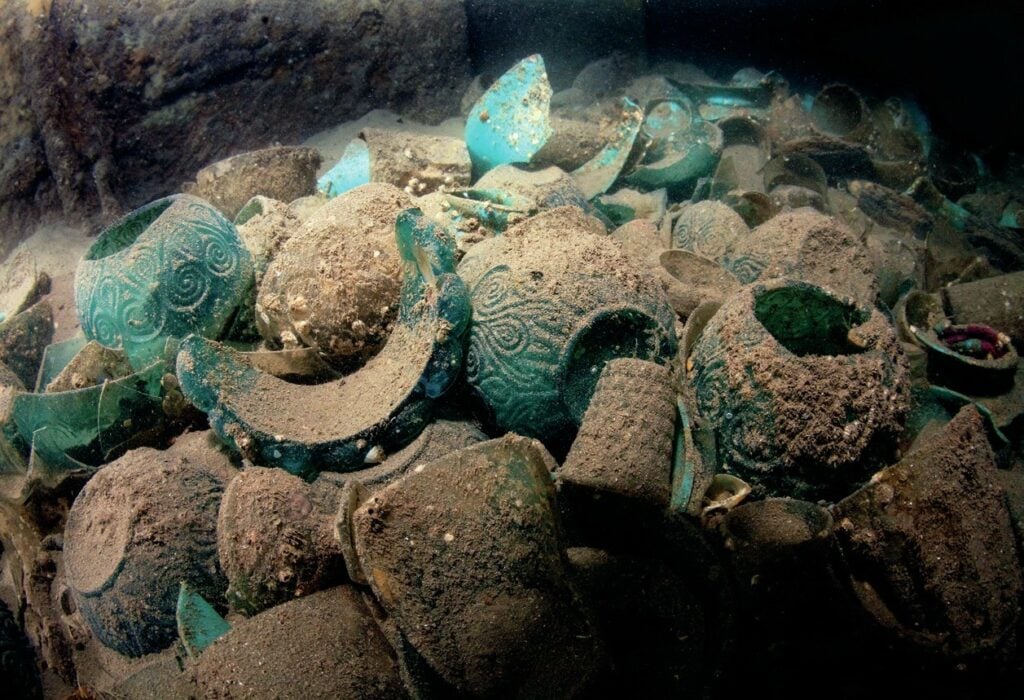
The cargo that lies in the holds of the Duke of Buccleugh is certainly an incredible sight, maybe another reason why I love this dive so much. These holds include 2,500 tons of machinery and iron rails and 600 tons of hand-painted porcelain and glassware picked up from Antwerp in Belgium.
At first sight, those original investigating divers must have thought they had discovered another Nanking treasure trove, however with plates being stacked loosely in the holds, it was soon obvious they were of little, if any, value and more than likely ‘seconds’. The glass among the porcelain plates includes blue Victorian lampshades and some interesting glazed bowls, those being intact examples that survived the seabed impact.

I once gave the Receiver of Wreck some slides of the cargo inside the wreck for use in her awareness presentations. ‘Wow, no wonder we have so many people declare recovered artefacts from this wreck’ was her reply.
The entire wreck is upright on a sandy seabed and largely intact other than the damage to her starboard side. Light levels on the wreck are low although the conditions can often be clear and divers have reported great visibility diving on the better tides.
Wooden rigging blocks and standing rigging deadeyes scatter the length of this 115-metre-long wreck, as does the ship’s machinery, much of which is now indistinguishable from over a century of marine growth. Her masts can be seen lying across the wreck and as the diver swims down either side, they will see the remains of teak decking now collapsed inwards at an angle from her gunnels.


Even against low light levels on the wreck, it is easy for the diver to swim into the vessel’s holds, where they will be confronted with that staggering cargo of porcelain and glassware.
It appears that the ship’s bulkheads broke when she hit the seabed, explaining the reason for a large amount of the porcelain and glassware being broken. The diver can still find intact examples, and while not of value, the porcelain dishes make for a welcome souvenir from a visit to the wreck.
The attractive hand-painted plates discovered by divers back in 1989 have been identified by Sotheby’s as having been painted in Belgium dated around 1800 and worth not much more than ten pounds each.
The forward hold is full of glassware from various-sized glazed bowls, and exquisite little caviar dishes to Victorian blue glasses, goblets and ashtrays.
What happened as a result of the two ships colliding was recorded by the Board of Trade enquiry back in 1889. However, Captain Langlois and his entire crew went down with their ship, so were unable to relate their side of the story.
Captain Coonan gave all the evidence to the enquiry and convinced the board towards the outcome; that all onus of the incident fell solely on that of the Duke of Buccleugh and her captain who, they claimed, had rammed into the Vandalia.


For an entire century, the English Channel was hiding a wellkept secret. One that for 100 years had been put to rest, that was until 1989 when the wreck was discovered by a group of divers and dive boat captains from Littlehampton, who had teamed up together to investigate a new and exciting seabed obstruction.
If the Duke of Buccleugh had rammed the Vandalia, divers would expect to see major cracking of the cant frames near the vessel’s bow, perhaps the whole stem buckled or ripped off completely, or even the entire bow absent. On investigation, this was completely the opposite and a new outcome to the incident 100 years before was quickly emerging.
After identification of the wreck and what the vessel was, the seabed evidence became clear to the divers that Coonan’s vessel, the Vandalia, was most likely responsible for the collision, and not the Duke of Buccleugh. Their first impression of the wreck was one of a four masted iron sailing ship, upright with many a wooden rigging block and standing rigging dead eyes scattered over her decks.
One of the divers, Nigel Chilton, brought up a porcelain plate with the shipping crest Ducal Line stamped on it, which in turn led to the identification of the wreck. But her bow was clearly, as they say, ‘ship shape’. In fact, they discovered damage not on her port side as stated by Coonan, but on the ship’s starboard side, some way back from the bow!
How could the Duke have rammed the Vandalia, as claimed by Coonan, and not succumb to any significant bow damage like that of the Vandalia? It was now obvious that Captain Coonan’s evidence at the enquiry had been fabricated, and Vandalia’s entire crew had known the truth all along.
The fact that one of the Duke’s lifeboats was also washed ashore in a rather smashed-up condition also backed the evidence of impact. A glance at a photograph of the ship itself clearly shows she carried her lifeboats amidships.


Even though those original divers who found the wreck reversed history and made a lifetime discovery, the story was still there for the telling. If Coonan’s vessel was responsible for the incident in March 1889, what had his ship – or either ship, to that fact – done wrong to put them into a collision course in the first place?
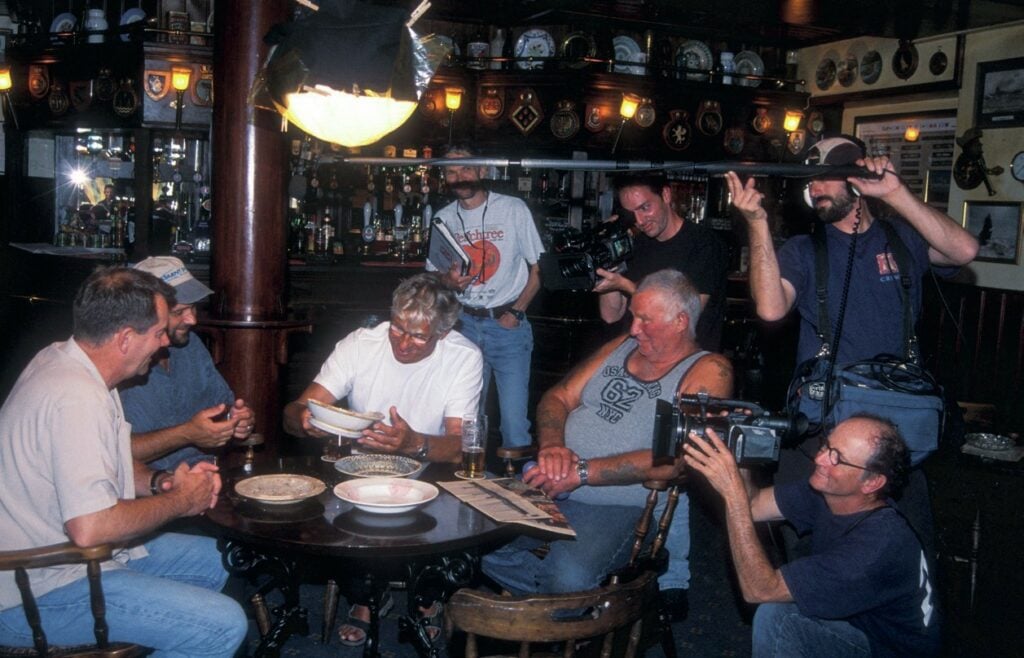
Not one to leave any stone unturned, I called up two good friends, John Chatterton and Richie Kohler, who at the time were presenters of the Deep-Sea Detectives television show during the height of its popularity. I found myself writing a treatment for a television documentary that was instantly snapped up by bosses at the History Channel, and it wasn’t long before the lads flew in from the States.
On the wreck, we found the rudder was hard to port, a strange position for a vessel that was said to have ended its career in a head-on position. The story that seemed to be emerging even for us was opposite to what history had recorded. The Vandalia in her haste to perhaps reach port and offload her cargo holds held her course. The Duke, on the other hand, for some as yet inexplicable reason, had made a suicidal last-minute turn to port, only to be rammed on the starboard side by the Vandalia.


We also discovered a jagged fracture aft of the bow extending from the rail to the seabed on both port and starboard sides, not the sort of damage you would expect from a collision.
The theory on the collision damage to the starboard side became mixed as it also looked as if salvage may have taken place at some stage.
Stories of a French salvage and the subsequent recovery of 1.3 million pounds in silver began to emerge; backed with evidence of activity on the wreck when the original divers discovered a lost ROV on the wreck soon after their discovery appeared in national newspapers. This muddied our investigation on the wreck and left us wondering what was recent damage and what was collision damage.
The answer, however, would lie in a long-forgotten case heard long ago by the House of Lords, and with a photograph taken of the damaged bow of the Vandalia, where a man can be seen in the photograph standing inside the damaged bow, just below the water line.
The case pivoted on the lights of the Vandalia and many other factors discovered during the research and filming of the ‘Deep-Sea Detectives show.
Leading marine accident investigators were brought in, each of whom studied the evidence to factor in a much more evidential verdict. The four judges of the board back in 1889 could not reach a majority verdict, therefore, the Duke of Buccleugh remained responsible, and the case against the Vandalia was dismissed.
Yet in hindsight, both captains were more than likely confused and equally at fault. One thing is for certain, whatever happened in 1899, the crews of either could not have imagined those who would come aboard Duke of Buccleugh 125 years in the future, let alone what they would be wearing.
Being my favourite wreck, I’ll certainly be booking another dive to the wreck next season – will you?
Divers still visit the wreck site from the Sussex-based dive charters, and still today, the wreck makes for one of the best dives in British waters for the normoxic-level trimix diver. With hundreds of tons of cargo still deep inside the wreck, divers are, however, advised to follow legal lifting legislation and, of course, declare recovered artefacts to the Receiver of Wreck. And for the record, the plates are dishwasher friendly…

This article was originally published in Scuba Diver UK #81
Subscribe today with promo code DIVE1 — enjoy 12 months for just £1!