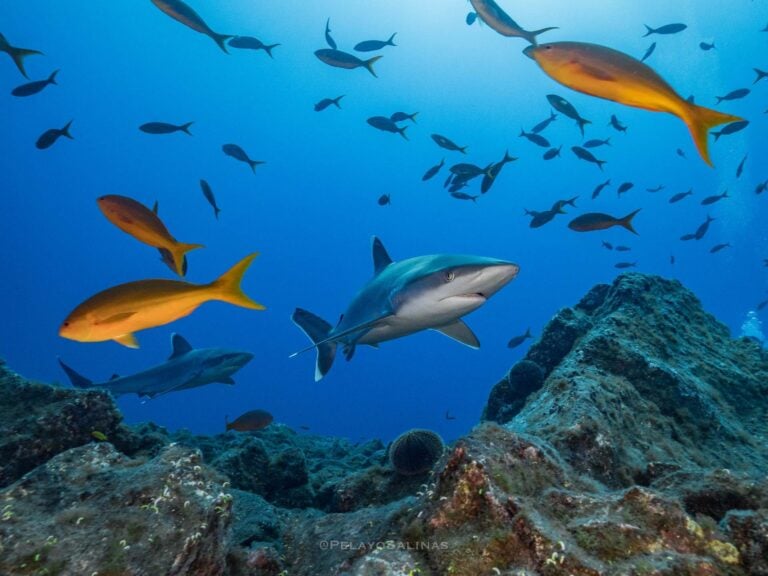
Claimed as a first-of-its-kind assessment of seven marine parks in the eastern tropical Pacific Ocean, a survey has recorded ‘bountiful’ populations of sharks and other pelagics in remote offshore Marine Protected Areas but severe depletion in MPAs closer to the coasts of the nations that govern those areas: Colombia, Costa Rica, Ecuador and Mexico.
Remote oceanic MPAs such as Galapagos and Malpelo support some of the largest assemblies of sharks reported globally, according to the Galapagos-based Charles Darwin Foundation (CDF).

“The oceanic islands of the Eastern Tropical Pacific represent a window into the past, where sharks and large predatory fishes are the norm and not the exception,” says Dr Pelayo Salinas-de-León, CDF principal investigator and senior author of the study.
“These areas provide a glimpse of what a healthy ocean looks like and highlight the key role ocean conservation plays in safeguarding these last strongholds from systematic overfishing.”
BRUVs deployed
The CDF worked with National Geographic Pristine Seas, the Galapagos National Park Directorate and other regional research institutions, carrying out two- to three-week expeditions with local partners such as the Malpelo Foundation in Colombia, Pelagios Kakunja in Mexico and France, Osa Conservation in Costa Rica and Ecuador’s Ministry of Environment.

Baited Remote Underwater Video systems (BRUVs) were employed to assess sharks and other large predators in seven MPAs: Clipperton, Galapagos, Malpelo, Revillagigedo and the coastal Caño Island, Galera San Francisco and Machalilla sites.
“Oceanic islands, like Galapagos and Malpelo, are incredible places where extraordinary populations of sharks and other large predatory fishes – like jack, grouper and snapper – still thrive at a time when these fish are rapidly disappearing elsewhere,” says the study’s lead author Simon McKinley.
“The MPAs around them, combined with their remote location, provide protection to marine communities from unsustainable fishing practices, allowing animals to live out their natural lives largely undisturbed.”

Most of the Galapagos sharks observed at Clipperton were juveniles, suggesting that the MPA was an important nursery site, while mature individuals were found at the other island MPAs, indicating that these served as adult aggregation or foraging grounds.
Regional currents, temperatures and food availability differentiated the MPAs, highlighting the importance of regional networks containing diverse MPAs able to support sharks during their various stages of life.
Scalloped hammerheads

The critically endangered scalloped hammerhead shark was recorded most frequently in the southern MPAs of Galapagos and Malpelo, while the vulnerable silvertip was the most commonly observed species in the northern MPAs of Revillagigedo and Clipperton, underscoring the need for management strategies tailored to differing ecological conditions.
Surveys of coastal MPAs revealed few large predators and low fish populations, a trend described as “fishing down the food web”. Removal of large species such as sharks was leading fishers to turn to smaller species, ultimately threatening their survival.
“The sad reality is that, despite being within protected areas, these species have likely been unsustainably fished over time to the point that they have been partly or entirely removed from marine ecosystems,” says McKinley.

Remote, seemingly hard-to-monitor Pacific sites might be expected to be targeted by illegal fishers. Asked then why they are faring so much better than coastal MPAs, McKinley told Divernet: “We did not directly assess illegal fishing in MPAs in our study, but our findings of very few sharks in continental MPAs, alongside reports that illegal fishing is common across the region, suggest it likely threatens protected shark populations.
“The key difference isn’t necessarily that it is easier to float regulations in oceanic island MPAs than continental MPAs, but rather that they require different enforcement strategies.
“Continental MPAs face pressure primarily from local artisanal fishing fleets operating near shore, while remote oceanic MPAs also contend with large multinational industrial fleets operating farther offshore.
“Therefore, we highlight that technologies such as Automatic Identification Systems (AIS) and satellite imagery could complement ranger patrols to optimize enforcement efforts across large and/or remote MPAs, ultimately reducing illegal fishing impacts on sharks.”

77 MPAs
More than 77 MPAs, varying in the level of protection they afford, have been designated in Colombia, Costa Rica, Ecuador, Mexico and Panama. Less than 10% of the world’s oceans is protected in any way, and only 3% can be described as “highly protected” by means of total enforced fishing bans..
“Minimally-protected MPAs simply aren’t able to offer the benefits that countries hope for,” observed another of the study’s authors, Pristine Seas founder Enric Sala.

“We only have five years left to achieve the global goal of protecting 30% of the ocean by 2030, with research showing we must establish 300 large, remote MPAs and 190,000 smaller, coastal MPAs to achieve the target. The success of the remote island MPAs of the Eastern Pacific Ocean serve as inspiration to us all.”
The study, published in PLOS One, was funded by the Save Our Seas Foundation, Mark Rohr Foundation, Darwin & Wolf Conservation Fund, MAC3 Impact Philanthropies, Rolex Perpetual Planet, Sven Lindblad and National Geographic Pristine Seas donors.