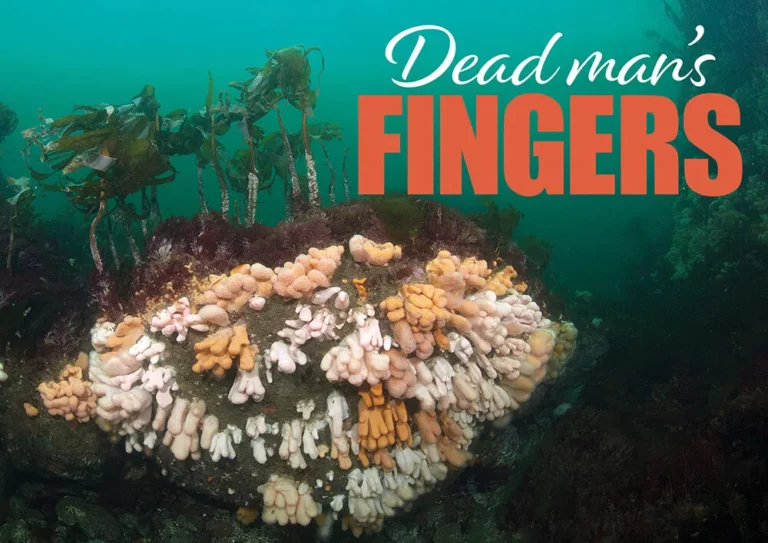
Lawson Wood takes a closer look atone of the most-recognisable members of the Cnidarian Octocorals super-family: the Dead Man´s Fingers
Understanding the Name: Coral vs. Fungus
Hardly an auspicious name, but unless you add the proper Latin name to this common name, many people may otherwise be confused, as there is a type of fungus (Xylaria polymorpha) with that same common name, also an incredibly toxic plant root from the hemlock water-droplet plant (Oenanthe crocata), that if ingested can lead to death in under 30 minutes. There are also several flavours of rum with the Dead Man’s Fingers name from a distiller in Bristol (much more palatable!).
Biology of the Alcyonium Digitatum
The marine dead man’s fingers (Alcyonium digitatum) is not toxic and is a member of the Cnidarian Octocorals. First described by Linnaeus in 1758, this is a large and successful group of invertebrates quite similar to anemones, true corals and hydroids. This super family also included the sea fans; sea pens and other soft corals.
As the name would suggest, these soft corals have eight feeding tentacles and because the medusoid stage of their development has been suppressed, the colonies are a group of loosely connecting polyps. Gradually the colonies grow and can form a dozen or more stout, thick lobes measuring over 20cm or more across.
Their common name comes from their vague resemblance to the bloated fingers of washed-up dead fishermen, these marine dead man’s fingers are often found on the beach after particularly strong winter storms.
Colours tend to range from white to orange and are often randomly mixed over a large area. Curiously the west coast of Ireland has only orange-coloured species and the south of England has white, but around the Berwickshire Marine Reserve, both colours are intermingled randomly everywhere. Here, they are found among plumose anemones (Metridium dianthus) grazing sea urchins and plenty of wrasse and pollock.

Dead Man´s Fingers´ Habitat and Feeding Habits
Colonies are recorded down to over 60m and are known to prefer rocky exposed sites with strong currents, as they are suspension feeders of phytoplankton and zooplankton. They grow actively for the first six months of the year and then tend to just hibernate for the rest of the year until they reproduce in December and January.
Colonies will tend to be either all female or all male, but some colonies are hermaphrodites, releasing both eggs and sperm at the same time. Fertilised eggs develop into free-swimming larvae and are at the mercy of the tides and currents, until they find a suitable hard surface to settle on. Colonies start with just one white polyp and gradually bud off each other to make a first small colony around 25mm across. Colonies are always separate, as they secrete a chemical trace to ward off others forming too close, so when we are diving, we can see literally hundreds and thousands of individual colonies. Gradually they form a hard body and the colony’s polyps are connected by internal canals allowing all of the polyps to benefit from whichever polyps are feeding at any given time.
A Micro-Ecosystem: Predators and Inhabitants
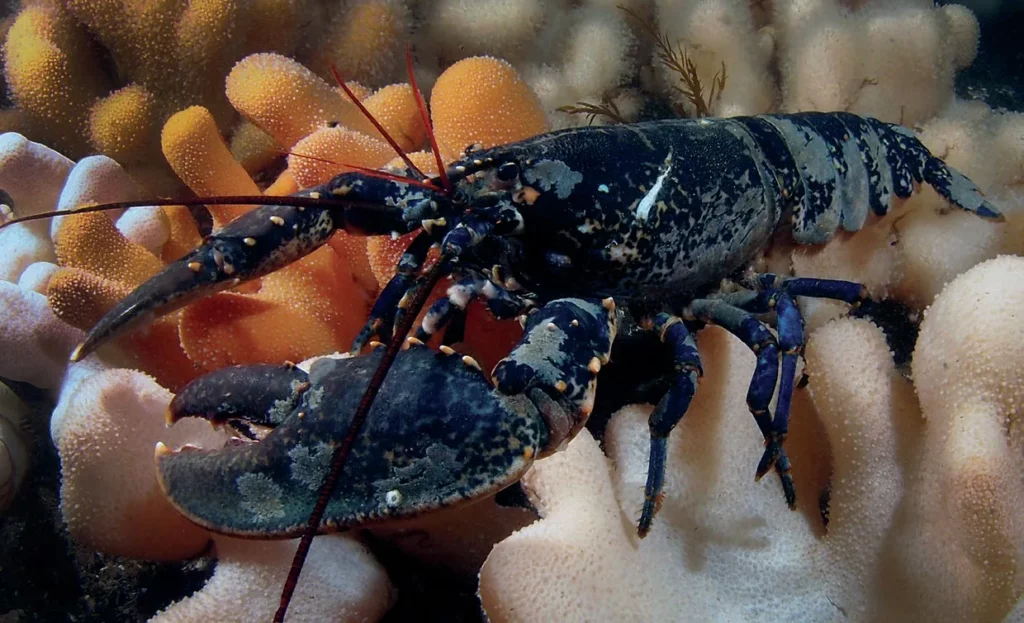
This soft coral is home to many different species of invertebrates, including several types of shrimp, squat lobster, various crabs, lobster, hydroids, isopods such as skeleton shrimps and numerous nudibranchs, particularly the soft coral slug (Tritonia hombergi), which is the soft coral’s greatest predator. A few other molluscs also make this soft coral home and these include both the Arctic cowrie (Trivia arctica) and the European cowrie (Trivia monacha). Grey top shells (Steromphala cineraria) are common, as are hermit crabs. Rarest of all is the poached egg shell (Simnia patula), more readily found along southern shores. They can be overrun by brittle starfish and octopus can usually be found in their midst.


Found from Portugal to Norway and Iceland, dead man’s fingers are found around all of the coastline of northern Europe. Also recorded from northern New Zealand, there is an almost identical species on the east coast of the United States and another two distinct, but similar species, found in UK waters. These are red fingers (Alcyonium glomeratum) and the pink soft coral (Alcyonium hibernicum), but by far the most abundant and common in all coastal areas is Alcyonium digitatum.
Related Species: Red and Pink Soft Corals
Red or red man’s fingers have an overall red body colour and very obvious white polyps and are more commonly found along the south coast of England and French coast and south to the Bay of Biscay and further north to northwest Scotland. ‘Fingers’ are smaller in diameter than A.digitatum and usually less that 25mm in diameter and prefer more-sheltered water conditions. Pink soft coral or pink fingers are also very similar in structure, but the body of this species is an overall pink with small white flecks, but these also have white (slightly longer) feeding polyps.
This species is much more light sensitive and will be more commonly found under overhangs and in caves and caverns, well away from strong sunlight. It can be found from the Isle of Mull; the Isle of Man; a number of sites in Ireland, and along the South Coast of England. These soft corals are some of the most commonly found in our waters and indicative of clear, clean water, a perfect habitat for all manner of other marine organisms, so stay a while and look a little closer, you will be amazed at what you can find.
FAQs
What are Dead Man’s Fingers in the ocean?
Dead Man’s Fingers (Alcyonium digitatum) are a species of marine soft coral belonging to the Cnidarian Octocorals family. They form colonies of polyps that resemble bloated human fingers, typically found in cold North Atlantic waters.
Are marine Dead Man’s Fingers toxic?
No, the marine soft coral Alcyonium digitatum is not toxic to humans. This is often confused with the “Dead Man’s Fingers” fungus or the highly toxic hemlock water-dropwort plant root, both of which share the same common name.
Where can you find Dead Man’s Fingers coral?
They are commonly found in the coastal waters of Northern Europe, ranging from Portugal to Norway and Iceland. They prefer rocky, exposed sites with strong currents and can be found at depths of over 60 meters.
What do Dead Man’s Fingers eat?
As suspension feeders, these soft corals feed on phytoplankton and zooplankton. They use their eight tentacles on each polyp to catch microscopic food particles from the surrounding current.
What is the “Soft Coral Slug” predator?
The soft coral slug (Tritonia hombergi) is the primary predator of Dead Man’s Fingers. This nudibranch feeds specifically on the polyps of the coral colony.
This article was originally published in Scuba Diver Magazine
Subscribe today with promo code DIVE1 — enjoy 12 months for just £1!
