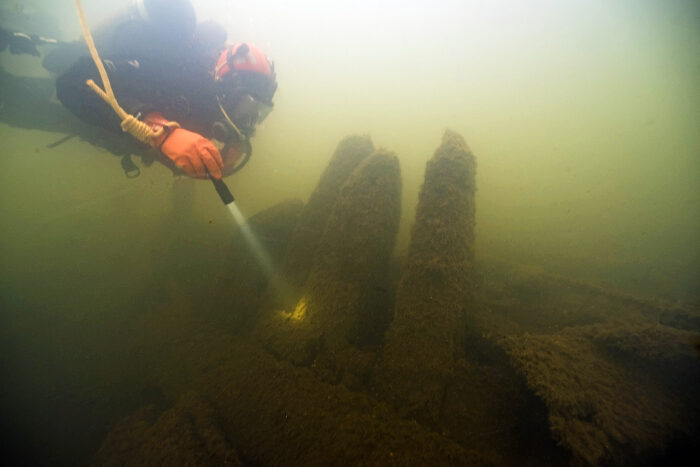
A new open-access database called the War Log has been released, recording the many forgotten but often well-preserved historic Swedish warships that sank in storms and battles or were scuttled in the Baltic Sea.
The project is based on extensive mapping of all known warships from the late 15th to the mid-19th century carried out as part of the Forgotten Fleet research programme, and includes 25 warships located, identified and documented in recent years.
“There is no country in the world that has as many preserved warship wrecks as Sweden,” says database project manager Jim Hansson, marine archaeologist at Vrak, Museum of Wrecks in Stockholm. “We hope and believe that the War Log will become an important and useful tool for both researchers and anyone interested in knowing more about these ships.”
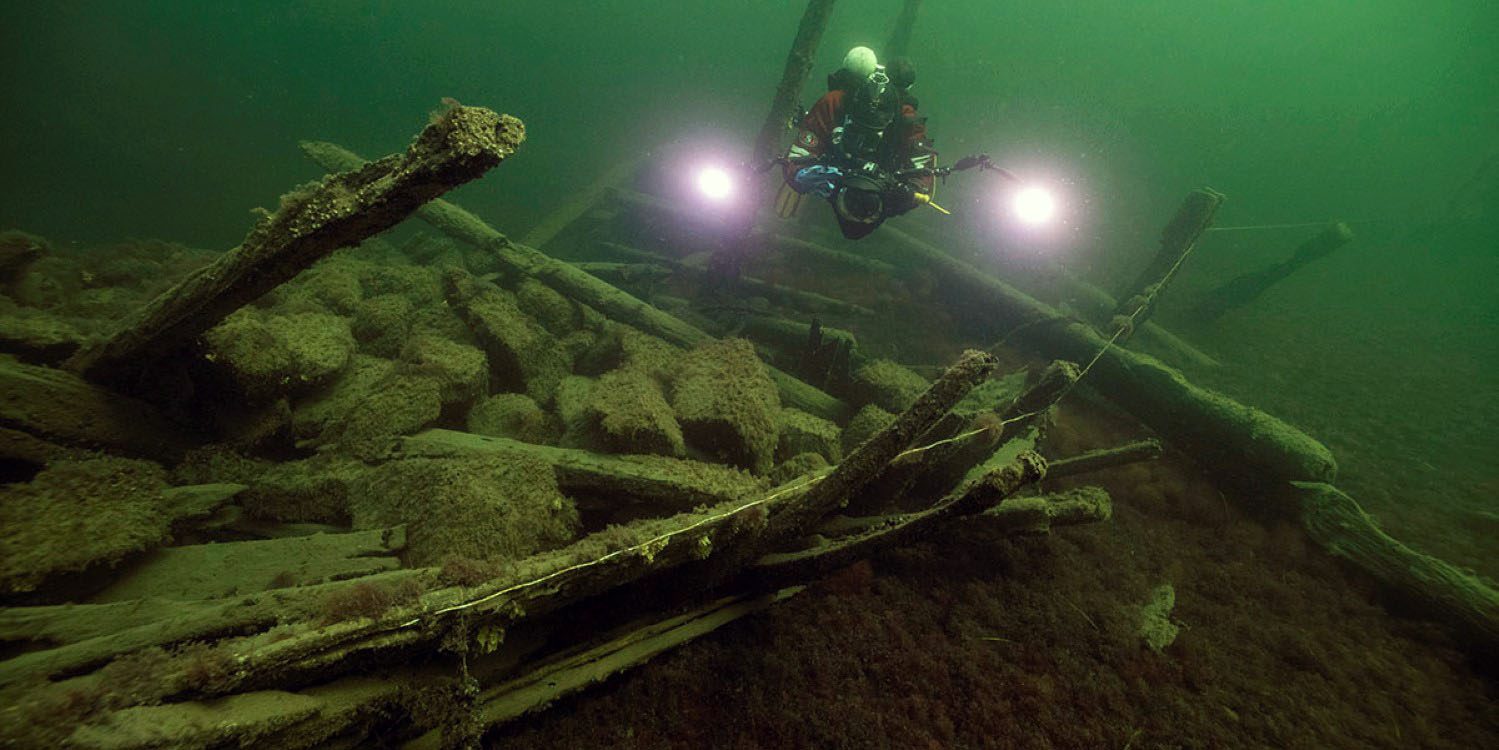
The War Log contains downloadable information on shipwrecks displacing at least 100 tonnes or more, and can be searched by ship name or type, or year or place of construction.
Wreck-find opportunities
Some 10% of the wreck-sites have been discovered and there are indications of where a further 16% could be located. The compilers hope that the War Log will become a useful tool for identifying further previously unknown wrecks.
“By examining the geographical location and filtering out information contained in the database, it will be possible to obtain good indications, which will make it possible to delimit our research,” says Vrak curator Ivan Santic Ljubetic, who compiled the database.

“The fact that we have so many preserved and discovered wrecks is unique in the world and shows what a fantastic environment we have in the Baltic Sea. Our knowledge of where many of the wrecks are shows that we conduct good marine archaeological research and have well-preserved archives in Sweden.”
The Forgotten Fleet
The Forgotten Fleet – Sweden’s Blue Cultural Heritage 1450-1850, a five-year interdisciplinary research programme, will be completed next year.
The project is a collaboration between the Centre for Maritime Studies (CEMAS) at Stockholm University, the National Maritime & Transport History Museums (SMTM), of which Vrak is a part, and the National Board of Antiquities in Finland, and is funded by the Riksbank’s Anniversary Fund.

“The War Log is a good example of how large research projects can lead to exciting and useful products,” says Leos Müller, programme research leader for CEMAS.
“It is of great benefit to researchers interested in the Baltic Sea’s maritime past, but also serves as an easily accessible entry point for tourists, museum visitors, recreational divers and anyone else who is interested.
“However, it is important to emphasise that the shipwrecks mentioned in the database are our common cultural heritage that must not be touched or damaged and is protected by law.”
The War Log database can be accessed free of charge on the Vrak, Museum of Wrecks website.

So, the website is in Swedish and offers translations in Nordic languages but not English under a tab that has the word “Language”. LOL Hopefully we will get an alert article when the site is accessible to English speakers.