
The Legend and Origins of Diamond Rock
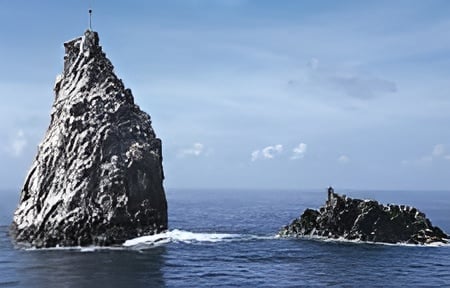
Legend has it that Saba’s dramatic volcanic spire Diamond Rock earned its name when a jilted sailor threw his amour’s engagement ring onto the rock as he returned to sea. The ring apparently remains there, awaiting discovery.
A more believable origin is attributed to the adjacent submerged series of pinnacles named Man O’War Shoals, which ripped the bottom from many ships which sailed between Torrens Point and the peaks of Diamond Rock.
Our boat used a mooring positioned between these two sites, giving only a 50m swim to each. Inevitably we chose to explore first the one we could see from the boat – Diamond Rock.

Even 50m at the surface is hard work when you’re towing two camera systems, but the effort was forgotten as we submerged on the east side of the largest pinnacle.
First Dive Impressions: Lava Walls and Pinnacles
The sheer face plummets with barely a break to 32m, and our first impression was of a profusion of colour on the lava walls.
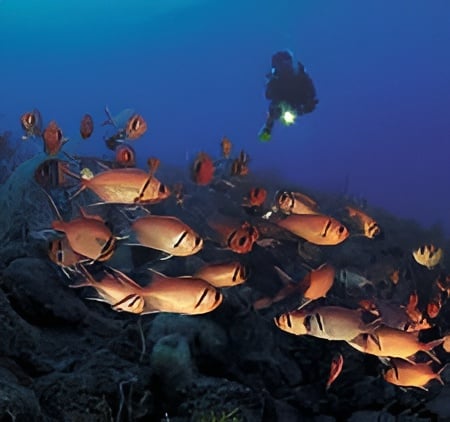
The next was of movement from the numerous fish attracted to the shelter of this isolated reef. Near the surface, horse-eye jacks patrolled the spire, while a little deeper schoolmaster, yellow-tailed and blue-lined snappers gathered in groups close to the reef.
In the cracks and overhangs, small schools of black-bar soldierfish hung out. We headed for the bottom in the hope of sighting reef sharks and eagle rays.

Incredible Marine Life Encounters
The sharks were there and briefly inspected us before departing into the blue, and in lieu of eagle rays we found several southern sting rays, which rose majestically as we approached to follow the sharks.
Circumnavigating the main spire, it became clear that there were four pinnacles here, two breaking the surface, two submerged.
This arrangement forms several deep dissecting gullies with dramatic sheer walls carpeted with sponges, gorgonians, soft corals and dozens of colourful anemones the size of dinner-plates.
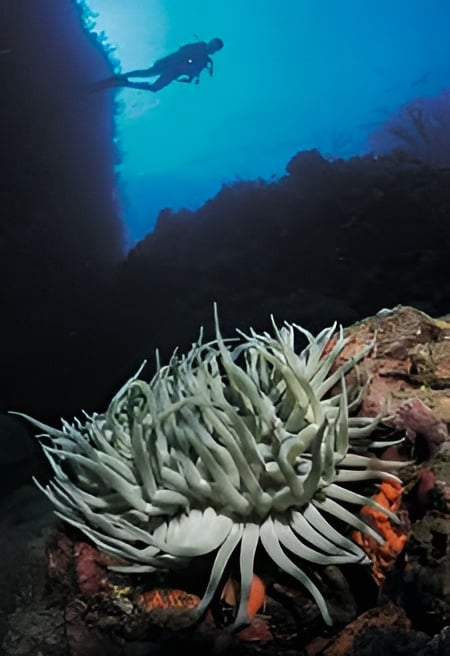
Within these were both symbiotic black and yellow blennies and gaudily patterned pistol shrimps. From fissures in the reef, green and black and white snowflake moray eels peered. The topography of the spire offers the perfect dive profile as you spiral upwards around it.
Reaching 6-8m on the west face, where the submerged pinnacles top out, the water movement can become a little more exciting, as the occasional heavy Atlantic swell finds its way from the open ocean on the far side of the island.
Unwary divers can be picked up and punched through the gap between the two largest pinnacles – fun, but not for the faint-hearted! At this depth you will likely encounter one of several large lone barracuda, able to hold station regardless of conditions.
It will patiently give you the eagle eye and a fearsome grin as you creep closer. We surfaced anxious to know if the neighbouring reef was as good.
A Calmer Adventure at Man O’War Shoals
The only indication of the presence of Man O’War Shoals is a white buoy attached to the highest point at 5m. It has a very different feel from Diamond Rock, even though some geological features are similar. The seabed bottoms out at 24m.

Two large interconnecting pinnacles reach the shallows and two much smaller outcrops rise some 8m from the seabed.
When the swell washes through the gap at Diamond Rock you’ll find a more relaxing dive at Man O’War Shoals, though our first experience of it was no less exciting. As we approached the rock, a frisky reef shark shot between us and headed for a small cave between the peaks.
We followed, but he showed signs of agitation at having his exit blocked, so we retired gracefully and continued our dive with a friendlier hawksbill turtle, which seemed determined to show us another cave where a small nurse shark resided.
The coral and sponge growth was again lush, but with far healthier gorgonian colonies away from the sometimes violent swells of Diamond Rock. Every sort of reef fish competed for meals, the oddest being the boxfish, trunkfish and filefish, all trying to feed through pursed lips.
Among the thickets of marine life the smaller fish species sheltered, and we noticed hawkfish, blennies, gobies and a variety of crustaceans, often camouflaged with bits of sponge and soft coral for protection.
The largest were the spiny lobsters. These had us thinking of our stomachs, though in a marine park, forget it! Their immunity leads to bold behaviour from the lobsters, which stroll about in the open, sometimes shadowed by trumpetfish waiting for scraps.
Up in the shallows there were large barrel sponges on the south side of the pinnacles. Close inspection as we ambled upwards revealed dozens of tiny secretary blennies, appearing to chatter to each other in the typing pool as they darted in and out of their burrows to feed on passing plankton.
We finished our dive on a safety stop atop the rocks, watching a school of Atlantic spadefish cruise in squadron formation out of dancing shafts of light thrown by the lowering sun.
Dive and Travel Tips for Saba
Getting There
One of the Leeward Islands, Saba is a part of the Netherlands Antilles group which includes St Maarten (half-Dutch, half-French) to the north and the ABC islands (Aruba-Bonaire-Curacao) off Venezuela to the south.
From the UK fly to St Maarten via Amsterdam with KLM or Paris with Air France. Connections to the islands are with Winair.
Diving & Accommodation
Brendan O’Brien dived with Saba Divers, which is attached to Scouts Palace Hotel.
Mark Webster visited Saba with MV Caribbean Explorer from Explorer Ventures). Brendan dived around Anguilla with Shoal Bay Scuba and Watersports
When To Go
All year round. Average temperatures 26-32°C, with warm easterly tradewinds. Water temperature 25-29°C. Hurricane season August-October, though this can extend to November. Wettest months May and November, though short showers can be experienced all year round. Hottest months May-August.
Money
In Saba the Netherlands Antilles guilder (ANG), in Anguilla the Eastern Caribbean dollar, but US dollars are accepted everywhere.
Further information
FAQs
Where is Diamond Rock located?
Diamond Rock is a dramatic volcanic spire off the coast of Saba, part of the Leeward Islands in the Caribbean Netherlands.
What makes Diamond Rock a popular dive site?
Its sheer walls, colorful coral and sponge growth, reef fish, hawksbill turtles, reef sharks, and underwater pinnacles make it ideal for divers.
How deep is Diamond Rock for diving?
The dive site ranges from 6–32 meters, with submerged pinnacles creating deep gullies perfect for intermediate and advanced divers.
What marine life can divers see at Diamond Rock?
Divers encounter reef sharks, stingrays, hawksbill turtles, barracudas, moray eels, blennies, pistol shrimps, lobsters, and a variety of tropical reef fish.
How can I reach Saba and dive at Diamond Rock?
Fly to St Martin via Amsterdam or Paris, then connect to Saba via Winnair. Diving trips are available with local operators like Saba Divers.
When is the best time to dive at Diamond Rock?
Diving is possible year-round, with water temperatures of 25–29°C. Hurricane season runs August–October, occasionally extending to November.
Subscribe today with promo code DIVE1 — enjoy 12 months for just £1!
