Divers MICHAEL SALVAREZZA and CHRISTOPHER P WEAVER have been venturing off the beaten track, exploring the tiny Caribbean island of South Caicos and finding more than they might have expected to keep them busy
Scuba divers are always looking for the next adventure. We seek new locations, new experiences, new dive-sites and new marine-life encounters when we plan our dives. The beauty of diving is that we are often rewarded with something new on every dive.
When divers think of visiting Turks & Caicos, a group of islands located south-east of the Bahamas, the island of Providenciales with its bustling dive industry often comes first to mind. But to get off the beaten track, to push further beyond a marine frontier, a journey to a tiny island is in order.
Welcome to South Caicos, where everybody knows everybody else, where funerals are a cause for celebration and where salt is revered as a miracle mineral that infuses all aspects of the local culture.

South Caicos is located in the south-eastern part of the Turks & Caicos archipelago. Measuring only 8.2sq miles and mostly low-lying, the island has been largely off the radar for visitors to this country.
For years it was reachable only by small plane or ferry from Providenciales, but recently American Airlines has introduced a twice-weekly service directly from Miami, so things might now begin to change for this quiet community of proud residents.


South Caicos is known for wild, rocky coastlines and is home to two luxury resorts (Salterra and Sail Rock) and one small beach hotel (South Caicos Ocean & Beach Resort). With a population of 1,139, the island lacks crowds and traffic.
Visitors are just as likely to encounter wild donkeys on the road as they are another vehicle. Cockburn Harbour is the main town, where a handful of restaurants overlook the boats.

Make sure to visit the Dolphin Grill to see Cleo, whose passion for describing the menu is worth the visit; and Daryl at the Sunset Grill, whose pride in his establishment is evident as he lovingly serves up island fare that includes his jerk chicken.

For divers, there is literally only one dive operation, Adventures by Salterra, which operates out of the Salterra Resort. The choice of operator might be limited but the experiences are rich and are of a high quality. This is a full-service operation, with a comfortable twin-hulled dive-boat offering daily dives, nitrox fills and ample rental gear.
Early days
The details of Christopher Columbus’ voyage to the new world in 1492 and where he first made landfall continue to be controversial. One theory maintains that his first landing was on Grand Turk Island. If this is true, it is likely that the second island he spotted was South Caicos.
In early days, South Caicos produced salt by evaporating seawater in shallow ponds known as salinas. Large-scale salt production started in 1850. Because of the large wetland coverage, South Caicos soon became the main producer of salt from the Turks & Caicos.

The remnants of this large-scale operation can still be seen when cycling through the countryside: salinas, dividing walls, windmills, sluice gates and even the wild donkeys and horses that roam the island are all left over from the business of salt production.
Other ventures have come and gone over the years: sea-sponge farming was attempted in the 1930s but eventually failed due to a fungal blight that killed off the sponges.
Around this time, a lobster cannery was established but proved unprofitable. In the 1950s a conch-shell exporting business was started but this, too, was unsuccessful and quickly closed. Today, most residents derive their income from a small local fishing business and the emerging hospitality industry.

In 1944, the USA established an anti-submarine base on South Caicos. Several years later, a LORAN (LOng RAnge Navigation) station was built on the north side of the island but, as GPS and satellite navigation emerged, it became obsolete and was decommissioned.
The Big South
In the 1970s and ‘80s, South Caicos became known as the Big South. Narcotics smuggling was prevalent throughout the Caribbean, including in Turks & Caicos.
Halfway between Colombia and the USA, these islands became a popular refuelling stop for drug-runners. Even though many planes and ships were confiscated by the authorities, many more made it through with their illegal cargoes.
Isolated South Caicos was often the island of choice for the smuggling operations and it is during this time that it became known as the Big South.

One story that continues to circulate is that a plane owned by the infamous drug lord Pablo Escobar once crashed on the runway on South Caicos. The plane was confiscated and one of the wings and some of the landing gear was later intentionally deposited into the ocean – making for an intriguing dive-site today.
Known as the Plane, divers can easily see the remains of the aircraft wing on the reef. Nearby are the remnants of the landing-gear. A large nurse shark can often be found resting comfortably beneath the wing.

Divers who swim over this small piece of wreckage can reflect on the damage done by Escobar’s drug empire to society as it is assimilated into the reef’s ecosystem.
Diving South Caicos
The eastern-facing coast of South Caicos borders a deep ocean trench that creates wonderful underwater topography and adventures for divers to experience.
Within sight of shore, the fringing reef breaks the surface and protects the island from large ocean swells. Beyond that reef, deep blue water belies the presence of deeper water.
Divers exploring this reef system will see the bottom drop precipitously, beginning in about 25m of water. Here the depths quickly reach 300m and dives are typically conducted swimming along a sharp wall covered in corals.

Within 3km, the water is between 2,100 and 3,000m deep. As many divers know, deep water and walls often attract various pelagic species, and South Caicos is no different.
On our first dive to the Grotto we watched as a pair of spotted eagle rays cruised gracefully along the wall at 30m.
As many underwater photographers know, the camera gods laugh when we have a macro lens set up on the camera only to see eagle rays swim tantalisingly close and, on the Grotto, this was our misfortune!
To add insult to injury, a large Caribbean reef shark was also patrolling its territory. Without anthropomorphising this animal, we felt as if it was mocking us with our 60mm lenses.
Along the wall we also encountered small schools of jack and several large barracuda. With little to no current, we were able to spend time photographing various reef creatures along the wall: grey angelfish, squirrelfish and damselfish vigorously defending their nest from the noisy intruders swimming by.

Near the Grotto is the the Plane, along with Eagleray Alley, named for the squadrons of rays often seen there; Troy’s Maze, an astonishing array of rock formations; and the Arch, a site that features a dramatic rocky formation.
Spanish Chain
We next explored the site known as Spanish Chain. The story related by Edgar the divemaster is that many years ago a Spanish galleon became trapped as an oncoming storm was building, because the crew couldn’t pull in their anchor. Their only remedy was to cut the chain and abandon it to the depths as they fled the bad weather.
Today, the remains of the chain can be found on the top of the reef in about 18m of water.
As we descended deeper along this reef towards the wall we spotted a large hawksbill turtle languidly swimming among the corals. Later, we saw several spotted moray eels poking out from their rocky lairs.
Large spiny lobsters reached their antennae towards us as we swam past and, tucked under a large rocky overhang, we came across several giant crabs hiding from the intruders.

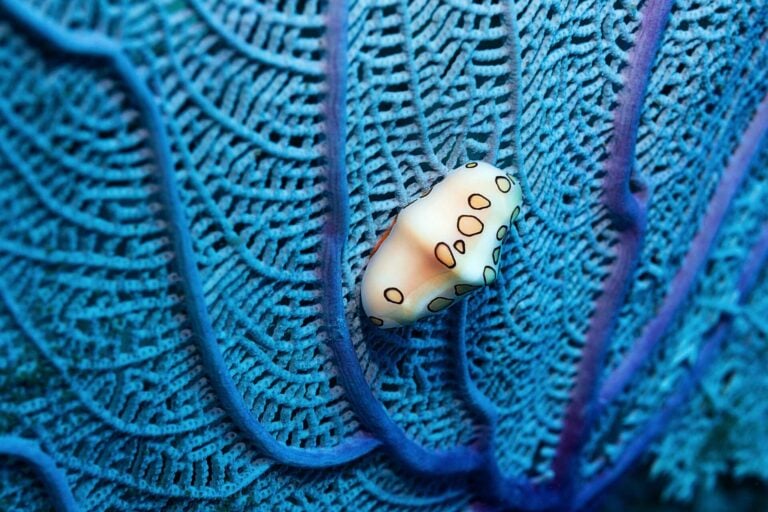
Looking more closely on the reef, we saw anemones of different shapes and sizes, Christmas tree worms and smaller reef fish flitting among the seafans and sponges. On several of the fans were flamingo tongue cowries, always a favourite subject for macro photographers.
Hogfish, snapper, grunts and butterflyfish all put in appearances as we explored these reefs.


On almost every dive we swam over large southern sting rays lying on the sandy bottom. Mostly buried, they were easily spotted as their eyes and tails marked a stark contrast to the white sand. While often alone, some were in groups of two, three or more and we were briefly mesmerised as we watched them softly sifting the sands for morsels of food.

At the end of our final dive, we came across a unique underwater site. Near the Spanish Anchor was a collection of PVC pipe structures supporting coral fragments hanging in the water. This was a garden of corals that are being grown, studied and prepared for eventual planting on the reef.
South Caicos’ reefs, like all those throughout the Caribbean, have suffered from climate change-induced bleaching, and other traumas that have degraded the overall health of the reef. While still vibrant, the reefs are no longer as healthy as they once were. On South Caicos a significant effort is underway to address this problem.
South Caicos Coral Reef restoration & sustainability

The South Caicos Coral Reef Consortium (SCCRC), co-founded by the Salterra Resort, is a non-profit organisation dedicated to helping protect, preserve and restore the local marine environment.
It works in conjunction with the School for Field Studies Centre for Marine Resource Studies (SFS CMRS) (South Caicos), the Reef Institute (Florida), and the Turks & Caicos Reef Fund (Providenciales) to research, replant and restore the coral reefs of South Caicos.

As environmental conditions evolve rapidly, its work focuses on researching and enhancing the adaptability and resilience of corals and the ecosystems they support. The SCCRC has established both in situ (ocean-based) and ex situ (land-based lab) coral nurseries. They have successfully planted hundreds of corals back onto local reefs.
Their recent successes include generating more than 1,000 coral fragments from 10 different species of corals, creating a coral nursery near the Spanish Chain dive-site and planting more than 500 coral fragments on six different dive-sites.
Salterra Resort offers complimentary tours of the facility, where visitors can see the tanks where corals are being rehabilitated, grown and prepared for release in the ocean. In the past 12 months, more than 200 visitors have taken advantage of these tours.

“We don’t charge for these tours,” says Camilo Arado Lilleslatten, director of sustainability at the hotel, “because we don’t want any barrier to entry for this. We hope by visiting the lab, guests who may not have a lot of knowledge about these issues will come away better informed and inspired to help.”
For divers, it is interesting to know that Salterra will soon be offering guests the opportunity, through its Reef Revival Experience, to join research scientists and participate in the coral-planting process.
After seeing the lab and diving in the coral nursery, we asked an obvious question about the efficacy of these efforts. Corals grow extremely slowly, the reefs are massively long and the replanting seems almost insignificant, so how can this help with the recovery of the reef?


The answer was inspiring and multi-faceted. The corals that are being used to regenerate the reef have already survived coral-bleaching and other damaging events, and the theory is that embedded in their DNA are the characteristics that make them naturally more resilient.
It isn’t the individual coral plantings that will rebuild the reef but, rather, when they spawn and over time propagate stronger corals over larger swathes of territory, the impact will be felt.
In addition, the corals being regenerated are, in some cases, vanishing from the reefs. This work is a hedge against extinction.
Go now

Our diving tour of South Caicos left us wanting to return. Our dives took us over shallow reefs, interesting sand patches and dramatic walls and steep drop-offs into deep water. Our visit was a brief taste of the variety and splendour of this relatively unknown dive location.
South Caicos is starting to emerge as a destination for tourists. The local commitment to sustainability will hopefully help to ward off the typical negative effects of increased tourism.
But for a unique diving experience as you seek your next underwater adventure, go now! South Caicos will not disappoint.
Find more travel features by MICHAEL SALVAREZZA & CHRISTOPHER P WEAVER on Divernet