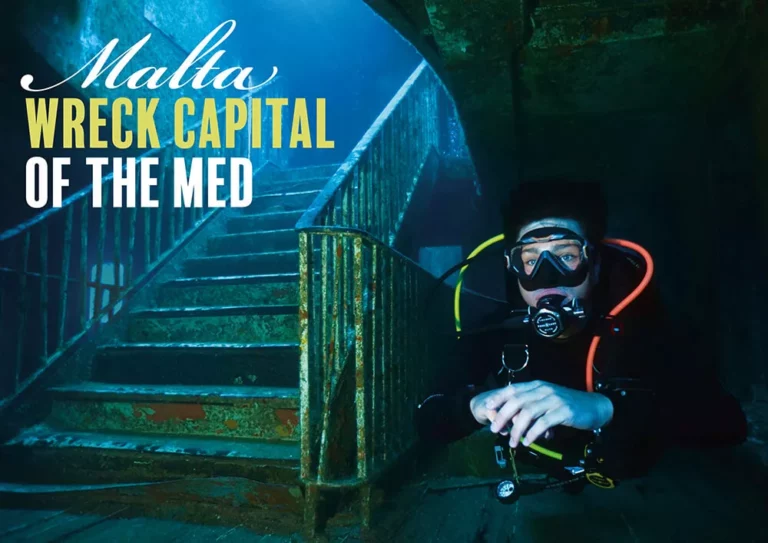
The Maltese archipelago is widely considered the Malta Wreck Capital of the Med. It might only be a small dot in the middle of the Mediterranean, but the islands of Malta, Gozo and Comino boast a plethora of wrecks just waiting to be discovered, in a range of depths to suit everyone from a newly qualified diver to veteran technical divers. Mark Evans and family explored a few of the most-popular sites
Dropping down through epic blue water towards the imposing stern of the cargo vessel Um El Faroud – one of the largest shipwrecks lying off the Maltese coastline – my 17-year-old son Luke frantically gestured at me and then swam towards the superstructure.
Passing divers might have wondered what the arm movements signified, but I’d already been briefed before the dive that he wanted some Insta-friendly shots of him next to big shipwrecks, so I knew what was required. I backed off and dutifully snapped a few images of him as he swam across the back of the Faroud, and later, I got the desired shots of him hanging over the top of the monstrous bow, and swimming through the dramatic split where winter storms tore the wreck apart.
All that was left was for him to grab my camera as we departed the wreck, and do some selfie still shots and videos, and we were done. Mission ‘teenage social media content’ accomplished.
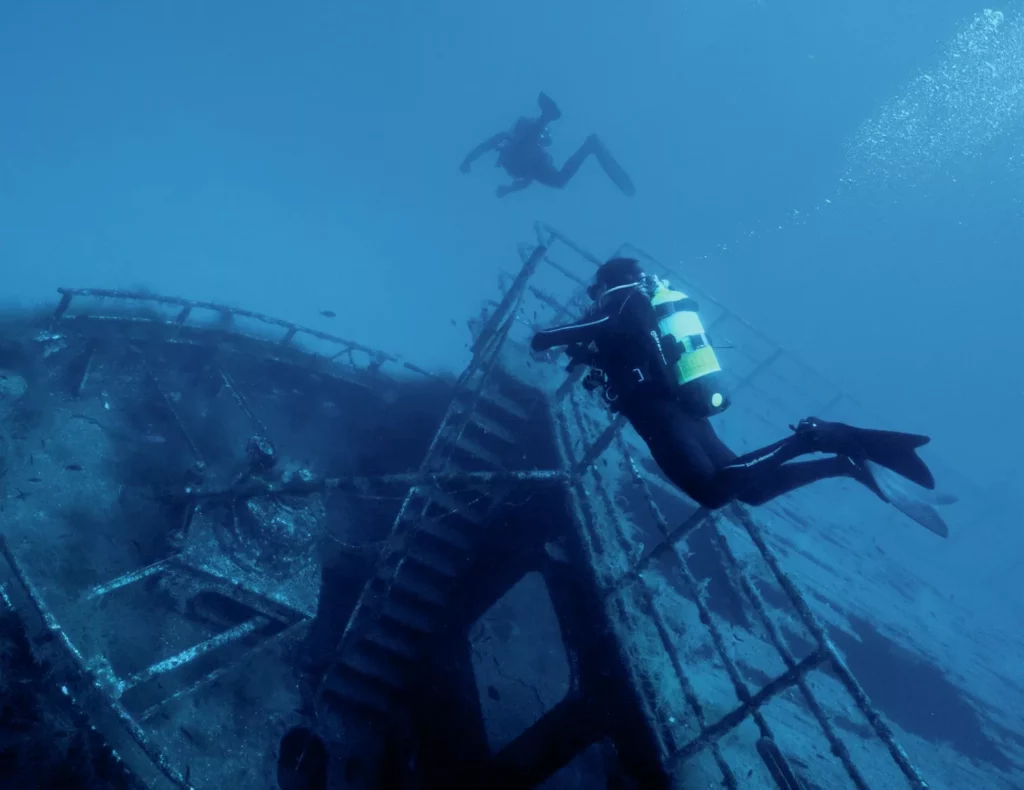
“Our destination for dive two was the 170-foot-long P29. This served as a patrol boat for the Maritime Squadron of the Armed Forces of Malta, and was scuttled as an artificial reef in 2007
Back on ‘the rock’
It had been five years since our last family visit to Malta wreck capital of the Med, and Luke was looking forward to exploring many of the wrecks that were out of bounds for him on our last trip. As a Junior Advanced Open Water Diver, he’d been limited to 68ft, so the P31 patrol boat on Comino was the highlight of that trip, but he had been hankering to do iconic sites like the Um El Faroud, the Karwela, etc, after seeing many of my images from previous visits.
Now a full Advanced Open Water Diver with just shy of 300 dives under his weightbelt, he was excited to finally see some of these tempting shipwrecks firsthand, especially as he is developing into a proper wreck ferret like myself… We made the most of his in-water time too, and he racked up his full Deep Diver and Wreck Diver Specialties while enjoying his week of diving, but that will be covered in a future issue.
Arriving back at Divewise HQ in St Julian’s felt like coming home. There is such a warm, welcoming feeling to the place, and it is not hard to see why the team have such a huge repeat clientele list. We were swiftly paired up with our driver, guide – and Luke’s instructor – for the week, Michael Tandy. Mike was an excellent guide, and he really gelled with Luke, who certainly enjoyed his two courses.
Dive site planner extraordinaire Viv had scheduled a great selection of dive sites over our four days of diving, which included one of Luke’s favorites from his last visit, the HMS Maori warship, as well as the aforementioned Um El Faroud, the P29 (sister ship of the one he did in Comino) and the MV Karwela.
Cirkewwa
Cirkewwa, on the northwest tip of Malta, was our first port of call on day one, and this is undoubtedly one of the most-popular diving spots on the island – it is rare you will find yourselves the only divers here.
True to form, on arrival, there were already a host of pick-ups, trucks and vans there from other dive centers, but thanks to the layout (right next to the ferry port to Gozo), there is plenty of parking space so you are not on top of one another, there are various entry/exit points to the water, and there is even a handy bathroom at one end of the car park area.
Underwater, there are multiple dive sites options, so while you may encounter other groups on occasion, it is not like swimming in diver soup, and you can often be exploring with your buddies with no other divers in sight.
The dive sites on offer include a shallow training area known as Susie’s Pool, and two natural arches, various swimthroughs and overhangs, which are all well encrusted with colorful marine growth. There are also two purpose-sunk shipwrecks – the tugboat Rozi, and the P29 patrol boat.
Exploring the P29 Wreck and Natural Arches
For dive one, as a shakedown dive, we followed Mike towards one of the more-regularly visited natural sites, the Arch. This was once a large cave, but since the roof collapsed, it has left a fabulous archway behind. It towers some 26 feet off the rocky seabed, with the upper part still 39ft below the surface. The route there and back takes you over seagrass beds, along rocky ridges, over small walls, beneath overhangs, and through some interesting swimthroughs. There is plenty of encrusting marine growth, corals and sponges on the rocky reef, especially ‘inside’ the Arch on what would have been the inner walls of the ancient cave. There will be plenty of marine life to keep you company.
We encountered a shoal of small barracuda, and there are all the usual suspects – bream, wrasse, grouper, snapper, goatfish, blennies, gobies and damselfish. Keep your eyes peeled for scorpionfish nestled on the bottom, and we also found several octopus and moray eels tucked into holes in the reef.
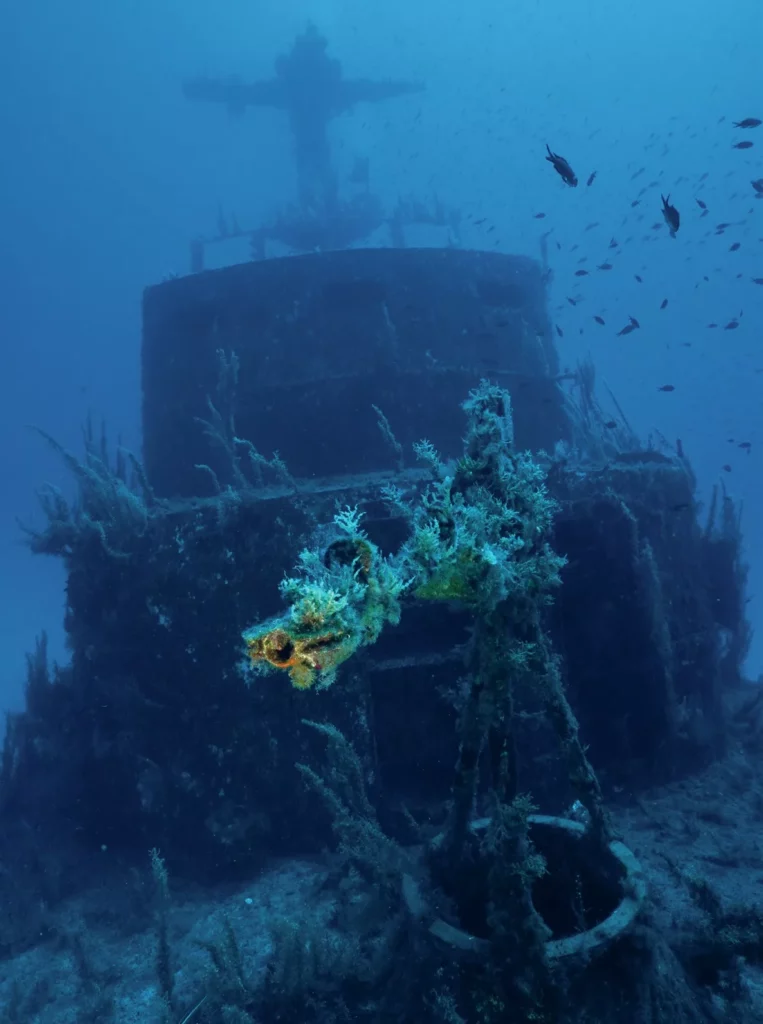
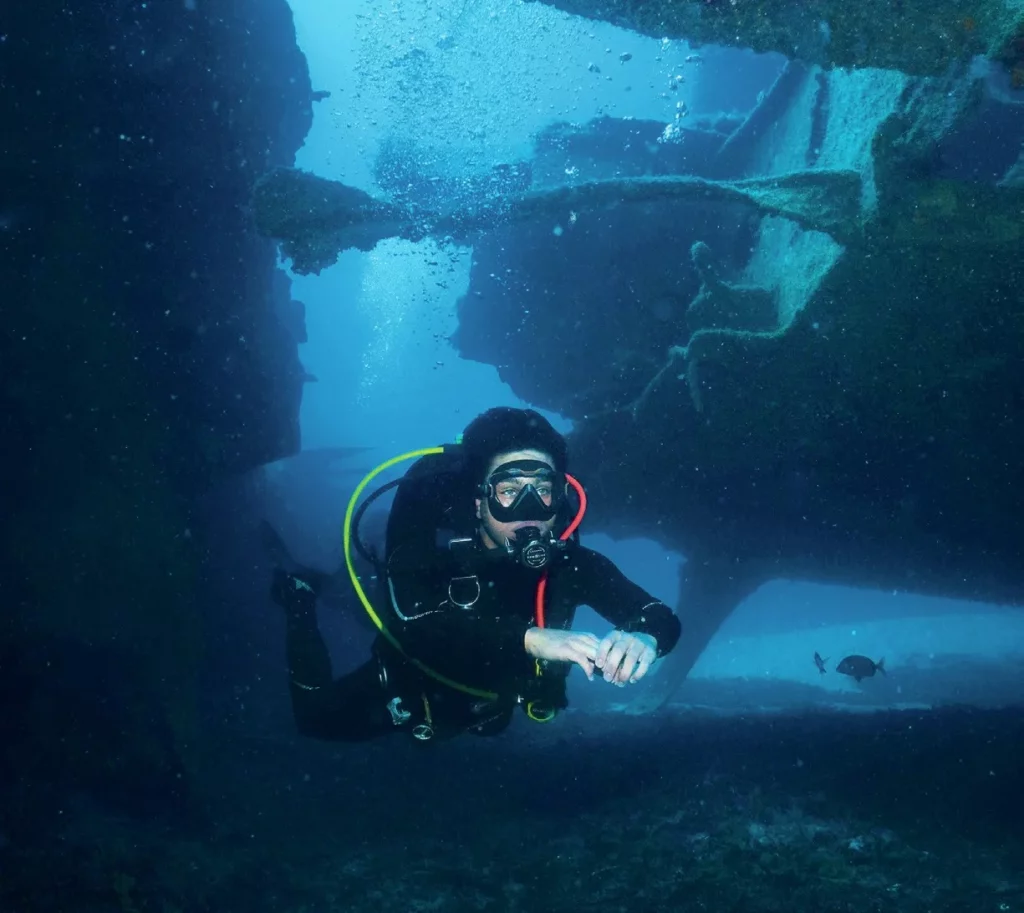
Our destination for dive two was the 170-foot-long P29. This served as a patrol boat for the Maritime Squadron of the Armed Forces of Malta, and was scuttled as an artificial reef in 2007. The towering mast is a magnet for shoals of fish, and there is a gun on the bow section that particularly appealed to Luke. Nowhere is particularly enclosed to the point where a torch is necessary, as it was thoroughly cleaned and prepared before sinking, but having one will allow you to poke around in nooks and crannies – there are plenty of scorpionfish on this wreck if you keep your eyes open.
She sits upright on a sandy seabed in approximately 104ft-111ft, with the upper part of her superstructure reaching towards 39ft, making her perfect to explore on a suitable nitrox mix to extend your bottom time. As well as camouflaged scorpionfish, the P29 can play host to moray eels, shoals of bream, and more. Keep an eye out for rays on the sand on the way to and from the wreck.
The P29 is only a short swim from the shore, and thanks to the usually epic visibility, she comes into view shortly after you leave the rocky reef behind and head off over the sand. The best approach is to stay relatively shallow, say 30ft, and then drop down towards the wreck as you draw near, thus reducing your gas usage and maximising your dive time.
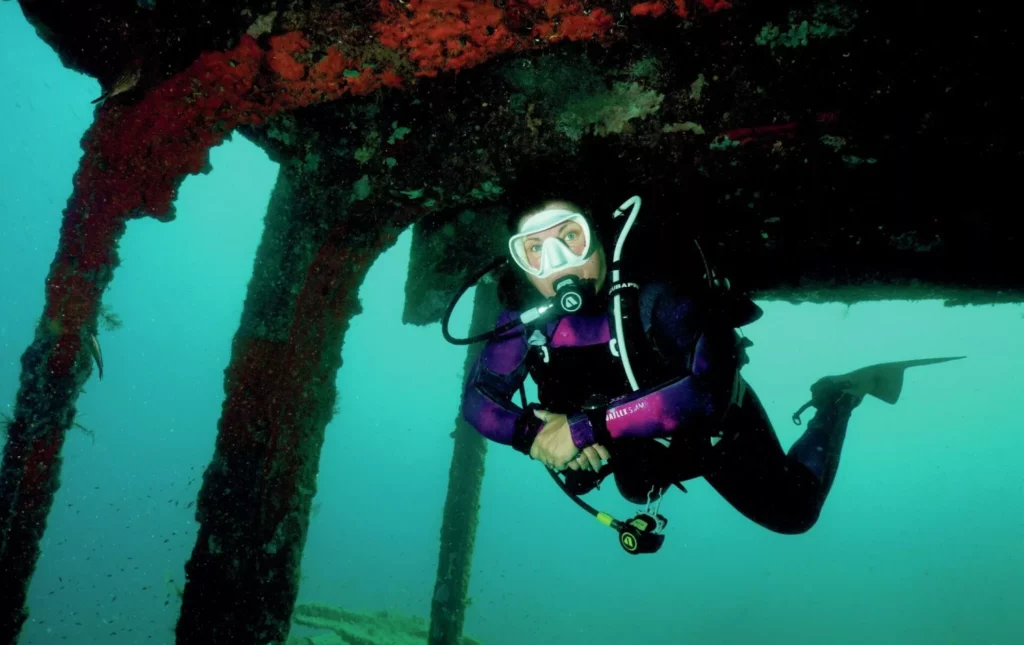
“Mike also pointed out a seagrass bed that looks like a small dog – I am not kidding, it really does! – and this is also useful for making sure you are going the right direction”


However, there can be a wicked thermocline you will encounter as you close in on the wreck – the water temperature on the surface was a balmy 82-84 degrees F, and this dropped to a more-expected 77 degrees F once we were around 22-24ft, but on our descent towards the P29, I could see the water visibility distorting from cold and warm water mixing, and braced myself for a temperature change, but even I was not prepared for a drop to just under 68 degrees F. Our 5mm full-suits with a 2mm vest underneath did the trick, but I was wishing I was in my dry-suit at that precise moment!

Did you know?
The HMS Maori was sunk in Valetta’s Grand Harbor during a German air raid in February 1942.
Um El Faroud
One of the best wreck dives in the Malta wreck capital of the Med, if not the entire Mediterranean, is the Um El Faroud, which is located off the coast of Wied iz-Zurrieq. A Libyan oil tanker, though originally built in Middlesborough in the UK in 1969, it was thoroughly prepared and scuttled as an artificial reef back in 1998 after suffering severe damage in a gas explosion while it was in drydock in 1995. Tragically, nine shipyard workers were killed in the incident, and there is a brass memorial plaque on the front of the bridge.
Measuring 360 feet in length, with a beam of some 52 feet, she makes for an impressive sight as she appears from the blue. You hit the stern first, and this vast chunk of superstructure certainly makes you pause and just take it in before continuing with your exploration. The prop is down at 118ft, while the top of the funnel reaches to 49ft, so that gives you an idea of the scale of the vessel.
She lies a good 500 foot plus offshore from the entry point (which is where the small tourist boats operate from to the nearby Blue Grotto, so watch your head as you are leaving/returning to the entry/exit point), but handily there is a sculpture of an old-fashioned hardhat diving helmet on a square plinth about halfway there to aid navigation. Mike also pointed out a seagrass bed that looks like a small dog – I am not kidding, it really does! – and this is also useful for making sure you are going the right direction. As it happened, on our diving day, the vis was that exceptional, we could just about make out the shape of the Faroud stern while we could still see the rocky reef behind us.
We did two dives on the Faroud, but this still only scraped the surface of what is possible on this huge wreck.
Experienced and suitably trained wreck divers could spend an entire dive inside the engine room and superstructure alone, whereas on our dives, we barely passed through a couple of areas of the bridge.
Given this was Luke’s first visit to the wreck, we decided the grand tour of the external areas was best, so dive one we focused on the stern, and on dive two, we headed to the bow and midships. During the winter storms of 2005/2006, the Um El Faroud split completely in two, and now the port side of the bow section almost lines up with the starboard side of the stern section. You can swim under and through this huge split in the hull, which makes for a great photography location. Being effectively two parts now, this fit well with our two-dive plan.
As described at the start of this article, Luke had a ball on this wreck and it more than met his expectations. He was already talking about coming back to explore some of the superstructure on future dives. This probably represented something like my 30-plus dives on the Faroud, and it still draws me back for more. Definitely one to add to your ‘must-dive on Malta’ list.
HMS Maori
One of Luke’s favorite dives on our last visit was the remnants of the British World War Two Tribal-class destroyer HMS Maori, in St Elmo’s Bay. He was totally smitten with this ‘proper’ wreck, and really enjoyed seeking out and finding identifiable parts during his dives.

“There is plenty of marine life around the wreck, and the rocky reef from the entry/exit point to the wreck is a veritable marine life nursery”
The HMS Maori, originally constructed in Govan, Scotland, ended up being sunk in Valetta’s Grand Harbour during a German air raid in February 1942, near the entrance to Dockyard Creek. In July 1945, the wreck was refloated and moved out of the shipping lane. However, while it was originally planned to tow her intact to near Fort St Elmo and scuttle her there, during the tow, two-thirds of the aft section broke off and went down in deep water, leaving just the remaining third – the bow section – to be sunk as planned, coming to rest in just 52ft, making this one of the shallowest wartime wrecks found in the Malta wreck capital of the Med, and a perfect entry point for those new to the islands’ history.
What is left of the wreck is well broken, with much of it semi-buried in the sand of the seabed, but this all helps create a truly authentic atmosphere when you are diving the wreck. The visibility is generally a bit on the green side and more reduced than at blue-water sites such as the Faroud or the P29, but again, this adds to the aura of the place. Just be aware that being a ‘proper’ shipwreck, there are lots of sharp edges to avoid, and the inside is thick with sand and silt, so watch your finning techniques to not destroy the visibility.
Take your time and you can find all manner of bits and pieces taking you back in history – Luke delighted in finding light fittings made from porcelain, and there are certain parts where you can penetrate, though this is more of a swim-through now given how much of the metal plating has fallen away or rusted through.

Did you know?
The mighty 360-feet-long Um El Faroud split in half during the winter storms of 2005/2006, and so now you effectively have two dives – the stern section complete with rear superstructure, and the midships and impressive bow area.
You can see the mounting ring from a forward turret – alas, the two forward guns were removed when it was refloated, and remounted at Fort Ricasoli as a shore battery. Still, you can see where the ball bearings it would have rotated on were situated.
There is plenty of marine life around the wreck, and the rocky reef from the entry/exit point to the wreck is a veritable marine life nursery, with lots of juvenile fish taking shelter in the rocks in the warm, shallow water. Around the wreck expect bream, flounders, fireworms, nudibranchs, goatfish, gurnards, and red mullet. If you are lucky, you might even find one of the resident seahorses, which can be found along the reef edge from the wreck site.
MV Karwela
Gozo is building up quite a collection of artificial reefs now, with three lying offshore from Xatt I-Ahmar on the southeast of the island. The Xlendi went down in 1999, and then the Cominoland – and our target, the Karwela – were both scuttled in 2006.
The MV Karwela was a former passenger ferry that used to ply its trade in Malta’s Grand Harbor, and it is now arguably the most-popular of the three sunken wrecks here in Gozo. The vessel, which was originally built in Germany in 1957, is nearly 164 feet long, and can be found sitting upright in some 130ft. The deck is at around 100ft, meaning nitrox is a must if you are going to get any meaningful bottom time on her.
Thankfully, being a relatively small wreck, you can easily get around her, and most divers will head to the famed staircase in the middle of the Karwela – the subject of many underwater photographs. Luke had seen a massive shot of this staircase in the dive center and was keen to see it for himself, and Mike was more than happy to oblige.
Swimming out from the shore entry/exit point, it is only a short distance to the Karwela, which can be seen through the blue water from a fair distance away. On our first dive, we explored around the outside of the vessel, and then ventured into the bridge area, only briefly looking inside so that we knew where our quarry – the staircase – was for dive number two.
With a plan in place for shooting the staircase, we headed back out for dive number two. We shot two different versions – one, the traditional shot, with a diver heading down the staircase itself, and the second, with the diver swimming around alongside the staircase, with the stairs disappearing up behind them. Both had their merits, but I think I am leaning towards the second, less-seen image as my favorite. There is not as much life on the Karwela itself as on the other wrecks we had done during the week, but once back on the sheer wall and rocky reefs, you can find plenty of life, including bream, damselfish, moray eels, octopus, scorpionfish, mullet, and more.
Conclusion on Malta, the Wreck Capital of the Med
Once again, Malta delivered as a short-haul diving destination from the UK (and mainland Europe), but it should not be overlooked by those coming from further afield, such as North America.
It is easy to get to, with flights coming in from most European hub airports, accommodation is plentiful and covers all price brackets, and there are multiple dive centers that can cater for everything from try-dives to full-on technical expeditions to some of the island’s deeper dive sites.
As well as the scuba diving and snorkeling on offer, which as we said is suitable for all levels of diver, Malta and Gozo also have a rich history going back thousands of years, so there is much to explore topside for those ‘culture vultures’.
The impressive citadel of Valletta, with its immense walls, is a sight to behold, and likewise the ‘Silent City of Mdina’ is worth a visit. The Roman burial chambers of St Paul’s Catacombs date back to the fourth and ninth centuries, while the Megalithic temples of Malta, many of which are UNESCO World Heritage Sites, were built between 3,600BC and 2,500BC, and had been claimed as the oldest free-standing structures on Earth until the discovery of the Gobekli Tepe in Turkey. Given Malta’s key strategic location in both World War One and Two, there is also much to see connected with these conflicts.
On a diving front, Divewise provided impeccable service as always – I can highly recommend these guys, who can handle recreational, technical and even CCR diver requirements. They can offer a wide range of courses for those wanting to expand their skillset, or just offer excellent guided diving for qualified divers keen to explore the dive sites of Malta, Gozo and Comino.
FAQ Section
What are the best wrecks to dive in Malta?
The most iconic wrecks include the Um El Faroud (a 360ft oil tanker), the P29 Patrol Boat, the MV Karwela (famous for its staircase), and the WWII destroyer HMS Maori.
Do I need a qualification to dive wrecks in Malta?
While some shallow wrecks like the HMS Maori (16m) are accessible to Open Water divers, many of Malta’s best wrecks sit between 30m and 40m, requiring an Advanced Open Water or Deep Diver specialty.
Can you dive the Um El Faroud from the shore?
Yes, the Um El Faroud is a shore dive located at Wied iż-Żurrieq. It is approximately a 150-meter swim from the entry point, guided by underwater landmarks like the “helmet” statue.
Is wreck diving in Malta suitable for beginners?
Absolutely. Malta offers a range of depths. Beginners can enjoy the HMS Maori or P31, while veteran technical divers can explore deeper scuttled vessels and historical sites.
When is the best time for wreck diving in Malta?
Diving is possible year-round, but May to October offers the warmest water (up to 28°C) and the best visibility, often exceeding 30 meters.
This article was originally published in Scuba Diver Magazine
Subscribe today with promo code DIVE1 — enjoy 12 months for just £1!
