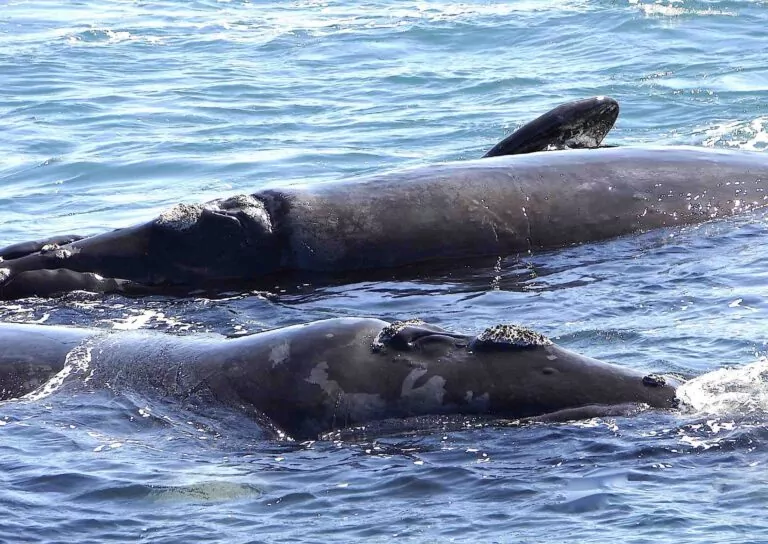
The potential lifespans of whales are as much as double previous estimates, say GREG BREED of the University of Alaska Fairbanks and PETER CORKERON of Griffith University
Southern right whales have lifespans that reach well past 100 years, and 10% may live past 130 years, according to our new research published in the journal Science Advances. Some of these whales may live to 150. This lifespan is almost double the 70-80 years they are conventionally believed to live.
North Atlantic right whales were also thought to have a maximum lifespan of about 70 years. We found, however, that this critically endangered species’ current average lifespan is only 22 years, and they rarely live past 50.
These two species are very closely related – only 25 years ago they were considered to be one species – so we’d expect them to have similarly long lifespans.
We attribute the stark difference in longevity in North Atlantic right whales to human-caused mortality, mostly from entanglements in fishing-gear and ship strikes.
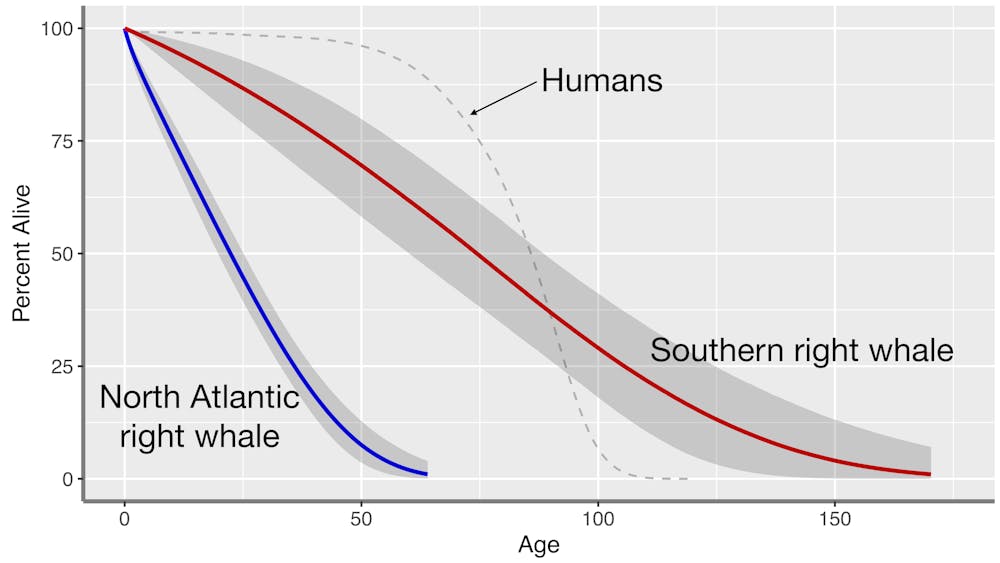
We made these new age estimates using photo identification of individual female whales over several decades. Individual whales can be recognised year after year from photographs.
When they die, they stop being photographically “resighted” and disappear. Using these photos, we developed what scientists call “survivorship curves” by estimating the probability that whales would disappear from the photographic record as they aged. From these survivorship curves, we could estimate maximum potential lifespans.
Twenty-five years ago, scientists working with Indigenous whale-hunters in the Arctic showed that bowhead whales could live up to and even over 200 years.
Their evidence included finding stone harpoon points that hadn’t been used since the mid-1800s embedded in the blubber of whales recently killed by traditional whalers.
Analysis of proteins from the eyes of hunted whales provided further evidence of their long lifespan. Like right whales, before that analysis, researchers thought bowhead whales lived to about 80 years, and that humans were the mammals that lived the longest.
In the years following that report, scientists tried to figure out what was unique about bowhead whales that allowed them to live so long. But our new analysis of the longevity of two close relatives of bowheads shows that other whale species also have potentially extremely long lives.
Why it matters
Understanding how long wild animals live has major implications for how to best protect them. Animals that have very long lifespans usually reproduce extremely slowly and can go many years between births.
Baleen whales’ life history – particularly the age when females start breeding and the interval between calves – is strongly influenced by their potential lifespan. Conservation and management strategies that do not plan accordingly will have a higher chance of failure.
This is especially important given the expected impacts of climate disruption.
What still isn’t known
There are many other large whales, including blue, fin, sei, humpback, grey and sperm whales. Like bowhead and right whales, these were also almost wiped out by whaling.
Scientists currently assume that they live for about 80 or 90 years, but that’s what we believed about bowhead and right whales until data proved that they can live much longer.
How long can these other whale species live? Industrial whaling, which ended only in the 1960s, removed old whales from the world’s whale populations. Though many whale populations are recovering in number, there hasn’t been enough time for whales born after the end of industrial whaling to become old.
It’s possible, even likely, that many other whale species will also prove to have long lifespans.
What other research is being done
Other research finds that the loss of older individuals from populations is a phenomenon occurring across most large animal species.
It diminishes the reproductive potential of many species. Researchers also argue that this represents a real loss of culture and wisdom in animals that degrades their potential for survival in the face of changing conditions.
What’s next
We want to better understand how whaling affected the number of old individuals in current whale populations and predict when the number of old individuals will recover to pre-whaling levels.
Preliminary results suggest that it might be another 100 years before whale populations truly recover, even for species whose populations now number as many as there were before whaling.
For North Atlantic right whales, our research shows that even when the population was increasing, the management actions taken were insufficient to prevent these whales from dying far too young.
Greg Breed is Associate Professor of Quantitative Ecology at the University of Alaska Fairbanks and Peter Corkeron is Adjunct Senior Research Fellow at the Centre for Planetary Health & Food Security, Griffith University. This article is republished from The Conversation under a Creative Commons licence. Read the original article.
Also on Divernet: Southern rights – What could possibly go wrong?, Whales in danger of extinction, Whalers did their worst – but their prey are back!, New maps show high-risk zones for whale-ship collisions