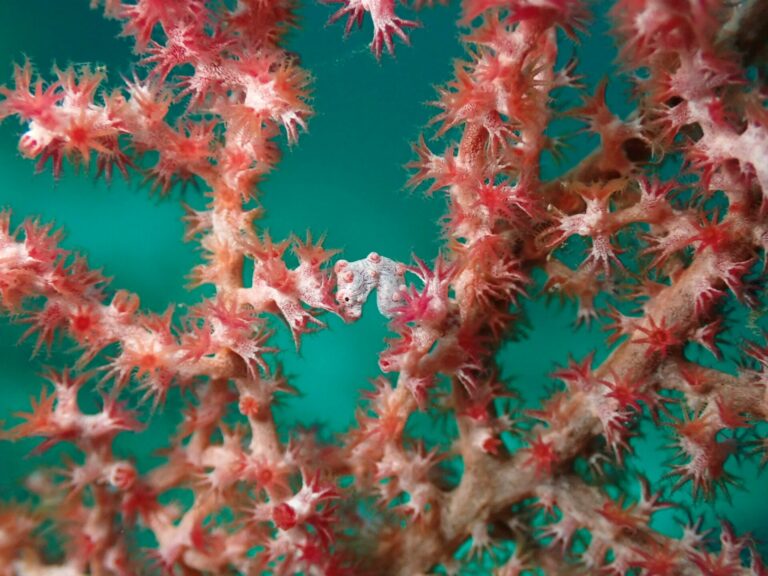
Meridian Adventure Dive bring you the monthly Raja Ampat Creature Feature series: Pygmy Seahorse
The underwater world is home to an astonishing array of marine life, each species adding its unique charm to the ocean’s tapestry. Among these, the Hippocampus bargibanti, commonly known as Bargibant’s seahorse or the pygmy seahorse, stands out for its extraordinary camouflage and diminutive size. This remarkable creature, discovered relatively recently in the late 20th century, intrigues marine biologists and underwater enthusiasts alike.
Hippocampus bargibanti was first described in 1970 by Georges Bargibant, a marine biologist whose name the species honours. Bargibant stumbled upon this seahorse while examining a Muricella gorgonian coral, highlighting its exceptional ability to blend seamlessly into its environment. These pygmy seahorses are predominantly found in the coral reefs of the Indo-Pacific region.

Bargibant’s seahorse is renowned for its tiny size, measuring just 1.4 to 2.7 centimetres in length. This minute size and its knobby, bumpy appearance provide excellent camouflage against the gorgonian corals it clings to. The seahorse exhibits two primary colour morphs: grey with red tubercles and yellow with orange tubercles, each variant adapted to match specific coral species. This extraordinary mimicry not only aids in evading predators but also makes the seahorse one of the most challenging marine creatures to spot. But do not worry; the dive masters at Meridian Adventure Dive Resort know where to take you to see these incredible tiny creatures in Raja Ampat.
The life of Hippocampus bargibanti revolves around the gorgonian coral. These seahorses are highly sedentary, often remaining attached to the same coral for their entire lives. They use their prehensile tails to anchor themselves securely, swaying gently with the currents.

Pygmy seahorses feed on tiny planktonic organisms, such as copepods and other small crustaceans, using a method known as suction feeding. They use their elongated snouts to create a vacuum, drawing in prey remarkably efficiently. Due to their minuscule size, their diet comprises only the smallest marine organisms.
Bargibant’s seahorses exhibit fascinating reproductive behaviour. Like other seahorse species, they practice a form of male pregnancy. After an elaborate courtship dance, the female deposits her eggs into the male’s brood pouch, where he fertilises and carries them until they hatch. This gestation period lasts about two weeks, after which the male gives birth to fully formed, miniature seahorses. This reproductive strategy ensures a high degree of parental investment, increasing the likelihood of offspring survival in their delicate reef habitats.

Hippocampus bargibanti, the pygmy seahorse, is a marvel of the marine world. Its unique adaptations and intricate relationship with coral reefs symbolise the delicate balance within ocean ecosystems.
Situated in Raja Ampat, Indonesia, Meridian Adventure Dive is a PADI 5 Star Resort and winner of the PADI Green Star award. Scuba divers enjoy our professional services that have become synonymous with both the PADI and Meridian Adventure names.
