
We chat to acclaimed underwater cinematographer David Diley, who burst on to the diving scene with his multi-award-winning documentary Of Shark and Man, and now provides a one-stop-shop for all things film and film-making, be that topside or underwater
Photographs courtesy of David Diley or as credited
Q: As we always do with these Questions and Answer sessions, how did you first get into scuba diving?
A: I have always wanted to be a diver since I first saw the Ron and Valerie Taylor film, Realm of the Shark, when I was seven years old. I was already obsessed with sharks then and when I realised you could dive with them, go on adventures and make films about them, I decided there and then, that’s what I was going to do.

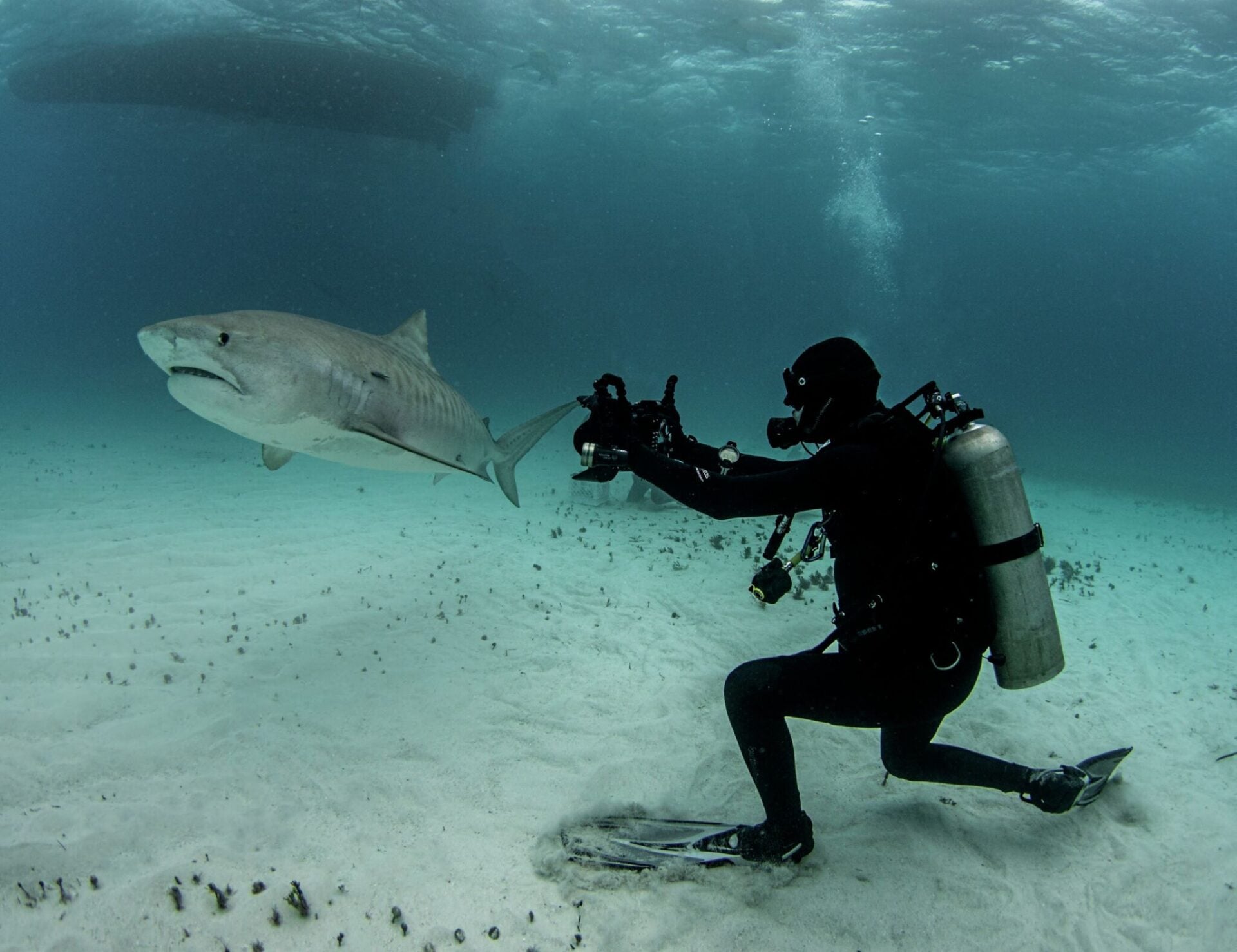
Q: You are perhaps still best known in diving circles for your documentary Of Shark and Man. How did this come to be in the first instance, and did you expect it to garner as many awards as it did?
A: I guess the short version of the story is that I was aware of this incredible story in Fiji and I was at a point in my life where I still hadn’t got anywhere close to achieving my lifelong dream of being a filmmaker specialising in working with sharks. I just decided to go for it, quit my job and do anything I could to make the film despite having no experience, no money and very little likelihood of me actually pulling it off!
Through sheer determination and a willingness to sacrifice any semblance of a ‘normal’ life, I somehow managed to go from zero to being on a plane out to Fiji in less than ten months. I’d never made a film before, so the only ‘experience’ I had was that I knew what I liked and what wasn’t being made anymore, so I set out to make the kind of film I wanted to see, hoping others would feel the same.
Thankfully they did, the awards were an unexpected but very welcome surprise, and the film was picked up for global distribution and is still doing well to this day, ten years after I finished it. I actually found out last year that it appears on several publications lists of ‘the best shark documentaries ever made’, which is mind-blowing to me considering I was pretty much winging it the whole way through!
“I’d never made a film before, so the only ‘experience’ I had was that I knew what I liked and what wasn’t being made anymore, so I set out to make the kind of film I wanted to see, hoping others would feel the same”

Q: What were some of the biggest challenges shooting large bull sharks, especially when there were so many of them at certain points of filming?
A: I guess the fact that there were so many of them.
Conditions in the arena at Shark Reef are usually pretty straightforward so the diving was simple, but I still had to keep an eye on all the sharks where possible while also focusing on getting the shots, not just artistically but the fundamentals of exposure, focus, etc.
There was an enormous self-imposed pressure on me to deliver the project to a high standard to reward the belief that was shown in me by the people who helped me get there, so it was a constant battle to multi-task everything, 30m underwater surrounded by over 100 of the world’s biggest bull sharks. It didn’t hit me until I returned home and I was physically and emotionally exhausted – I could barely get out of bed for the first two weeks.
Q: You now head up Scarlet View Media. Rather than just being a company offering filming services to companies around the globe, you go the extra mile and also cover film production, digital grading and post-production. Give us an insight into the world of Scarlet View Media.

A: The idea was to create a boutique production company that, alongside offering the standard services you’d expect from a commercial production company, we would not just offer but specialise and excel when it comes to specialities like underwater cinematography and aerial cinematography, while also being completely self-sufficient in regards to post-production. We use small, easily manageable teams of experts in their field to provide everything from concept development through to delivery without the need to bring in other people. We’re one of, if not the only, company in Europe that can do this in-house.
I’m currently putting an emphasis on a new product we are offering to dive tourism clients where we can create and deliver the content and platforms for dive resorts and liveaboards to have a strategic, broadcast-quality video marketing campaign designed to drive engagement and bookings from adventurous dive travellers, all of which at a pricepoint way lower than one would expect. I love making travel content.
Q: While you do shoot topside for clients as well, you are renowned for your underwater work. What systems do you shoot with, and why?
A: I shot with the Panasonic AU-EVA1 Cinema Camera for seven years and it has been fantastic for me, a truly underrated camera with a beautiful image, but I have just upgraded the entire set up now to shoot with RED. I have the RED Komodo X which, underwater, I pair usually with a Sigma 8-16mm lens. My monitor is the Small HD Ultra V and I use Big Blue Dive Lights, which are fantastic for so many reasons.
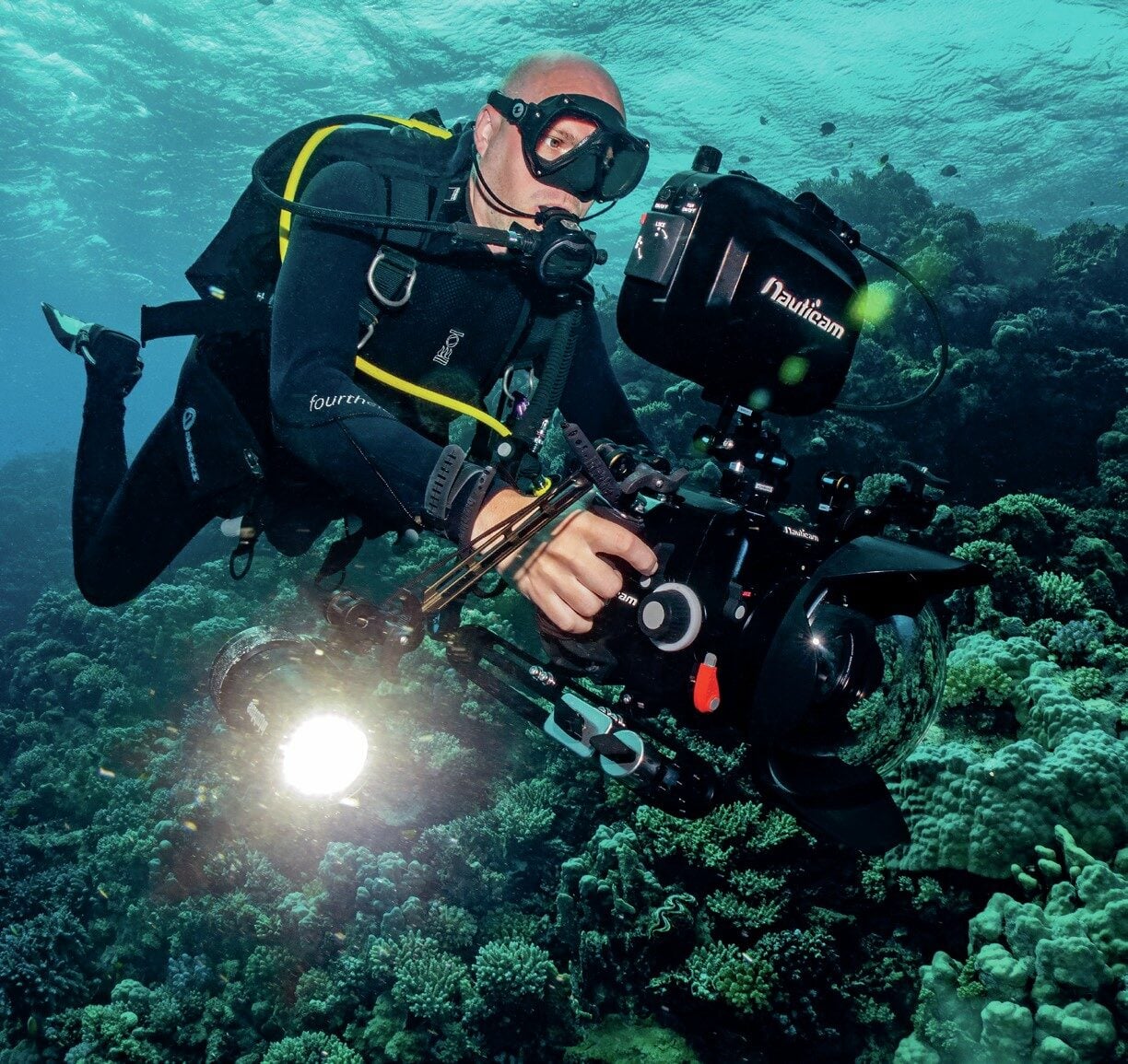
I chose RED for the image quality, high frame rates and perhaps most importantly of all, the ability to shoot internal Redcode Raw, which is the best recording codec bar none. Because I work as a colourist also, I have a detailed knowledge on the various available recording formats and Redcode is by far the best due to the level of flexibility it offers in post. It also helps that RED is still very much the standard in the global film industry when it comes to shooting underwater so I need to make sure I can offer my clients what they want without them having to take on the expense of renting kit externally.
I also have an Insta360 X4 which is usually mounted on the housing for social media content but I also like to occasionally use that by itself to shoot pure 360 VR headset content, something I plan on doing a lot of in the future.
Q: What is your most-memorable diving experience?
A: It has to be the final dive in Fiji on Shark Reef. Hundreds of sharks, no guests and my own private show from the greatest shark dive on Earth. It was a truly incredible experience.
Q: On the flipside, what is your worst diving memory?
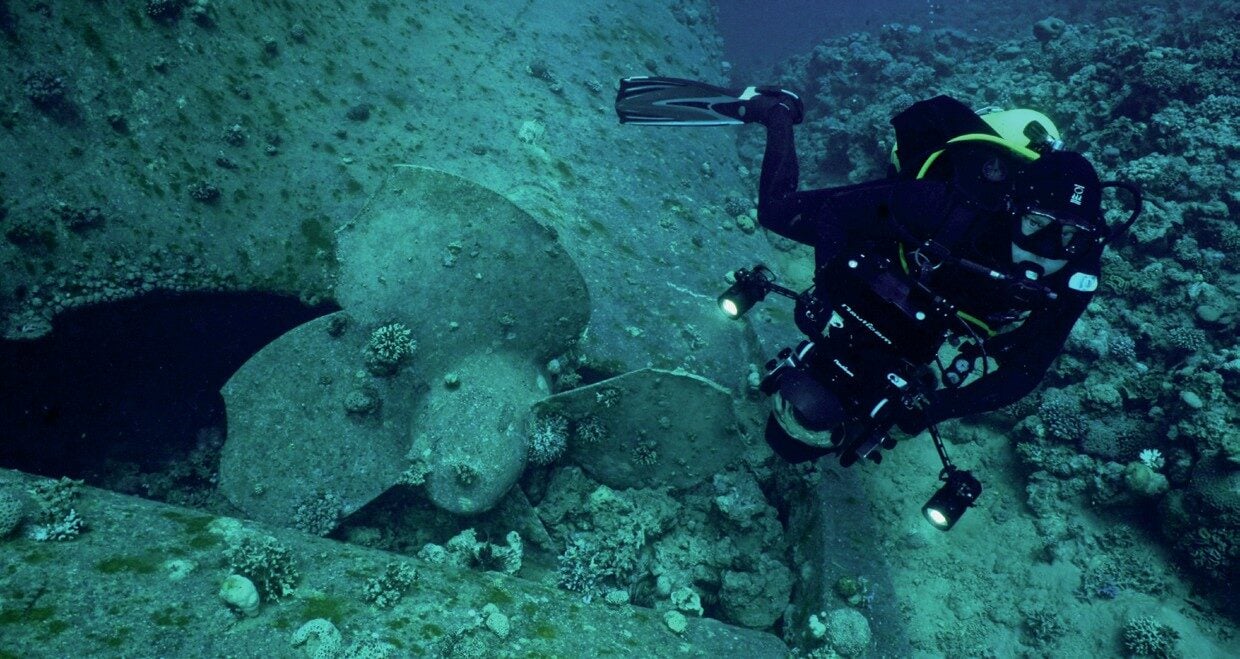
A: I almost died on Elphinstone in 2018. I was diving with an ex-Egyptian military guy called Jimmy and my good friend Sarah. We got hit by a freak down current and went from a nice gentle dive at 18m looking for hammerheads to 100 metres off the reef and down at 68m in the blink of an eye. Thankfully Sarah managed to avoid it, but both Jimmy and I had to struggle through the current to get back to the reef, which felt like it took forever. By the time we got there I had only 20 bar of air left. I did the maths in my head in regards to how long it would take to make a safe ascent and how much air I had left and there was a deficit of six and a half minutes. I held on to the reef and thought it through. I could let go, make a slow ascent and let the current take me, hoping the boat found me before the sharks did, or I could climb up the reef one-handed because I didn’t want to drop my camera (crazy I know!) Both seemed hopeless and for a few brief moments, I gave up and decided to stay there, wait until my air ran out and hopefully die a quick and relatively painless death.

I then thought about my son and my parents, how upset they would be, and decided to at least have a go at surviving, so I clawed my way up the reef breathing as lightly as possible. I somehow made it to 5m, where we had a six minute stop to do, so Jimmy and I shared Sarah’s air until she was empty and had to surface. Jimmy and I then shared my air (which had been reading zero for about five minutes at this point) and miraculously made it to the surface, where I took the very last breath of air in the cylinder.
I had ripped all the skin from the palm and fingers of my left hand, which is why I always wear gloves on dives now, but we somehow survived when I should really be dead. I was back diving the next day in exactly the same spot.
Q: What does the future hold for David Diley?
A: As I mentioned, a focus on dive tourism content but the biggest thing is more film work. I am the underwater cinematographer and dive team leader for an incredible documentary project which we filmed a large part of out in Dubai in May. I have the underwater sequences for a feature film based in Saudi Arabia coming up later this year alongside some commercial filming work, but the biggest thing is the sequel to Of Shark and Man. I am committed to making that as soon as possible, to take everything from the first film and do everything even better now I actually know what I am doing!
I need to raise a much, much bigger budget this time but I am approaching it in the same way as the first film, truly independent and inspired by the great underwater exploration films of the 1970s and 1980s. I think people who love underwater storytelling about sharks deserve content that inspires, moves and entertains them, which is ambitious and artistic and portrays sharks in the way they deserve.

“I have the underwater sequences for a feature film based in Saudi Arabia coming up later this year”
Who is David Diley?
David Diley is an acclaimed underwater cinematographer and filmmaker, best known for the award-winning documentary Of Shark and Man.
What is Of Shark and Man about?
It tells the true story of how Shark Reef in Fiji transformed through shark conservation and ecotourism, showcasing the relationship between humans and sharks.
What camera does David Diley use underwater?
He shoots with the RED Komodo X cinema camera and Sigma lenses, complemented by Big Blue Dive Lights and an Insta360 X4 for 360° content.
What was David Diley’s most challenging dive?
He survived a life-threatening down-current at Egypt’s Elphinstone Reef, running out of air at depth before making a miraculous ascent.
What does Scarlet View Media do?
Scarlet View Media is Diley’s full-service production company specialising in underwater and aerial cinematography, post-production, and colour grading.
What’s next for David Diley?
He’s filming new dive-tourism projects, a feature film in Saudi Arabia, and developing a sequel to Of Shark and Man.
This article was originally published in Scuba Diver Magazine
Subscribe today with promo code DIVE1 — enjoy 12 months for just £1!
