Dive industry warns Minister Watt, Protect our oceans or risk $4.2-billion tourism hit
Australia’s leading dive operators are urging Environment Minister Murray Watt to expand marine sanctuary protections, warning the nation’s multi-billion-dollar dive industry depends on healthy oceans.
In a joint letter to the Minister released today, industry leaders say the imminent review of Commonwealth marine parks is a once-in-a-decade opportunity to boost high-level protection in Australia’s offshore waters.
Richard Nicholls, from the Dive Industry Association of Australia, says marine sanctuaries protect the turtles, sharks, reefs and iconic underwater places which make Australia a world-class dive destination.
“From tiny, vibrant nudibranchs, to giant potato cods, whale sharks and schooling hammerhead sharks, our waters deliver experiences of a lifetime, attracting divers and snorkelers from around Australia and the globe.
“But without stronger protection of key marine environments, we risk losing what makes Australia special – along with up to $4.2 billion dollars the recreational dive industry contributes to the economy each year.
Terry Cummins OAM, of Dive Queensland, says marine sanctuaries are the engine rooms of a healthy ocean.
“You see the difference as soon as you’re under water – sanctuary zones are teeming with life. They replenish our oceans by providing safe feeding and breeding grounds for our increasingly vulnerable marine life.
“But currently, not enough of our diverse marine habitats are protected.
“We’re calling on the federal government to use the review of our Commonwealth marine parks to ensure our sanctuaries are big enough – and in the right places – to keep our oceans, our jobs and our economy healthy.”
Lee Johnson, Managing Director of Perth Scuba, says effective ocean protection is a win for everyone.
“Some of Australia’s most iconic dive destinations are located within sanctuary zones, including Osprey and Bougainville reefs in the Coral Sea, Lord Howe Island, and Geographe Bay and Two Rocks in Western Australia.
“This isn’t just about conservation, it’s also about protecting a thriving tourism industry and the jobs that come with it. When our oceans thrive, Australia thrives.”
Mark Tozer, co-owner of Rodney Fox Shark Expeditions, says sound science and practical experience must guide the marine parks review.
“Well-designed protected areas have been shown to improve ecosystem health, increase fish biomass, and provide long-term benefits for both conservation and sustainable tourism.
“As someone involved in marine tourism, shark conservation, research and education, I support a balanced approach to marine park management, which allows recreational and commercial use where activities can be shown to be sustainable.
Craig Stephen, President of the Cod Hole and Ribbon Reef Operators Association, says sustainability has to be at the heart of Australia’s marine management.
“We have an opportunity in this upcoming review to get that balance right – increasing sanctuaries where they’re needed, while maintaining access for users who are operating sustainably.
“There’s strong science from the Great Barrier Reef showing that higher protection levels increase fish numbers and reef health and that’s backed up by what fishers are seeing on the water. It’s a model we should be building on.”
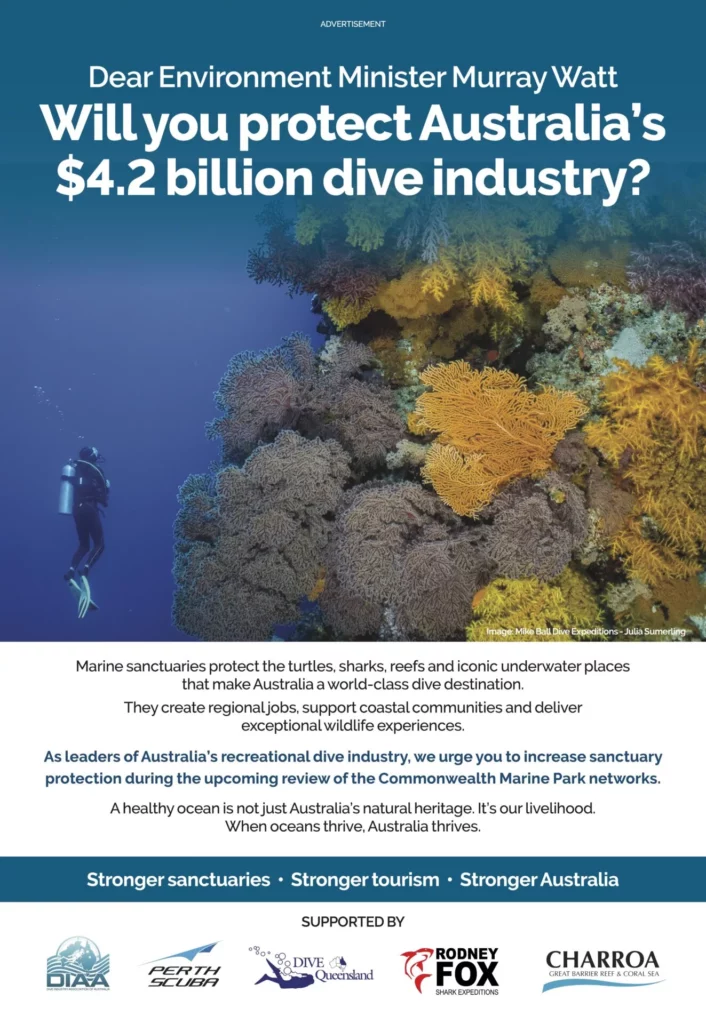
The dive industry has taken out full-page advertisements in major newspapers today, calling on Environment Minister Murray Watt to protect Australia’s $4.2-billion dive industry.