
Scuba air purity is the foundation of a safe dive. Choosing a reputable dive operation with a reliable safety record is important for ensuring your personal safety while diving, even if you rely on them for nothing more than air fills. Having clean air to breathe is one of the basic requirements for sustaining life both above and below the surface, so divers and dive operators alike must be mindful of breathing gas purity.

The Silent Threat: Carbon Monoxide (CO) at Depth
Gas purity is of particular importance to divers and the diving industry because hazards relating to air supply contamination increase in severity with depth. Two molecules of particular concern that must be closely and responsibly monitored in divers’ air supplies are carbon monoxide (CO) and carbon dioxide (CO₂).
CO is an odourless, tasteless, and invisible toxic gas, which makes it a problematic culprit for breathing gas contamination due to the ease with which it can infiltrate gas supplies and remain undetected without careful monitoring and prevention. Read more about how to use portable sensors in our guide to Carbon Monoxide Detection for Divers.The reason CO is a dangerous molecule is because it binds readily to haemoglobin, which is the primary carrier of oxygen in the blood. With lots of CO bound to the blood’s haemoglobin, the blood’s ability to carry oxygen is diminished, which can cause both immediate and long-term health effects related to oxygen starvation in tissues and organs.
CO2 and the Trigger to Breathe: Understanding the Risk
Elevated levels of CO₂ in breathing gas also pose a significant threat to divers because CO₂ is the most abundant potential contaminant present at fill station locations. CO₂ has many of the same characteristics as CO but is unique in that it has an additional oxygen atom, double bound to the central carbon atom, resulting from complete rather than incomplete combustion. CO₂ is essential to life on earth due to the role it plays in photosynthesis. However, in humans, CO₂ is a byproduct of respiration and is the primary mechanism that triggers breathing in our bodies. Therefore, exposure to elevated levels of CO₂ can result in increased respiration, hyperventilation, dizziness, spasms, unconsciousness, and even death. Therefore, it is important to manage CO₂ in breathing gas to ensure it remains below established limits.

Surface vs. Depth: The Physics of Gas Toxicity
The challenge that divers face with exposure to CO and CO₂ in breathing gas is that levels of contamination considered to be within safe limits on the surface become very problematic at depth. For example, a CO reading of 10 parts per million (ppm) at the surface would have an equivalent effect of 60 ppm on a person at 50 metres of seawater. This would be dangerous to divers because according to the US Environmental Protection Agency, the maximum short-term exposure level to CO must not exceed 35 ppm, within a one hour time frame, no more than once per year. Evidently, divers must be very mindful of CO and CO₂ risk, as multiple exposures could easily add up to exceed the accepted annual safe levels recommended to avoid CO and CO₂ poisoning or even death.
Vetting Your Fill Station: What to Ask Your Dive Op
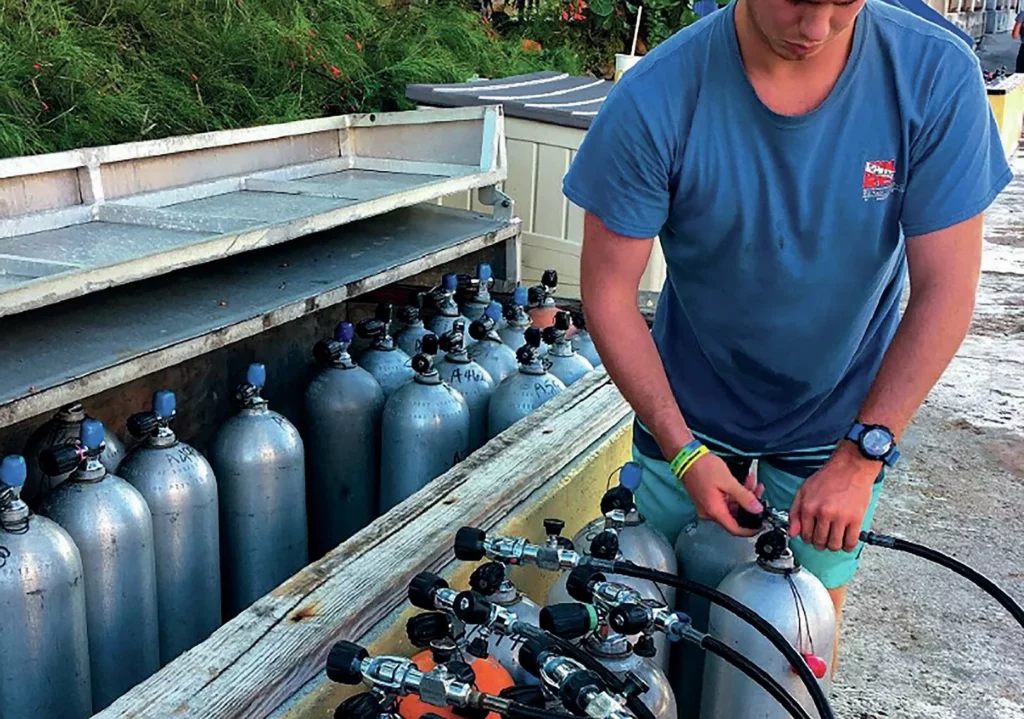
To manage the risks associated with exposure to CO and CO₂, it is important to consider potential origins and their relative proximity to air compressor intake values. Common sources of both CO and CO₂ overlap, so dive operations can generally manage both issues simultaneously with a comprehensive risk mitigation and hazard identification plan for their air fill stations.
As a consumer, it is important to perform a background check on prospective dive operations to gain insight into their risk mitigation procedures and policies specifically relating to cylinder fill stations. Transparency and acknowledgement about where intake and output values are located relative to these potential sources is essential for finding a reputable dive business who will work to keep you safe on your next diving adventure.
DAN is Your Diving Safety Association. Visit World.DAN.org for an extensive range of diving health and safety content.
FAQs
Why is carbon monoxide (CO) particularly dangerous for divers?
Carbon monoxide is an invisible, odorless toxin that binds to hemoglobin much more effectively than oxygen. This prevents oxygen from reaching your tissues. At depth, the increased partial pressure amplifies these toxic effects, making even trace amounts dangerous.
How do carbon dioxide (CO2) levels change during a dive?
While CO2 is a natural byproduct of breathing, elevated levels in your tank can lead to hypercapnia. This causes breathlessness, headaches, and confusion. Like other contaminants, the physiological impact of CO2 increases significantly as you descend.
What is the maximum safe limit for CO in breathing air?
According to EPA standards, short-term exposure should not exceed 35 ppm (parts per million). However, for divers, even 10 ppm at the surface can become the equivalent of 60 ppm at 50 meters, exceeding safe limits.
Can I smell or taste contaminated air in my tank?
Usually, no. Both CO and CO2 are odorless and tasteless. While some compressor issues might produce an oily taste, pure gas contamination is often undetectable without specialized testing equipment or sensors.
How can I check if a dive center has clean air?
Look for up-to-date air quality certificates posted near the fill station. You can also ask about the location of their compressor intake (it should be away from exhaust) and how often they replace their filtration filters.
This article was originally published in Scuba Diver Magazine
Subscribe today with promo code DIVE1 — enjoy 12 months for just £1!
