
Alex Mustard takes a look at the highly rated Backscatter XTerminator software
Photographs by Alex Mustard

What is the hottest product in underwater photography right now? Well, it is not a camera, strobe or lens, but a piece of software. Software that you can’t take underwater and doesn’t even run on its own – it works as a plug-in within Photoshop. Yet despite these preconditions, it is so usable and capable that it gets my vote as THE item to spend your hard-earned money on. How much money? Well, it is still available at its introductory price of US$179.95.
What Is Backscatter XTerminator?
The software is called Backscatter XTerminator (known as BSXT to friends) and it cleans underwater images of all those specs and blobs that light reveals when we take pictures through water. The reason it is so exciting is that traditional backscatter cleaning is tediously slow and/or gives obviously fake results. This new software offers one-click simplicity, almost instant results and produces clean pictures that are so perfect that even an expert eye would never know the subject or the background had been previously plagued with the dreaded backscatter. It is revolutionary.
Why Backscatter Is the Underwater Photographer’s Enemy
Backscatter is the underwater shooter’s longstanding nemesis and it can never be totally avoided. Backscatter is caused when particles in the water reflect light back towards the lens which show up in our pictures. Unless we’re diving in filtered Evian, water will always have particles in it and we always need light for photography, so there will always be backscatter. But don’t stress, backscatter is a natural part of pictures and as long as it isn’t epidemic, most people never notice it. Despite this software making cleaning a one-click job, nobody ever said that underwater images need to be antiseptically clean!
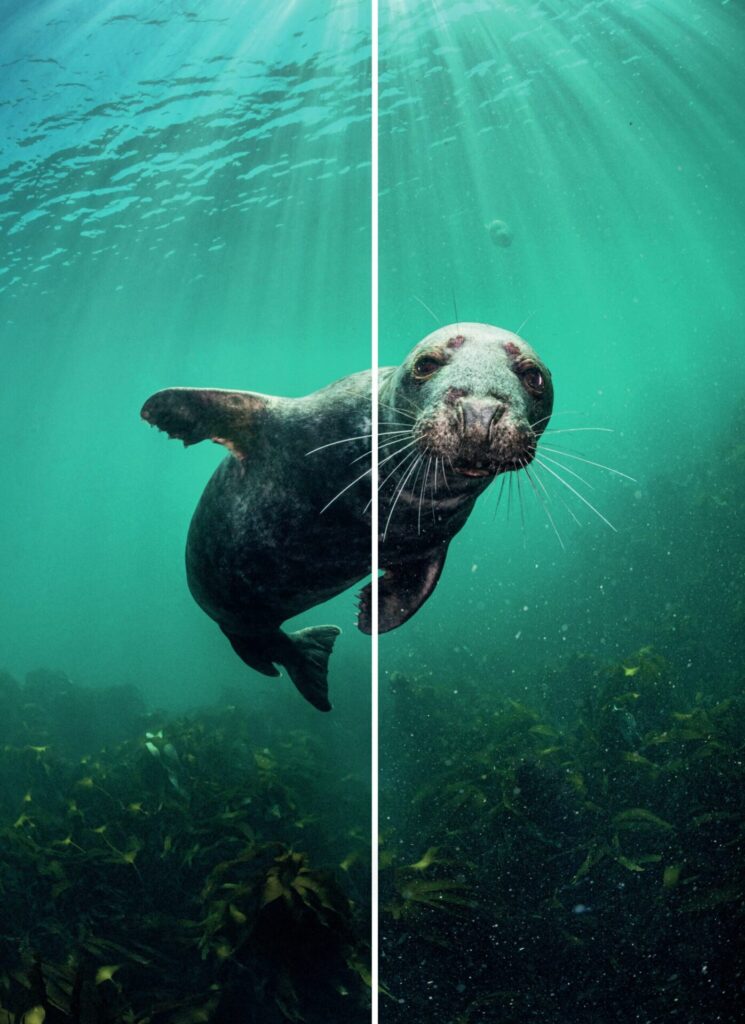
That said, backscatter is particularly noticeable when we use strobes and shoot through poorer visibility. At best it distracts from the subject; at worst it obscures it killing the image – something we diagnose as terminal backscatter! Strobes produce lots of light and particles close to the camera and reflect the light back to the camera looking like bright pinpricks while more distant ones show up as blurred aperture shaped blotches. The good news is BSXT deals with both, blending them away without a trace.
In-Water Techniques to Reduce Backscatter
There are lots of in-water solutions that will minimise backscatter. We can’t decrease the concentration of particles in the water, but poor in-water skills can increase them! Good diving skills such as buoyancy control, trim and fin awareness really make a difference to scatter free shots. However, while we can’t reduce the concentration of particles, we can decrease the number between us as the subject by simply moving closer. I know it sounds obvious, but it is the number one, best way to reduce backscatter and is often overlooked as photographers confuse themselves trying ever more elaborate strobe angles. The best ‘technique’ when trying to minimise backscatter is not some magic trick, it is to simply shoot to the conditions. For example, when shooting fisheye, I will shoot big scene wide angle when I am lucky enough to be in clear water, however, in low vis, I will limit myself to close focus wide angle images.

Strobes are a major cause backscatter and while we need strobe light to illuminate the subject, we don’t need it spraying everywhere. You can avoid strong strobe flare backscatter by keeping them pulled back from the subject. Most underwater strobes are set up to cover a very wide area, and especially when shooting macro we really don’t need this. You can restrict the amount of light you spray around by going to a single strobe, or fitting beam restrictors to narrow the beam. Finally, backscatter shows up most clearly against a brilliant black background, so when conditions are bad, we can make it less obvious by shooting against brighter surroundings, such as the seabed or using a longer exposure to burn in the water colour.
All that said, one thing that unites all underwater photographers is we all get backscatter in our images. Sometimes it is the fault of the conditions, sometimes our fins, sometimes our technique is lacking, or sometimes we know the shot will be spotty, but the subject is so exciting that the right decision it to click that shutter. This is where the XTerminator comes in. BSXT was developed by Erin Quigley and Bruce Warner, and I’m pleased to say I’ve dived with both of them. Erin is the world’s leading teacher of post-processing for underwater photographers, through her popular platform Go Ask Erin. Erin knows Lightroom and Photoshop inside out, but she has a unique talent for demystifying the complexities of the software in terms photographers understand and remember. Bruce is a keen underwater photographer whose day job is astrophysics. Astronomy images are often de-starred so the main features in the night sky can be seen. And Bruce knew Russ Croman who developed RC Astro software to do this job. The three of them teamed up to see if the RC Astro software could be reprogrammed and the AI retrained to take on underwater backscatter and after several years of development, we have BSXT.
How Backscatter XTerminator Works in Photoshop
BSXT is set up to run as an action in Photoshop, so you just click play and watch the magic happen. You are then left with three layers – the original as the Background, the middle layer called BSXT is the result of the extermination, and an empty top layer called Cleanup. The cleaning level of BSXT is well judged, but these three layers give you the flexibility to fine tune. If the cleaning has gone too far, you can simply use the layer mask on the BSXT layer to return certain areas to the original state or fade the entire layer so the overall cleaning effect is still there but less obvious. Some contests do not allow backscatter removal, but there are currently not any rules about fading backscatter to a lower level!
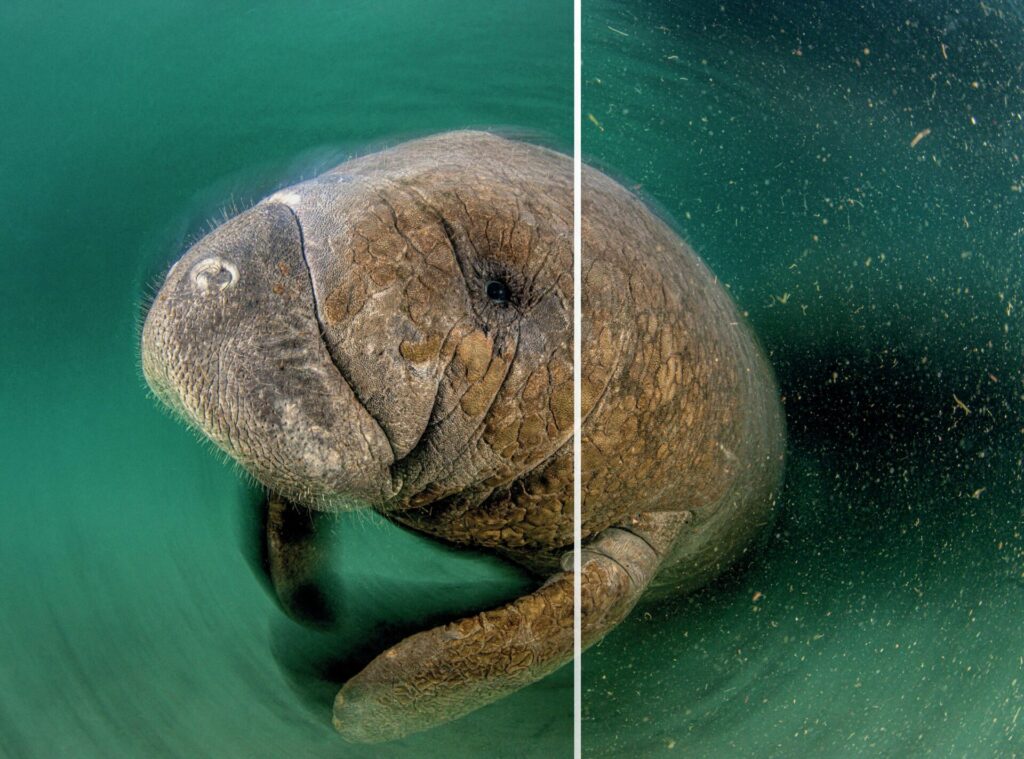
BSXT does amazing with most subjects, but I find it gets confused by small schooling fish and spotty fish, like morays, coral grouper and eagle rays. In these rare cases it is the work of a couple of seconds to brush any lost detail back in. BSXT will leave spots that it isn’t sure about, and this is what the Cleanup layer is used to correct. In this layer you can select the Remove tool and simply spot away anything that still needs to go. Then with backscatter removed, you can flatten the layers and get on with any other processing.
Real-World Performance and Limitations
Does it work? Yes, and then some! I can say more than six months on, I use this software on almost every image. Most of the time it is perfect straight off, saving so much time over traditional backscatter cleaning and producing a more natural result. Even when the original might only have a few specs, it is quicker to run BSXT. The software uses AI to differentiate subjects from backgrounds (while cleaning both) and is occasionally confused, especially by frames filled with lots of fish. But that never stops me trying it.
Final Verdict from Alex Mustard
More than 9 out of 10 it is perfect or very close to perfect straight out of the box. And when you have problem pictures, it is miraculous, doing a better job in one click than I could do in 1000s of clicks and several hours of my time. As someone who processes a lot of underwater photographers, that makes it a total must-buy.
Even problem pictures can be magically rescued with the BSXT software
Frequently Asked Questions
What is Backscatter XTerminator?
Backscatter XTerminator is an AI-powered Photoshop plug-in designed to automatically remove backscatter from underwater photographs.
How does Backscatter XTerminator work?
It runs as a Photoshop action, creating editable layers that remove backscatter in one click while preserving natural detail.
Is Backscatter XTerminator worth the money?
According to Alex Mustard, it saves hours of editing time and produces more natural results than manual cleaning, making it a must-buy tool.
Does Backscatter XTerminator work on all underwater images?
It works exceptionally well on most images but may occasionally struggle with dense schooling fish or spotted subjects.
Can Backscatter XTerminator be used in competitions?
Some competitions restrict backscatter removal, but fading the effect may still be permitted depending on contest rules.
This article was originally published in Scuba Diver Magazine
Subscribe today with promo code DIVE1 — enjoy 12 months for just £1!
