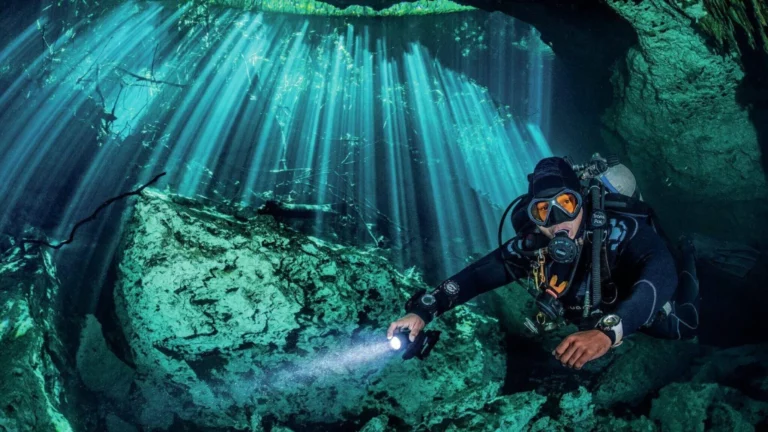
Alex Mustard focuses his attention on how to capture underwater sunbursts.

Finally, the rain has come! And I think I was as pleased to feel it splashing on my head as my yellow-dustbowl of a lawn. I think that the last time I experienced rain was back in June, before I went to the Red Sea.
There have been a few breaks in the gloriously sunny weather this summer, but they came while I was on hols in Sardinia. So I think it was over ten weeks since I last experienced a cloudburst, drizzle or any sort of precipitation. As an Englishman, I have been very much outside my comfort-zone with all this sunshine! The sun can also scare underwater photographers. It is not for nothing that it is nicknamed the ‘white ball of death – WBOD’ for its ability to kill a photo. But captured correctly, underwater sunbursts add ethereal beauty and an enchanting underwater feeling transforming an everyday shot into an attention-grabbing, almost-magical photograph.
The Secret Ingredients for Perfect Underwater Sunbursts
Time and again, when I show a beautiful sunburst images, I am asked the same question. And it is the wrong question. “What were your settings?” Camera settings are important, but contrary to popular belief, there isn’t a magic formula hidden in your camera’s menus that transforms the WBOD into radiant sunrays and a stunning sunball. Instead, the two most-important ingredients are unrelated to our camera – they are the prevailing conditions and the depth at which we choose to shoot.
Optimum conditions obviously involve having the sun shining, but equally important is having a smooth water surface. Windy conditions ruffle the sea’s surface, and underwater this breaks up the sunburst and preventing the beams from forming those all-important attractive rays. Larger waves and swell aren’t problematic as long as the surface of the water remains smooth. So as well as waiting for the sun, I am also waiting for those special mill-pond days, when the water is smooth.

Patience is a virtue, but good things also come to those who look for them. Many tropical dive destinations are exposed to easterly trade winds, so dive sites on the protected western sides of islands prove the smoothest water. Additionally, as the land heats up faster than the sea each day, breezes develop, with winds blowing from mid-morning to late afternoon. The calmest conditions and best sunrays are usually at either end of the day. The Red Sea is often windy, the average windspeed in Hurghada, for example, is above ten knots year round! This is where small-scale topography and other obstacles for the wind can create valuable pockets of smooth water, ideal for underwater sunbursts photography.

The steep sides of protected inland dive sites, especially old quarries, provide this type of shelter. Similarly, a large liveaboard can create a small patch of millpond even in blustery conditions. The high cliffs around Sharm El Sheikh protect coast dive sites and provide one of my favourite places for both split level and sunburst photography.
The more you seek these conditions, the better you become at predicting them. There are often great sunbursts waiting in locations where coral grows right to the surface and where marine life clings to submerged walls of steep-sided islands, such as around the limestone rock islands of Raja Ampat. When on a liveaboard, spend a few minutes observing the terrain, the position of the sun and conditions between dives to plan your diving and photography accordingly.
Diving Shallow: Avoiding the “Cyan Halo”
Attractive sunrays can be photographed in warm and cold, salt and fresh, and clear and murky water when the conditions are right, but not at all depths. While the sun can still be used in deeper photos, it won’t produce attractive rays at depth. Staying shallow is crucial because sunrays become increasingly defocused with depth. As they pass through water, their light scatters in all directions, weakening them.
Another reason for staying shallow is that the sun’s light becomes increasingly blue with depth, and this affects how the edge of sunball looks in our pictures. The sun is bright and we should expect it to overexpose as white in our photos. But the deeper we go, this white sunball is increasingly surrounded by an unattractive cyan-halo or partial overexposure. Underexposure (usually by increasing the shutterspeed) will shrink the ugly halo, but it will simultaneously darken the water and make light beams less visible. Post-processing also really struggles to deal with the halo, so the best advice is to avoid it by diving shallow.

Radial vs. Dappled Light: Timing Your Dive
That said, I will include the sun in my photos at any depth for additional contrast and as a focal point. However, I know that for a beautiful sunball and sunrays, I dive need to shallow. The ideal depth depends on the sun’s height in the sky, which varies with time of day, latitude, and season. When the sun is high in the sky, such as midday in the tropics, I stay in the top 10m to capture its best. In these conditions, the sun creates symmetrical beams known as radial light. When the sun is low in the sky, I dive much shallower, as the best sunrays are seen in the top 3m. This type of underwater sunbursts, known as dappled light, is attractive because it travels through more atmosphere, giving it a warmer colour and small waves split the light into layers of golden rays. But remember you really do need to be shallow – safety stop depth is too deep – if you want beautiful dappled light you need to dive for it! Dappled light is often associated with evening light, but early risers or those diving on sunny winter days at high latitudes can find equally stunning dappled light at midday. One of my favourite times and places for spectacular dappled light is a winter’s day dive at a sheltered inland site in the UK and is a nice reward for braving the cold.
Find all of Mustard´s Masterclasses on here
Mastering Exposure: Beyond the Camera Settings
While there are no magic settings for capturing underwater sunbursts, getting the right settings is important. The sun is the brightest object in our solar system, so you will likely need a fast shutter speed and a closed aperture for the correct exposure, but the exact numbers are not critical. Avoid underexposing too much and instead adjust your composition so the sun rays are the brightest feature in the frame. I try to hide the brightest part of the sun slightly out of frame or behind something in the frame, which gives the strongest beams.
The key to creating world-class underwater sunbursts is not relying on a secret camera setting but reading the conditions, and when they are right diving for sunbursts, because they have the power to transform a good underwater image into a great one.

When on a liveaboard, spend a few minutes observing the terrain, the position of the sun and conditions between dives to plan your diving and photography accordingly
FAQs
What is the “White Ball of Death” (WBOD) in underwater photography?
The “White Ball of Death” is a nickname used by photographers for a sunburst that has overexposed into a solid, featureless white blob. Capturing a true sunburst requires balancing exposure to turn that “white ball” into attractive, radiating light rays.
What are the best water conditions for capturing sunbeams?
The most critical factor is a smooth, “mill-pond” water surface. While large swells are fine, wind-ruffled surfaces break up light rays. Look for sheltered bays, the leeward side of islands, or inland sites like quarries to find the calmest water.
At what depth should I shoot to get the best sunbursts?
To capture clear, sharp rays, you must stay shallow. Sunbeams become defocused and weakened by light scattering as you go deeper. For the best results, stay in the top 10m for midday sun and within the top 3m for “dappled” evening or winter light.
Do camera settings matter most for underwater sunbursts photography?
While settings are important, Alex Mustard emphasizes that prevailing conditions and depth are more vital. You will generally need a fast shutter speed and a closed aperture (high f-number) to manage the sun’s brightness, but no setting can fix poor surface conditions.
How can I avoid the “cyan halo” around the sun in my photos?
The “cyan halo” is caused by light being filtered through too much water. To avoid this unattractive blue ring around the sunball, move into shallower water. Post-processing often struggles to fix this, so getting it right in-camera by staying shallow is key.
This article was originally published in Scuba Diver Magazine
Subscribe today with promo code DIVE1 — enjoy 12 months for just £1!
