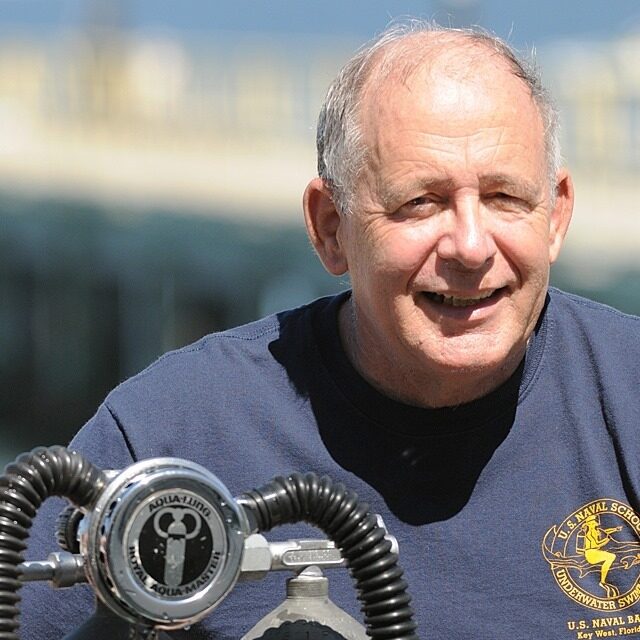
Bernie Campoli is best-known for his work filming the ground-breaking Sealab I aquanauts in the 1960s, though for him that was just one of many memorable scuba-diving assignments. He died yesterday, and to mark this remarkable diver’s passing STEVE WEINMAN posts a previously unpublished extended interview with him from last year
Veteran scuba diver Bernie Campoli died on 4 December at the age of 86. “He lived a remarkable life,” says his daughter Andrea. “He was a pioneer in his field and made his passion into a career. He touched countless people and we are deeply grateful to everyone who walked beside him through his life journey and honoured him along the way.”

Born on 2 March, 1939, Bernie would become the last surviving member of the Sealab I underwater habitat team from the 1960s. He had started scuba-diving 69 years ago, his first underwater photo was published in a magazine in 1955 and by 1958 he had set a world record for submerged endurance.
Enlisting in the US Navy in 1961, he would record President Kennedy’s fleet visits, test the MK VI semi-closed rebreather and film the commissioning of the Alvin and Archimedes deep-ocean research submersibles and NASA’s Mercury, Gemini and Apollo space missions. It was in 1964 that he immortalised the Navy’s pioneering Sealab I saturation diving mission (see below).
“Locking out” is a procedure in which Navy SEALs exit from a submerged submarine with their mission equipment. Bernie was the only underwater photographer routinely locking out of Navy nuclear submarines – he did it more than 70 times, from 10 different subs.
As a scientific and technical photographer at the Naval Coastal Systems Laboratory he documented military mine counter-measure systems in air and under water, and hovercraft development. He also worked for the Smithsonian Institute on coral-reef film The Sea – A Quest for the Future.
With the Ocean Systems submersible department in California he worked on the Mk 1 Deep Dive System, and his underwater footage featured in two Emmy award-winning The Twentieth Century programmes.
Bernie continued to dive recreationally, and last summer spoke to me at length on the 60th anniversary of the pivotal Sealab I project, on which the conversation naturally centred.
Setting a marker in ‘58
You might have guessed that the 19-year-old Bernie Campoli would turn out to be a rugged individualist when, in 1956, he volunteered to see how long he could remain submerged on open-circuit in the chilly waters of a limestone quarry in Hamburg, New Jersey.
“Seemed like a good idea at the time,” explained Bernie. “I was working in a dive-shop, and somehow it came up.”
The centre had been conducting its open-water courses in the flooded quarry. “There was a guy called Ed Fisher down at Florida Keys who had stayed down for 24 hours while testing a new regulator, so I knew it was do-able.
“I started with another guy but he choked on some food and went up. I hung in there. I had a little platform suspended from the surface at about 15ft. They’d bring down tanks for me. But also close to the pond we had a little building with hot-water heaters, so once in a while they’d bring a hose down and I’d stick it in my suit. Felt pretty good.
“I pretty much stayed on the platform but I knew that quarry so I wasn’t bored, I’d swim around.”
Bernie emerged the following day, having set a world record for underwater endurance of 30 hours, six minutes. “Record lasted a couple of years,” he said.
This was in July 1958, when Bernie had already been using an Aqualung for a couple of years, diving deep Atlantic wrecks like the Andrea Doria – a recent loss at the time.
Setting up Sealab I
The quarry exploit was just one of many waypoints in Bernie’s extraordinary diving career, but I was talking to him because it was the 60th anniversary of the 1964 Sealab I project, when for the first time divers had spent more than a day or so in an underwater habitat, and a deep one. As an established underwater photographer, Bernie had been their official chronicler.
A 60th anniversary commemorative event held at The Man in the Sea Museum in Florida in the summer of 2024 had brought encounters with many old friends, though sadly those pals could not include the four Navy divers who had earnt the title “aquanaut” by spending 11 days submerged on Sealab I: Robert Thompson, Lester Anderson, Bob Barth and Sanders Manning.
Astronaut Scott Carpenter had been set to join them on Sealab I, but a scooter accident on Bermuda in the run-up to the experiment had shattered that dream. He would later set a record of 30 days under water on Sealab II but, like the other four, he has since passed on.
“I’m the last man standing from SeaLab I,” said Bernie ruefully. “I filmed it when I was 25 and I’m 85 now.”

Sealab I was the first of a series of US Navy Special Projects Office experiments designed to prove the viability of saturation-diving over extended periods of time.
The programme had been preceded in 1962 by Edwin Link’s 61m-deep Mediterranean habitat, where Robert Stenuit had spent more than 24 hours submerged and, a week later, Jacques Cousteau’s two-man Conshelf I, also in the Med but only 10m deep, and Conshelf II the following year in the Red Sea. “I got to know Cousteau a bit in the ’50s,” Bernie told me.
What remained uncertain in 1964 – to Cousteau, Stenuit and everyone else – were the psychological and physiological strains that might affect humans living at depth for considerably more than 24 hours.
To find that out, Sealab was the brainchild of naval senior medical officer Dr George F Bond, who had worked with Cousteau and whose Genesis Project had been researching the effects of gas under pressure. Commanding Sealab I from the surface, Bond was known as Papa Topside.
The habitat itself, constructed from converted floats held together by railway axles, was initially tested to about 18m off Florida using animals and then humans, before being lowered to a challenging depth of 59m way off Bermuda, on 20 July, 1964.

The four aquanauts were to spend 21 days submerged, though a tropical storm caused the mission to be aborted after 11 days. That was considered enough to prove the viability of sat-diving in the open ocean for extended periods, however, and provided useful data on perceived challenges such as communications in a helium atmosphere.
Mild discomfort from joint aches had slowed the men down during their first few days submerged, but these cleared and were not considered a serious obstacle.


Remaining problems would be tackled in 1965 when the better-equipped Sealab II was launched off California. In 1969 it was refurbished to become SeaLab III and ventured three times deeper, though the programme would sour with the death of one of the aquanauts.
‘Now it’s called a safety stop’
Sealab I is still considered a pivotal diving event, and it was Bernie Campoli’s task to film the mission. “There were no more than eight diver-photographers in the Navy at that time, and there wasn’t much gear,” said Bernie. “The gear we had was primitive by today’s standards.”
It was at the Navy Underwater Swim School, where he also underwent Underwater Demolition Team and SEAL training, that he had earnt the official designation Navy Photographer/Diver. Assigned to the Atlantic Fleet Mobile Photographic Group, he was also a member of its underwater stills photo team.
“We had a lot of work,” he said. “I was only in the Navy on active duty for four-and-a-half years but in 1964 we got committed to work on Sealab and came down here to Panama City in May when it had its unveiling.
“They took it out to sea for the first time and we filmed it here and then joined it in Bermuda in July to cover it topside and under water. I did most of the underwater stuff.”
From his first meeting with the aquanauts they became life-long friends, said Bernie. “Bob Barth and Sanders Manning had been involved with the Genesis Project but Bond and Anderson had done chamber dives – they’d actually done one to 200ft [60m].”
The assignment was very different from shadowing President Kennedy, though Bernie seems to have regarded the repetitive 60m air-dives as all in a day’s work, and remained convinced that youth allows divers to get away with a lot.
“I did daily dives to just shy of 200ft and logged 18 dives. There were a lot of things we would end up doing just on open-circuit scuba, using an Aqualung twin-hose.
“Besides the camera there was a lot of lead around, pieces of 10 or 15lb [4.5-6.8kg]. My trick was to put the weights on a loop of line around my elbow, so I’d be down at the bottom in, say, 45 seconds.
“If you swam a lot you’d get nitrogen narcosis, and I’d feel the effects after eight minutes or so, but if anybody tried to swim down with me or later showed up, I could tell if they were not quite right. Now the Navy limits you to 130ft [40m] on scuba.
“I would be pretty clear-headed until just about before coming up. I was told I would feel the effects when my lips felt like 850 inner tubes or something, but being 25 had something to do with it, and I’d been doing a lot of diving before that.
“We’d usually squeeze out a 10-minute dive but we’d stop on the way back at 10ft [3m], which wasn’t in the books. Now it’s called a safety stop.”

Outside looking in
The footage showed the aquanauts either working outside the lab or inside, taken through the windows. “I’d put my head up in there every once in a while and yell something to them, but that was about the closest contact.”
Outside the habitat the aquanauts would spend up to six hours a day working on the seabed, feeding and photographing fish, or positioning and checking measuring devices. It was claimed at the time that they were able to complete as many tasks in their 11 days submerged as scuba divers operating from the surface would have completed in a year.
Like astronauts on a spacewalk they kept fairly close to Sealab and linked to it by safety lines, venturing no more than 140m out and keeping it in sight at all times.
“The hard part was trying to co-ordinate with when the guys were going to be out doing something,” Bernie told me. “In the photos you can see them coming down with a cooking pot you could put stuff in, and later we made a clothes-line from the surface to the bottom so you could send stuff down.
“One key shot when the habitat was on the bottom was when the bell came down and the four divers came over and entered the SeaLab I. That’s a complete sequence that took a little planning and timing.
“The footage I shot in Bermuda has been used many, many times, including on the PBS special on which, if you look closely, they gave me a credit line,” said Bernie. “Which nobody else did!”
At the time the US Navy specified 35mm film for use both topside and under water. “The housing I had was called a Samson, and it held a Bell & Howell Eyemo that dated back to WW2, with a modified 400ft magazine, which would run for about 12 minutes.
“In the water it was fine, it was beautiful, you could swim with it. It had a rear-view port, you could look through it and see the viewfinder, so diving you could hold the thing up to your head, clear your ears and so on. By today’s standards, it was pretty primitive.”
The rugged and compact motor-driven Eyemo had been introduced in 1925 and remained in production through the 1970s.
“That was about the time the Nikonos 1 came along, so you could put it around your neck and also shoot stills, which is what I did, primarily black and whites.
“I have shots at the bottom with 192ft (58m) of available light. It was an incredible spot to dive, real clear water and, when you broke the surface, you could still spot the SeaLab at the bottom. A lot of sea-life too.
“I got to go back there a few years later after I got out of the Navy and was working on a small submersible called the Cubmarine.”

How had the aquanauts felt when the mission was aborted by bad weather? “I think they’d had enough at that time. They’d proved the whole theory of the first open-ocean sat-dive.”
Remembering Sealab
As mission photographer, Bernie was honoured at a banquet at the 60th anniversary get-together, alongside aquanauts from the final official part of the programme on Sealab III.
Guest speakers included Aquarius aquanaut Fabien Cousteau, whose own Proteus Ocean Group hopes to have underwater habitats operating within the few years and who Bernie had known since the 1980s, and oceanographer Dr Sylvia Earle.

Sealab I was on display at the Man In The Sea Museum in Bernie’s home town, Panama City, as was a cake featuring a little diver with a big camera on top – “and that’s a model of me, which I laughed my ass off at!” he said.
Over the weekend he presented a history of SeaLab I, covering its afterlife. “It started off surveying buoyancy tanks for a mine-clearing project. It flooded out twice, once off Panama City and once off Bermuda, and then it was used for unmanned testing, and was flooded for about 10 years.
“I was part of the crew that salvaged it in 1980, brought it ashore, sand-blasted it, then took it back to the beach, where they cut its legs off.
“It had a hard life – it looks better nowadays. It’s outside all painted up again, with a lot of other gear in the parking lot, including the Mk 1 Deep Diving Unit.

Bob Barth had gone on to be involved with the new, double-sized SeaLab II in California in 1965, staying submerged for two weeks but ultimately requiring a rescue. “I was involved in the training for the rig we used and did some preliminary dives, but then I was temporarily assigned,” said Bernie. This became permanent, but he had “kept up with the programme”.
After Sealab III (where five teams of nine aquanauts were to spend 12 days each on the habitat at 60m) in 1969, and the death of aquanaut Berry Cannon – attributed to CO poisoning through rebreather scrubber error while working for a long period on amphetamines to repair a helium leak – the Sealab programme was cancelled.
It was however rumoured to have continued as a clandestine Cold War espionage operation, and there had been other whispers of sabotage by an unstable individual onboard the mothership. “Yes, it’s been a controversial thing,” agreed Bernie.
“One of the presenters at the get-together, Kevin Hardy, has done a terrific amount of research and believes Cannon was electrocuted. I also talked to Richard Blackburn, who was the guy who saved Cannon’s buddy Bob Barth and recovered Cannon’s body, and he agrees totally. The theories didn’t go away.”
Bernie had a lot of yarns, and a habit of darting off down unexpected side-alleys. Discussing Fabien Cousteau’s shark-shaped one-man submersible led him to reminisce about the now-banned pursuit of shark cage-diving in Guadalupe, Mexico.
He had done a lot of this because, as he said, for an underwater photographer it was irresistible – though I felt that some of his memories might not land well with those he termed “shark-huggers”.
Would he have liked to be an aquanaut himself? “At Aquarius I did a lot of surface diving. I never got saturated and it was only 70ft (21m) deep but I had enough time to photograph the divers and a lot of sea-life there. But I would have loved to have done one of their five- or seven-day sats.”

Bernie was still scuba diving “but it’s kind of frustrating – I’ve got the best gear I’ve ever had but I’ve got this arthritis nagging me now. I don’t know why, I’m only 85.”
That had not stopped him helping his friend, the noted photographer Steven Frink, run underwater photo workshops on the Florida Keys. “And I’ve got a place north of here, a real clear spring, where I’ve shot a lot of product photography.”
Plank-owner and proud
Finally, I wanted to know what Bernie considered the highlight of his long career – though I thought I could guess, from the way he kept returning to one particular fascination.
“After I got out of the Navy I worked with the Mk 1, and that was a big project,” he said. “My background was with the Underwater Demolition Team, which became SEAL Teams, and it was about SEAL delivery vehicles, crewed submersibles.
“It was about 30ft long and 9ft down with three modules, one of them a hangar that you put these little wet subs in, and you could put up to 20 pissed-off SEALs into it. Then you locked up from the sub to the centre module – the forward one was like a medical dock.

“I worked with that from its inception in ‘82. I would shoot it, edit it in my studio in Panama City and get it out to help sell the programme. I was working off and on for nearly 20 years on it, until 2000. That came under Navy special warfare and they gave me a civilian medal for my work.
“Of course, it didn’t endear me to the people I reported to. I would be in Hawaii or Puerto Rico, and I’d come back from doing all the work and they’d say: ‘How was your vacation?’ So I’d say: “You didn’t see my ass hanging off a submarine underway under water!” Bernie chuckled.
“Do you know what the term ‘plank-owner’ means?” he asked me. “It goes back to the days of shipbuilding when the guys who laid a keel were called plank-owners.
“So I’ve been a plank-owner on a lot of projects, and I reckon that’s the best time to be involved – because after that they would go on to make up a lot of useless rules!”
Thanks to Steve Mulholland, executive director of The Man In The Sea Museum in Panama City, Florida, for his help in illustrating this feature.