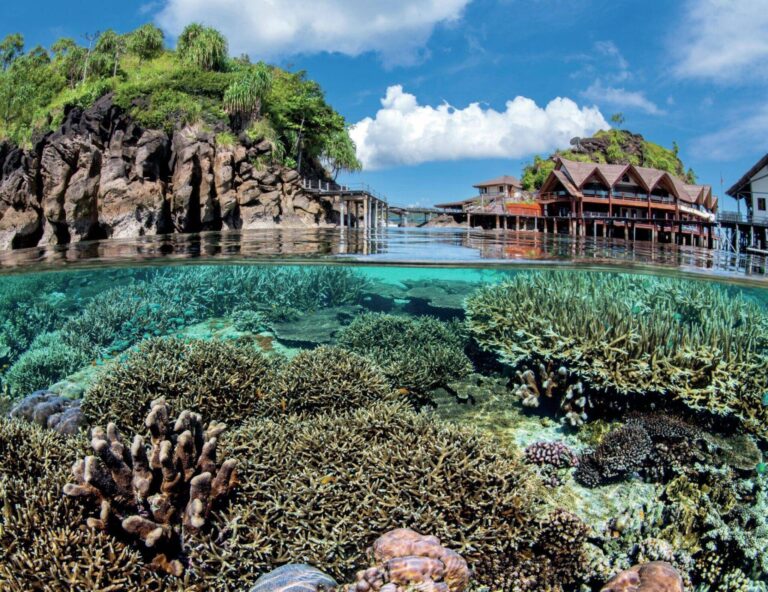
Alex Mustard takes a closer look at photographing hard corals, and offers some suggestions on the best way to shoot them
Photographs by Alex Mustard
Why Hard Corals Deserve the Spotlight
In my formative years, nobody paid any photographic attention to the stony corals that built the reef. The experienced shooters of the day would actively advise you to swim past them in the hunt for colourful soft corals that would create a rich splash of eye-catching colour on your Velvia. But perceptions change. Most divers have now seen degraded reefs, dead corals where once they thrived, and flourishing hard corals have become something to be treasured and celebrated.
I once asked David Doubilet whether he had old images of coral gardens, hoping to be able to revisit the same spots to show change. While he had some, he didn’t have many. “We never thought to shoot the corals, it would be like a safari photographer shooting the grass!” His point was that hard corals seemed so unchanging, so enduring, that they was no story to tell. Yet once we all realised how much there are struggling, they have switched from being background to a priority subject. This month’s column suggests some techniques for shooting them.

My own transition started in the spring of 1998, in the Maldives. This was deep in the era of slide film and during the trip I’d make use of the island’s expensive E6 processing to develop an occasional roll of slide film to check all my gear was working properly. I got my slides back and was worried because the hard corals seemed overexposed. I’d not really noticed it underwater, but lit with flash and shot with my usual settings and the corals were almost white. I started to pay more attention underwater and with each day the change was increasingly obvious. By the end of my trip the reefs looked as if they had just received a fresh snowfall.
I later learned that this was coral bleaching and I was in the middle of the largest bleaching event ever seen (at that time), which is estimated to have killed up to 90 per cent of coral in the region. There are very few records of mass bleachings before that 1998 event killed many corals more than 1,000 years old. Yet now, they come most years, even to reefs that are well away from the equator. And year on year, it makes me increasingly motivated to record reef building corals in all their glory.
Subject selection is a critical step for compelling coral images because, let’s face it, corals are not as exciting as baitballs or cetaceans! We have to maximise everything to grab attention and the two factors at the top of my shopping list are density and diversity. For spectacular coral shots I am seeking out areas with high, if not total, coral cover to produce a ‘wow’ shot. That said, I also want variety in my picture.
Mastering Light: Crossed Strobes and Texture
A mixture of different shapes is far more interesting than monotony. Usually this comes from biodiversity, a section of the reef dominated by a variety of species, but it might also be an area where one coral species has grown into different sized, shaped and coloured colonies. Corals are defined by their hard, lumpy morphology, so crossed strobes lighting is my go-to technique. Crossed strobes is essentially double side lighting, which creates lots of texture on the subject, while simultaneously evenly illuminating the scene.
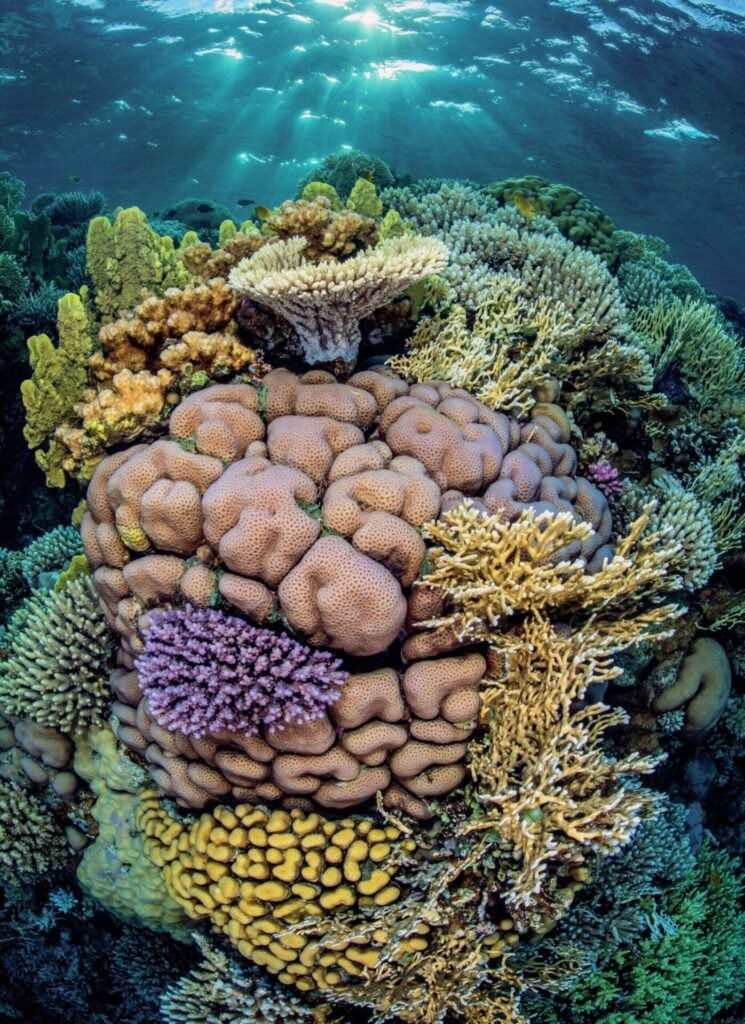
This lighting style only works when we are close to the subject, because the effect is created by the angle of the light that produces lots of small shadows around any knobbles, grooves, branches or plates in the coral. And it is these small shadows that reveals the texture in the final shot. The set up is simple – push the strobes out wide and then angle them back in at the subject. But it is important to look for a coral formation with space around it, so you can manoeuvre the camera rig into position with such a large wingspan.
Photographing Hard Corals and Gardens with Natural Light
When shooting large expanses of coral garden it is better to use strobes more subtly, or not at all. Available light shooting often suits these bigger scenes, creating a vibrant image with a naturally fall-off of colour with distance. I also like to do these images with a low level of strobe, combined with switching my camera to Underwater Auto White Balance. This technique also gives great colour throughout the frame, but with a little extra punch in the foreground.
Capturing the Magic of Coral Spawning
While corals are animals they aren’t the most active species, save for one night each year when they spawn. Mass coral spawning is one of the wonders of the oceans and if you are lucky enough to witness it, you are immediately a member of a very select club.
”Available light shooting often suits these bigger scenes, creating a vibrant image with a naturally fall-off of colour with distance”
The world had been introduced to Star Wars and Indiana Jones before marine biologists learned that corals reproduce in spectacular synchronized mass spawnings, and shots remain rare. It is a challenging event to shoot because an individual coral may only spawn for a few seconds each year, and it often happens late at night, meaning we need to be well prepared to get pleasing pictures.
Listen to briefings, learn to recognise the key species and the signs that a coral is about to spawn. Shooting macro is much easier than wide angle at night and is the better option on your first coral spawning dive. But wide shots will really tell the story best. Coral spawning dives usually have a period of waiting, use this to plan your shots and perfect your settings and then stick to these compositions when the action starts.
Documenting Coral Challenges and Conservation
These days it is impossible to talk about corals without mentioning the challenges facing reefs, and taking and showing such images is a way we can help. Coral bleaching, caused by global warming, is ever more common and bleached corals and anemones are important images to capture. Frustratingly these images don’t always work well in isolation, since bleached corals look pretty and we often need to show healthy and bleached shots when presenting these to the public. Coral diseases have also been devastating, especially in the Caribbean, where most have a human link.
Fortunately, lots of people care about corals. So coral restoration programmes, including coral propagation on trees and the planting out of new colonies, is something that we can document. While it is valuable to document the challenges facing corals, it is also important to give people hope, by mixing in stunning reefscapes and telling the stories of those working to help corals have a future. n

Frequently Asked Questions
Why are hard corals important subjects for underwater photography?
Hard corals form the foundation of reef ecosystems. Photographing them helps document reef health, biodiversity, and the impact of environmental change.
What are the best lighting techniques for capturing hard corals?
Crossed strobes are ideal for revealing coral texture and structure. For wide scenes, natural or low-level strobe light creates vibrant, realistic results.
How can photographers make coral images more visually interesting?
Focus on density and diversity. Combine multiple coral species and shapes within the frame to create a dynamic, colourful composition.
What challenges do photographers face when shooting coral spawning?
Coral spawning happens only once a year and lasts seconds. Preparation, macro setups, and recognising pre-spawn signs are key for success.
How can underwater photography raise awareness about coral conservation?
Images of bleaching, disease, and restoration efforts communicate reef decline and hope for recovery, motivating conservation and climate action.
This article was originally published in Scuba Diver Magazine
Subscribe today with promo code DIVE1 — enjoy 12 months for just £1!
