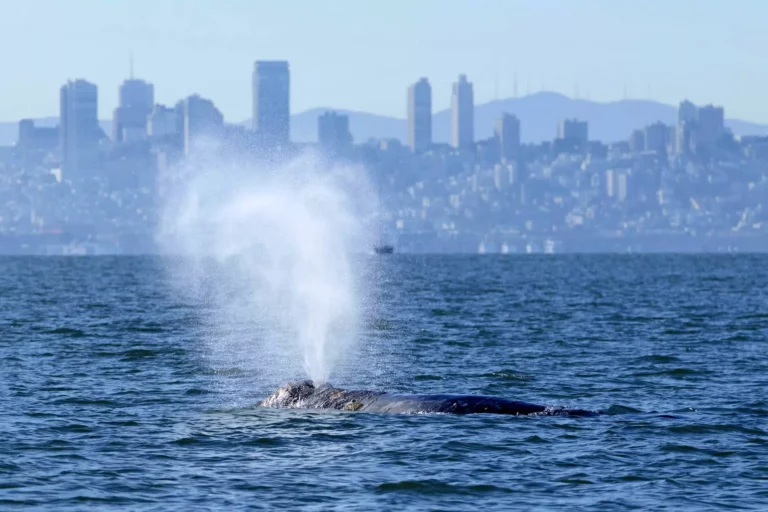
Once a conservation success story, grey whales are now in crisis as a result of climate change. Now ocean scientists, the US Coast Guard, ferry companies and whale-tracking experts have joined forces to implement a new solution to a spate of fatal strikes in busy San Francisco Bay.
Last year 21 grey whales were found dead in and around the bay, with 40% of the deaths coming from collisions with vessels. Whale season typically peaks in the bay in May, and seven whales have already died this year.
The answer takes the form of a near real-time thermal camera monitoring system, which detects whales’ heat signatures and exhaled breath, or ‘blows’, and warns nearby mariners to re-route or cut their speed accordingly.
Grey whales migrate 12,000 miles from their feeding grounds in Alaska to their Mexican mating and birthing lagoons and back, but scientists believe that the changing climate means that their Arctic food sources are insufficient to sustain them on the journey.
This is why so many emaciated and exhausted whales are making unusual stops in the bay and elsewhere in search of food, and being struck by vessels.
Half of all eastern North Pacific grey whales have died in the past 10 years as the food chain on which they depend comes under threat.
“It is heartbreaking to see these starving whales stumbling around in the middle of the hustle and bustle of San Francisco Bay,” says Prof Douglas McCauley, director of the Benioff Ocean Science Laboratory at University of California Santa Barbara.
“Every day is a nail-biter, but what gives me hope is seeing how all the right partners in the Bay Area community have come together to do something. This new system will save whales’ lives. We are all proud of this.”
Benioff lab researchers collaborated with the Coast Guard’s Vessel Traffic Service and whale experts at the Marine Mammal Centre to develop the system, which uses Flir thermal cameras and AI-powered WhaleSpotter detection technology that can detect a warm-blooded whale’s heat signature from up to 7km away.

Each detection is instantly reviewed by a WhaleSpotter marine-mammal specialist before an alert goes out. UCSB scientists map them on the Whale Safe website and share them with mariners and the Vessel Traffic Service.
Now discussions are underway to expand the network to eventually create capacity to detect and track all whales in all parts of the Bay.
“For too long, mariners have been asked to protect whales they simply couldn’t see,” says WhaleSpotter CEO Shawn Henry. “We’re changing that.
“This deployment means that ships in San Francisco Bay now have eyes on the water, day and night, miles ahead. The whales have been here for thousands of years. We intend to keep it that way.”
Also on Divernet: Public eye: Deep-sea mining tracker launched