French Polynesia’s well-protected reefs offer some incredible marine life encounters, as Diveplanit’s Deborah Dickson-Smith experiences
Photographs by Bernard Beaussier, Grégoire Le Bacon, Grégory Lecoeur, Frédérique Legrand,
Jim Winter and Stéphane Mailion Photography
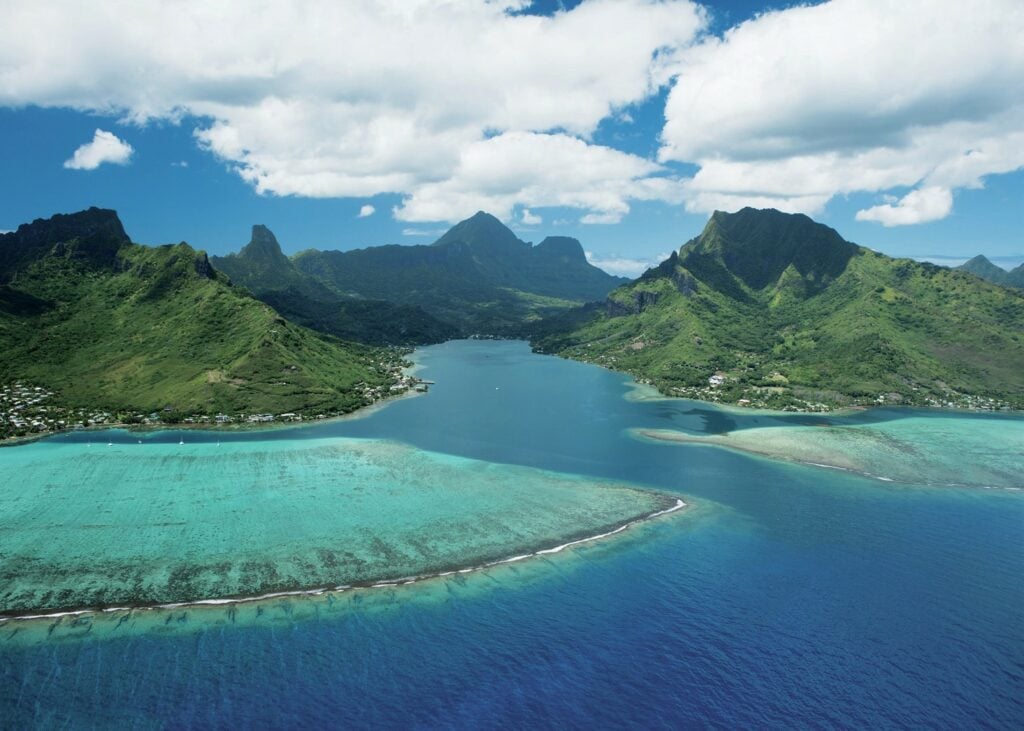
French Polynesia, commonly referred to as ‘the Islands of Tahiti’, its most-famous island, has long been imagined as a luxurious, romantic destination, with picture-perfect overwater bungalows, poised over crystal-clear water – and a perceived high price tag.
But there’s another, wilder side to the islands of French Polynesia, especially underwater. Here you’ll find some of the most-exciting marine encounters in the world. In the space of seven days, I managed to cram in several once-in-a-lifetime marine encounters in French Polynesia.
Hammer time in Rangiroa
My first leap into French Polynesia’s big blue is on the coral atoll of Rangiroa, a thin circle of islands surrounding an enormous lagoon.
In the morning we dive on the incoming current, drifting slowly through Tiputa Passe, passing clouds of purple anthias, schools of butterflyfish, snapper, cardinalfish, and humphead wrasse.
Along the way we spy whitetip and blacktip reef sharks, grey reef sharks and below us at depth, two large great hammerhead sharks pass by, an exhilarating sight.
Dancing with dolphins
In the afternoon we return to Tiputa Passe, this time spending time on the outer reef. As the tide goes out, waves form in the channel, making it a bumpy ride out for us, but great fun for bottlenose dolphins that we see leaping through the surf.
The dolphins follow us for most of the dive. They circle us, dance with us and as we’re distracted by some colourful wonder on the reef itself, we’re buzzed by them several times.
Baby blacktips
Before heading to Fakarava, I headout on a day trip to Rangiroa’s famous Blue Lagoon, on the far side of Rangiroa’s vast lagoon from the main settlement.
We stop for a snorkel at the aptly named Aquarium before heading over for lunch on this palm-fringed turquoise pool for another wonderful marine encounter, this time with baby blacktip reef sharks that circle us in their dozens as we paddle in the shallow lagoon while waiting for lunch to be prepared.
Did you know?
Dolphins can be found in French Polynesia year round, with some islands better known to be more active. The types of dolphins you might see around the islands include bottlenose, spinner and rough-toothed dolphins.
Surrounded by sharks in Fakarava
Hovering on the reef wall of Fakarava’s South Passe, my eyes are wide as I watch a wall of sharks in front of me in the big blue, while behind me and all around me, several others flit through thick clouds of reef fish. It’s magnificent.
These are grey reef sharks, and they aggregate in the entrance to this channel, in their hundreds, on the incoming tide every morning, along with half the South Pacific’s population of reef fish it would seem.
The diversity, and the sheer number of fish here, is staggering. The visibility (and stronger current) in the channel is best on the incoming tide each morning, and this is when the shark action happens so you can expect an exciting two dives each morning.
Fakarava, part of the Tuamotu Archipelago in French Polynesia, is fast becoming one of the most-popular dive destinations in the South Pacific. This atoll has two channels on the opposite sides of its inner lagoon – the Garuae Pass in the north and the Tumakohua Pass in the south.
The plankton growing inside the lagoon escapes by these natural gates through the reef and attracts pelagic species in numbers. Serious numbers.
These channels and their abundant shark populations are what make the Tuamotu Islands famous worldwide. Due to its exceptional ecosystem, Fakarava Atoll and its neighbouring islets are a registered UNESCO biosphere reserve.
Open sesame -Ali Baba’s treasures
One of the other attractions of Fakarava’s Garue Passe is a wide gully away from the main drift current called Ali Baba Canyon. Here, on the incoming current, you’ll witness fish concentrated literally in their thousands, if not millions.
Did you know?
Grey reef sharks often migrate short distances as they seek prey, they are very loyal to their home turf and seldom leave an area once they are established.


The standouts here are the cardinalfish, normally shy little red fish with large eyes which are usually found hiding in groups of ten or 12 under overhangs and in small caves, here there are thousands of them forming a thick red blanket over the reef.
In fact, there are so many that I can barely see my dive buddy through them. Every now and then this red sea of fish will part as a shark cruises through, before closing in its wake.

On most healthy coral reefs in the South Pacific, you’ll see similar species of reef fish – damsels, butterflyfish, Moorish idols, angel fish, snapper, big eyes, trumpetfish and wrasse.
They’re all here. There’s just more of them. There are large schools of snapper, and in the blue, swimming among the sharks, thousands of unicornfish dart around like butterflies.
Manta ballet
Afternoon dives on Fakarava are a little more relaxed. Diving on the outer reef, there is little to no current, yet still huge schools of reef fish everywhere you look. It is on the afternoon dives you are more likely to see reef mantas, and it’s not long into the dive before we have our first encounter.
Two reef mantas approach as we flatten ourselves on the reef top to watch. They dance and swirl above us for at least ten minutes, coming so close I duck to avoid contact.

The annual marbled grouper orgy
Each July, in the lead up to the full moon, Fakarava’s south channel hosts a spectacular event – the annual marbled grouper spawning.
Weeks before the event, marbled grouper make the journey from the open ocean and bays of the atolls of French Polynesia to the south pass of Fakarava. Here they will spawn for just one hour on one night. Hundreds of thousands of fish gather to take part in the orgy and for some, it means a violent death.
The full moon causes larger tides. When the tides recede, the lagoon empties through the pass causing a rushing current back out to open ocean. The fish spawn on this outgoing current during the early morning hours, on or near the full moon.
As spawning time draws near, the female will bring water into her body, soaking their eggs. As the eggs hydrate, they will swell, making her belly bulge. Because of this phenomenon, the exact hour of spawning is not as hard to predict as one might think.
As the event nears, the female grouper start to show a bulging baby bump. When this happens, the spawning will likely take place early the following morning on the outgoing tide.
Getting there
The Islands of Tahiti are roughly halfway between California and Australia. All international flights arrive at Faa’a International Airport, located near the city of Papeete on the main island of Tahiti.
Flights from the east coast of Australia are via Auckland, taking approximately nine hours from Sydney, and five hours from Auckland. Flights from Auckland typically arrive late at night and depart at 8am, so an overnight stay in Papeete is required at each end if you plan to visit islands such as Fakarava and Rangiroa.
Faa’a Airport also serves the domestic airlines, Air Tahiti and Air Moana, for flights to the other islands and atolls in this vast archipelago and a ferry service provides transfers to Moorea.
Air Tahiti flies to Fakarava daily and several times a week to Rangiroa. A Multi-Islands Pass can be purchased that covers flights to several islands. The Lagoons Pass covers Moorea, Rangiroa, Fakarava and Tikehau.
Top Dive Tahiti has dive centres in Tahiti, Bora Bora, Rangiroa, Tetiaroa, South Fakarava and Fakarava North, and partner centres in Tikehau, Raiatea and Huahine.
An Inter-Island Pass can be purchased which covers between six and 20 dives on any of these islands if you decide to do a bit of island-hopping. Multi-island dive packages can also be purchased through O2 Fakarava.
Because of the complex nature of these island-hopping itineraries, it is recommended that you book an all-inclusive package with a dive specialist travel agency such as Diveplanit Travel.
Diveplanit.com enquire@diveplanit.com


FAQ: Diving in French Polynesia
Q: Where is the best place to see hammerhead sharks in French Polynesia?
A: Rangiroa’s Tiputa Pass is a hotspot for great hammerhead sharks, often spotted during incoming tide dives.
Q: What makes Fakarava famous for diving?
A: Fakarava is a UNESCO Biosphere Reserve known for its massive grey reef shark aggregations, pristine reefs, and the annual marbled grouper spawning event.
Q: Can you see dolphins while diving in Tahiti?
A: Yes, especially in Rangiroa where bottlenose dolphins are known to interact playfully with divers in Tiputa Pass.
Q: When is the marbled grouper spawning in Fakarava?
A: Each July, around the full moon, thousands of marbled grouper gather in Fakarava’s south pass for a spectacular spawning event.
Q: Is French Polynesia only for luxury travellers?
A: While famous for overwater bungalows, French Polynesia also offers adventurous diving opportunities that appeal to marine life enthusiasts of all budgets.
Q: How do you get to Rangiroa and Fakarava?
A: Both are accessible via domestic flights from Tahiti’s Faa’a International Airport. Air Tahiti offers Multi-Island Passes to combine several atolls in one trip.
This article was originally published in Scuba Diver Magazine
Subscribe today with promo code DIVE1 — enjoy 12 months for just £1!