
Through his years as professional photographer and content creator, Scuba Diver North America Editor Walt Stearns has provided hundreds of images used in a wide spectrum of national and international publications and ad placements, and here he reveals some of his secrets around the use of negative space in underwater photography.
The Hidden Art Behind Simplicity
Thumbing through a favorite dive magazine, you can’t help but notice that a good number of the feature stories open with a two-page spread that uses a single large image that is overlaid with the feature’s title and the story’s opening text.
Some examples of this include my feature on Anthony’s Key Resort, the photo column on Blackwater Photography from the previous issue of this magazine, and the opening to this photo column, where the image of an oceanic whitetip shark swimming in blue water alongside a diver leaves ample neutral space to place title and text around the subject.
What do all these images have in common? They all leave varying degrees of neutral space to one side or the other for dropping in title, headers and text. Art directors love this type of composition because it leaves the right amount of exploitable space.

While most of those images likely would not win in a photo contest, it still is an art form that can be quite valuable when you get it right. For example, that lead photo from the Anthony’s Key feature was re-cropped and used as the issue’s cover shot. Granted, it may not have been one of my personal favourites, but the art director certainly liked that it ‘fit the bill’ for what they needed to do.
Did you know ?
The oceanic whitetip shark is a large pelagic requiem shark inhabiting tropical and warm temperate seas. It has a stocky body with long, white-tipped, rounded fins. The species is typically solitary, though they have been seen in relatively large numbers at food concentrations.
What Is Negative Space and Why It Matters
As prime demonstration to the interplay between Positive Space, Negative Space and Active Space, we have a large oceanic whitetip shark as the primary subject taking up Positive Space of the image with a diver just beyond it. Surrounding the two, the image contains plenty of Negative Space to provide a state of presence to where this is taking place. To enrich the narrative further, both subjects are offset more to one side leaving additional space in front of the shark.
This way, the viewer’s eyes are guided in the direction the shark is traveling thereby suggesting the image is active.
Interplay Between Positive, Negative, and Active Space
If you research the topic of making active use of space in a photograph, you’ll run into a litany of terms that include Positive Space, Empty Space, Dead Space, Negative Space and Active Space. For all practical purposes, Empty Space and Dead Space are just as they sound. Some texts denote empty space as white space, whereas dead space is essentially unused empty space that does little to nothing to convey any of the images’ story-telling elements. In general, a large empty space with a uniform single-color background can leave an image looking unbalanced and unfinished, but there are also ways to exploit that space which we will get into a bit later.
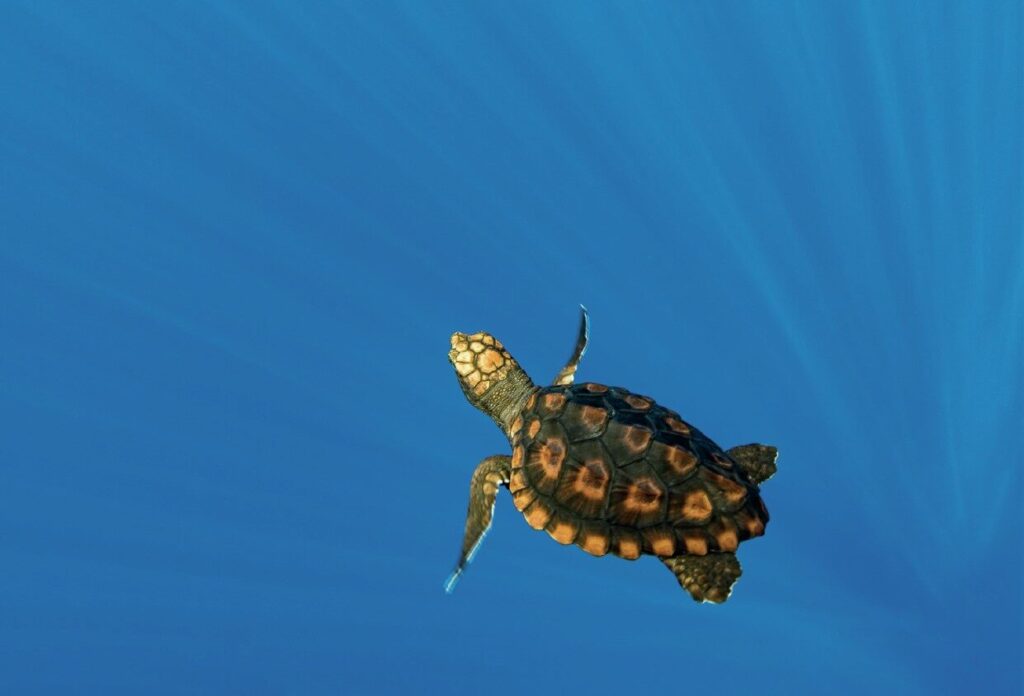
Some quick examples include the turtle image mentioned before and the deep black background you get on a blackwater dive.
For art directors, an upside of a uniform background is the ease of cloning additional peripheral spaces to create appropriate space for adding text. Following Empty and Dead Space is Negative Space.
Unlike Empty and Dead Space, Negative Space has a more integral function in how it relates to Positive Space within a picture.


Positive Space — The Main Subject
Positive Space is the actual subject in the picture. In this case, the large green moray eel in the foreground is the first thing the eye is drawn too – defining the image’s region of Positive Space. From there your eye is drawn to the school of fish and the reef around and behind it. This region of the image is referred to as Negative Space. The purpose of Negative Space is to help emphasize the subject matter, drawing the eye first to the front occupied by the eel, then within the frame while at the same drawing the eye to the background; thus, the photo presents a greater sense of dimension.
However, with that photo I admit that it sits on the threshold of having too little negative space. If I had tightened the composition anymore, I would have run the risk of having it turn out overly cluttered and busy with every element in the photo screaming for the viewer’s attention. The reason for leaving a sufficient amount of Negative Space surrounding the subject is to provide breathing room for your eyes.
Negative Space — Creating Breathing Room
Now look at the baby turtle swimming in the blue. Compared with the shot of the eel, the space reserved to show the water column around the turtle is larger. Incorporating this much Negative Space is a minimalist tactic in photography to train your eye on the Positive Space that is actually the turtle within the frame. But that’s not all. Those who understand the Rule of Thirds will also see that the turtle’s position is more towards the lower right corner of the frame leaving the remaining two thirds more open.
In doing so, I have taken the principles of ‘Negative Space’ a few notches higher by deliberately arranging visual elements in such a way as to create the appearance of motion to the turtle with a destination in mind. In short, I have created a region of ‘Active Space’ to provide greater impact of the uncertainty of the tiny creature’s future as it begins its journey in a very big ocean.
Active Space — Guiding Motion and Storytelling
When dealing with a subject that is actively moving or looking/facing a specific direction, ideally you want to have space in front of the subject to help establish a sense of motion and/or anticipation. Without Active Space, your primary subject will have less impact to the story you want to convey in your picture.
Overcrowding
One of the more-common mistakes is overcrowding the frame. Too many elements within the frame can easily overwhelm the viewer to the point of weakening the impact of the image. You don’t want the Negative Space to steal the show, but rather have it aesthetically enhance the image.
Backgrounds play a highly important role in an image. Often more so than people give it credit for. A good rule of thumb to achieve the right effect during composition is to allow for Negative Space to take up at least 50% of the image. At the same time don’t ignore what is going on in the background. A background that is cluttered can distract, while a simpler one adds depth and positive space
As the adage goes, sometimes ‘less is more’ in the composition of an image. Hopefully you’ve gained a better understanding into the mechanics of Negative Space as well as Active Space. By implementing into your own photographic process, you will develop a greater mastery to both the Rule of Thirds and the Rule of Space.
Frequently Asked Questions
What is negative space in underwater photography?
Negative space refers to the empty or open areas around your subject that help define composition, balance, and visual storytelling in underwater imagery.
Why is negative space important in underwater photography?
It creates depth, directs the viewer’s eye, and adds emotion or context — making your main subject pop while maintaining aesthetic harmony.
What’s the difference between negative, positive, and active space?
Positive space is the subject itself, negative space surrounds it, and active space adds direction or movement — guiding how the eye travels through an image.
How can I use negative space effectively when shooting underwater?
Position your subject using the Rule of Thirds, leave open blue water or sand as balance, and anticipate movement to maintain visual breathing room.
What are common mistakes when using negative space?
Overcrowding the frame, ignoring background clutter, or leaving too much empty area can weaken the image’s storytelling power and balance.
This article was originally published in Scuba Diver Magazine
Subscribe today with promo code DIVE1 — enjoy 12 months for just £1!
