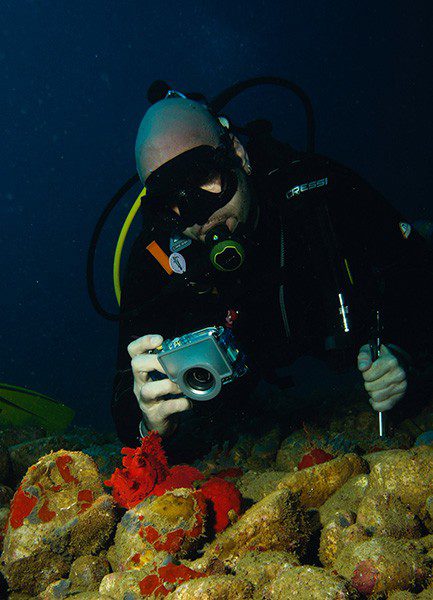
Most of us like to feel that we’re in the know about the accepted way of doing things – and nobody more so than divers. SIMON PRIDMORE has been looking at ‘doing the done thing’
IN SCUBA–DIVING, as in every sphere of human activity, conventions arise over time that govern the behaviour of the participants.
These may not necessarily be set in stone or legally required and enforced. Sometimes they just become established and generally accepted over time. Often they differ from country to country.
This is part one of a three-part series that covers a variety of scuba-diving situations in which certain forms of etiquette exist. Not everyone will agree with my recommendations, and I’m sure the more experienced among you will have your own particular opinions and bugbears. But that’s all part of the fun.
TOUCHING
The convention is to look, don’t touch! This doesn’t apply only to big animals such as turtles, manta rays and whale sharks but to the smaller ones too.
In fact, you could argue that the smaller the animal, the more vulnerable it is and the more reason to leave it alone.
Some operators prohibit their divers from wearing gloves in an effort to discourage them from laying their hands on the reef and its occupants.
There is much debate over whether a glove ban works, and it’s an issue that can arouse strong feelings. I believe that educating divers is more effective than imposing rules. I don’t think that most of the people who wear gloves do so because they want to interfere with the marine life.
Gloves can make you feel more comfortable, or help to keep you warmer. Nor do I believe that someone who wants to disturb the animals is going to be dissuaded if they have to do it with bare hands.
However, good etiquette also requires that if you want to dive with an operation, you abide by its rules. If a dive-centre has a no-gloves rule and you want to wear gloves, choose another dive-centre. But, whatever your preference, don’t touch the animals.
TIPPING
The issue of when to tip and how much to tip causes a great deal of anxiety, especially on dive-boats when there is a mix of nationalities on board.
Although some dive operations try to establish a tipping convention and suggest that a certain percentage is “normal,” there is actually no established etiquette for tipping in the dive industry, just as there is no worldwide agreement on the culture of tipping.
Some people tip heavily, some tip a little, some do not tip at all. No matter how attractive their lifestyle seems, dive-industry employees do work long hours and are not well-paid. So tips are much appreciated. Most dive operations do not add an automatic service charge to the bill.
Like many restaurants, dive-operators often prefer that you place your tip in a gratuities box so that it can be shared out among everyone, including backroom staff such as technicians and office workers, who you probably won’t have met but who contributed just as much to the experience you enjoyed as the “front of house” staff such as divemasters and instructors.
However, if your trip was enhanced considerably by the performance of one or more specific individuals, then you should not feel at all awkward at giving them a personal gratuity. It’s then up to them if they choose to add it to the general tip pool or otherwise.
Regarding how much to tip, the best advice I can give is this: don’t fret about doing the right thing or causing offence. Neither should you concern yourself about what others in your group are doing. Tips should be a personal decision.
I usually advise those who ask me to tip dive-industry employees the sort of percentage they’d pay for good service at a restaurant back home, adding more if they feel the service was extraordinary.
HUNTING
There are laws and seasons governing spearfishing and hunting for food in many places. Some are very strict, but others are surprisingly relaxed in these environmentally aware times.
It is commonsense advice to make sure you know and abide by local laws. If no laws exist and you feel you have to shoot fish, then the least you can do is follow the established etiquette:
- 1 Be sporting; freedive instead of using scuba when you spear fish, and don’t spear them at night using an artificial light source.
- 2 Don’t use a speargun when other divers are nearby.
- 3 Don’t hunt in areas where fish are used to interacting with divers.
- 4 Don’t hunt in places where people feed fish to attract divers.
- 5 Take only what you can eat and eat everything you take.
LOST DIVE-GEAR
It is an established convention that an item of dive-equipment found under water should be returned to its rightful owner. To benefit from this community-friendly piece of etiquette, make sure to tape your email address or phone number to anything you think you might drop in the ocean, such as your mask, camera, torch or dive-computer.
If you come across something that someone has been lost, make every effort to locate the owner. After all, what goes around comes around!
TERMINOOGY
In many areas of human interaction, a common bonding mechanism is the shared use of references, a code used by members of the group to identify each other and separate them from outsiders.
In the military, this often manifests itself with the use of acronyms that are incomprehensible to the uninitiated.
On the London criminal scene in the 19th century, the code they used to conceal their activities from police-informers is now known as Cockney rhyming slang.
In scuba-diving we’re often guilty of doing the same. We insist that “real” divers refer to fins rather than flippers and cylinders rather than tanks. But, does it really matter?
These days the number of new people coming into our sport is shrinking. We need to focus on including prospective divers, rather than alienating them by sniggering superciliously when they use the wrong word. After all: “What’s in a name? That which we call a rose by any other name would smell as sweet.”
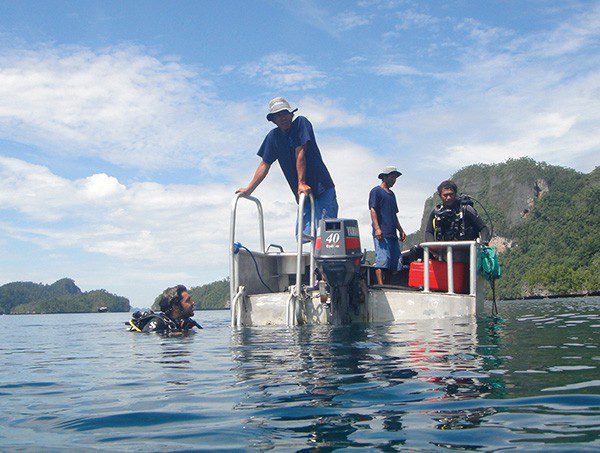
There is a right way of doing things when you’re on a dive-boat – and then there’s the other way that draws sideways looks. SIMON PRIDMORE aims to keep us on the straight and narrow
ON THE DIVE BOAT
All dive-boats and operations have different procedures, and when you’re diving with them the etiquette is to follow these. Listen and be flexible.
If you dive with the operation often and want to do your own thing, there may be room for negotiation. If it won’t compromise and it matters to you, vote with your feet and go elsewhere.
On day-boats, space is often very limited so pack with care, using a gear-bag or small plastic crate that fits neatly under benches.
Pack your scuba-gear in reverse order of use: that is, the things you need to get out first should be at the top. Stow your gear neatly out of the way and keep everything together both before and after the dive.
Bring everything you need but only what you need. Keep your phone and cash in a dry-bag in the dry area but keep your spares box with your scuba gear rather than in your dry-bag, as there is every chance that you’ll be in your suit when your O-ring blows.
Keep out of designated dry areas if you’re wet, even if you have a damp towel around you.
On any boat, never leave a cylinder standing unsupported. They are heavy metal objects, and a falling cylinder can crush a toe, destroy a regulator second stage, crack a mask or demolish a dive-computer as well as causing irrevocable damage to the cylinder-valve.
For similar reasons, keep weight-belts in a box or on the deck and out of the way. Never put weights or a loaded belt on the bench beside you or anywhere else where the movement of the boat could cause them to fall.
The toilet on a boat is called the “head”. This is not because it is where you should put your head if you feel seasick. The best place to hang your head is over the side of the boat, preferably the side where the wind will carry away your stomach-contents when they appear.
Your fellow-travellers will appreciate this, as will the crewmember whose responsibility it is to clean and unclog the head. The fish under the boat will be happy, too, at the unexpected delivery of manna from heaven.
ENTRY, EXIT, AND WHAT HAPPENS IN-BETWEEN
When you are geared up and making for the exit, the correct thing to do is move directly and with caution. You have a large object strapped to your back, so it is a little more difficult to squeeze yourself through small spaces.
Etiquette is all about being considerate. Take extra care when standing up and sitting down. Be aware that the person next to you might choose that exact moment to bend to strap on a fin, and will not take kindly to encountering the swinging tail of your cylinder with the side of his or her head.
I have seen countless near-misses in my time, as well as many hits! The two basic rules are: “Look behind you” and “Avoid sudden movements”.
Once in the water, move away from the entry area to unite with your buddy so that others can enter safely.
When returning to the boat, exercise ladder courtesy. Wait your turn. Never hang below someone who is climbing the ladder in case they lose their grip.
Exit the water quickly, then move away directly from the area above the ladder so that others can follow you.
It is worth mentioning one particular aspect of underwater etiquette that is rarely taught in dive courses. From time to time during a dive you will get kicked by a careless fin, or batted by a flailing arm.
The etiquette is to act as if nothing happened, while making a private note to keep a little further away from your assailant in future.
You certainly shouldn’t refer to it once you’re both back on the boat. The other diver might not even be aware of it or, if he or she is, might not know who took the blow and already feels bad.
After all, what goes around comes around and one day it will be you who inadvertently whacks someone in the head, and you will be very pleased if it isn’t mentioned later.
However, if you are the guilty party and you know exactly who you hit, then of course you should take the initiative to apologise afterwards.
ON A PERSONAL NOTE
Keep it covered up! Diving involves changing clothing, which by definition can involve temporary nudity.
One of the great things about our sport is that it brings together people from different backgrounds, walks of life and cultures, some of whom might not have a broad-minded attitude to public exposure, or share your high opinion of the beauty of your own naked form.
For the comfort of all, therefore, good etiquette requires discretion. Stay humble. If you are a skilled diver and have a lot of experience, this will be recognised by those around you without you having to broadcast it.
A professional can easily spot good divers by the way they set up their equipment, the way they observe and interact with others, the way they position themselves in the water and the high level of comfort they exhibit with all aspects of the diving environment.
We might not show what we think, but divers who feel the need to announce their exalted training level or high degree of experience loudly to everyone might just as well be raising a large red flag saying: “I am potentially dangerous.”
Rest assured, once they do that, the professionals will certainly be watching them closely – but not for the reasons they might wish.
A final personal etiquette tip concerning post-dive snot: you should point it out to your buddy subtly and with a smile. Fortunately, it is beyond the call of etiquette to offer to wipe it off.

Are you the sort of underwater photographer who gives the pastime a good name? If youâre worried that you might be the other sort, SIMON PRIDMORE has a few tips
In my career in diving I’ve often been called on to deploy my legendary diplomatic skills to defuse potential flare-ups between photographers and non-photographers.
The reasons behind the heated debates are always the same and, having been both a photographer and a non-photographer, I think I can see both sides of the argument.
So here is a quick guide to the major issues, presented in the hope that mutual understanding will promote greater harmony.
DIFFERENT FOLKS
Here is the problem in a nutshell. Many divers don’t care about taking pictures under water, nor do they have any idea of how much financial sacrifice it takes to buy an underwater camera system.
For many other divers, taking pictures is the sole purpose of scuba-diving. Their systems and their photographs are of such immense importance to them that they wouldn’t bother diving at all if they couldn’t take their camera with them. Here are the main issues:
ENVIRONMENT
Underwater photographers are often accused of callously damaging the seabed and the plants and animals that live there while they are manoeuvring to get a good angle for their pictures.
In their defence, most photographers do not deliberately set out to wreak havoc on the reef. However, burdened as they are with the destabilising potential of a camera and strobe system, and with the technical limitations imposed by the behaviour of light under water requiring them to get close to their subject, occasional accidents are hard to avoid.
Furthermore, with their focus on what is going on in front of the lens, photographers are often oblivious to the peripheral impact of what they’re doing.
This can be misinterpreted as carelessness. It isn’t always the case that someone poised against the reef, camera in hand, has just landed there unthinkingly. He might have carefully chosen this particular spot specifically to avoid damaging anything, and deserves the benefit of the doubt.
What is less excusable is the propensity of some photographers to manipulate their subjects into places where they can be seen more clearly, away from the environment that conceals them; an environment that they have chosen for their protection and which they have evolved to copy.
This can render them highly vulnerable to predators. Touching marine life can also damage it or make it susceptible to disease.
Quite apart from offering us an uplifting experience, underwater photographs serve a valuable purpose by sharing the beauty and wonder of the creatures beneath the sea with those who cannot see them for themselves, and who may thereby be more likely to support environmental causes.
But perhaps before photographers remove a delicate animal from its camouflage; before they wriggle themselves and their gear through a fragile eco-system in pursuit of their quarry; they should ask themselves if the end justifies the means, and if the photograph is really that important!
EQUIPMENT
Cameras, housings and strobes are all delicate pieces of engineering and highly vulnerable to water, so common sense suggests that you give the photographer and his gear plenty of space.
A camera-table is for camera-related items only, so don’t put a drink down anywhere near a camera, and remember that when you’re wet after a dive, so is your hair.
Craning your head over the shoulder of a photographer as he runs through his pictures post-dive can cause drops of sea water to fall onto delicate electronics.
Photographers need to take a certain amount of responsibility too, and make sure that they keep their precious and ultra-expensive equipment out of the way of the uninitiated.
Remember that they’re divers, so are going to be excited when they come up from their dive, and the security of your camera system is not going to be uppermost in their minds.
The best dive-boats and resorts have camera-only areas, even private rooms, just for photographers.
UNDER WATER
The generally accepted convention is that while photographers are busy with a subject, it is theirs until they have finished with it. It is not done to intrude, either to take a peek at what they have in their sights or to crack off a quick snap on your point-and-shoot.
However, photographers need to be considerate of others who might want to see the animal too, particularly if it is something unusual.
Good etiquette dictates that a diver without a camera has just as much right as a photographer to see, watch and examine an animal.
If divers want to savour the moment and burn the image of a rare creature into their brains rather than onto a digital card, that is their choice. So photographers should take their pictures promptly, then leave.
If they want to come back to the animal, they can join the holding pattern and wait until everyone else is done. When they see photographers in action, other divers should steer clear and be aware of how their positioning in the water might affect the shot the photographer is striving so hard to perfect.
Passing carelessly upcurrent of a photographer can cause the debris of your passage to drift into the viewfinder. Swimming below a photographer working on a reef wall and exhaling will create a snowstorm of expanding and exploding bubbles all over a meticulously framed backdrop.
In the panel are some suggestions for photographers and their buddies, designed to ensure that they both get the most out of a dive. Not all photographer/buddy relationships work well. Like every good relationship, it comes down to empathy, mutually compatible priorities and shared objectives.
You may have noticed that I have not dealt with the issue of two photographers diving as a buddy-team. The main reason I have avoided this is because I believe it to be an impossible thing.
Photography is such an individual, single-minded pursuit that the likelihood of two photographers being able to stay together and work as a team while dedicating themselves to their respective goals is so remote that to try to suggest rules of etiquette would be futile.
Read more from Simon Pridmore in:
Scuba Confidential – An Insider’s Guide to Becoming a Better Diver
Scuba Professional – Insights into Sport Diver Training & Operations
Scuba Fundamentals – Start Diving the Right Way
All are available on Amazon in a variety of formats.
| 7 TIPS ON DIVING WITH PHOTOGRAPHERS 1. Discuss the roles you’re going to play and the division of responsibilities before the dive – and make sure that you agree. 2. See the safe completion of the dive and the acquisition of great photographs as joint achievements. 3. Remember that, as the person with the camera will have their eye on the viewfinder most of the time, it is the non-picture-taking buddy who is mostly responsible for keeping the pair together. 4. However, good etiquette demands that photographers indicate to their buddy that they have seen something, and make sure the message has been received before stopping and settling down over a subject, so that the buddy does not just swim off into the blue alone. 5. However reliable and devoted a buddy is, the photographer should take care not to fall into the trap of shifting the burden for staying within the dive-plan onto the buddy’s shoulders. A basic rule of scuba-diving is that a diver’s air supply and decompression schedule are his or her own responsibility. 6. While the photographer is busy, buddies can keep in sight and try to find further targets. If they find something cool, they should wait and watch for the photographer to look up, then raise their arm to draw attention. 7. Photographers should take time to snap a few photos of their buddy during the dive and make a gift of them afterwards. Most people don’t have many pictures of themselves under water, so will be grateful. |