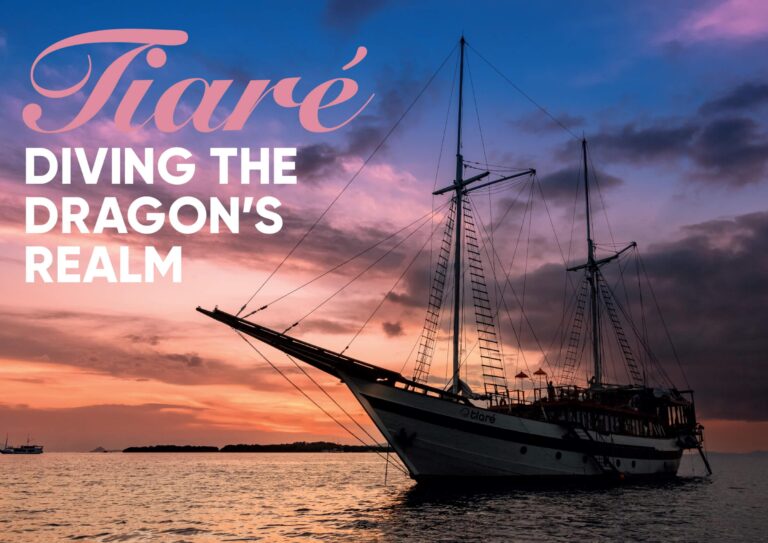
Komodo National Park is famously known as the home of the world’s largest lizard, the Komodo dragon. A face-to-face meeting with these giant reptiles is undoubtedly a bucket-list experience, but it is far from the only thing that lures divers to this region of south-central Indonesia. Walt Stearns tells all about diving Komodo from the Tiaré liveaboard.
Why Komodo National Park Is a Diver’s Paradise
Komodo National Park is named one of the New Seven Wonders of Nature, and not just for the lizards. The waters surrounding the park’s ten-island archipelago are rich in coral reefs that support one of the world’s most bio-diverse marine ecosystems.
My interest in the waters of Komodo was first sparked by a description penned more than two decades ago by photojournalist and Indonesia diving expert Maurine Shimlock, who wrote “We enter the cool transparent water, leaving behind Komodo Island’s baking hot primeval landscape. Drifting easily down a volcanic slope flamboyantly adorned with soft corals, we slip through undulating masses of transparent fish. Perched on a mass of pastel-colored soft corals is a rare lacy scorpionfish, camouflaged as a filter-feeding crinoid nestled among the gorgonians. Moving carefully, and willing myself to breathe calmly, I raise the camera to my eye and begin to photograph this exquisite creature.”

As luck would have it, Komodo became my introduction to Indonesian diving in the form of a 2002 trip aboard the Komodo Dancer liveaboard. Back then there were no flights from Bali or Jakarta to get you to Komodo. Instead, trips began with 300-mile sailings on liveaboards like the Dancer, which were modeled after a specific type of Pinisi schooner.
The appellation ‘Pinisi’ applies to a specific type of homegrown Indonesian sailing vessels that have plied island waters for more than 500 years.
Did you know?
Among the many changes I have witnessed in Indonesia over the years is the ability to get cell service in some pretty remote regions. Unfortunately, cell service around Komodo is still spotty in most cases. While the Tiaré does provide free on-board WiFi, I would not count on it working once you get a few hours outside of the port.

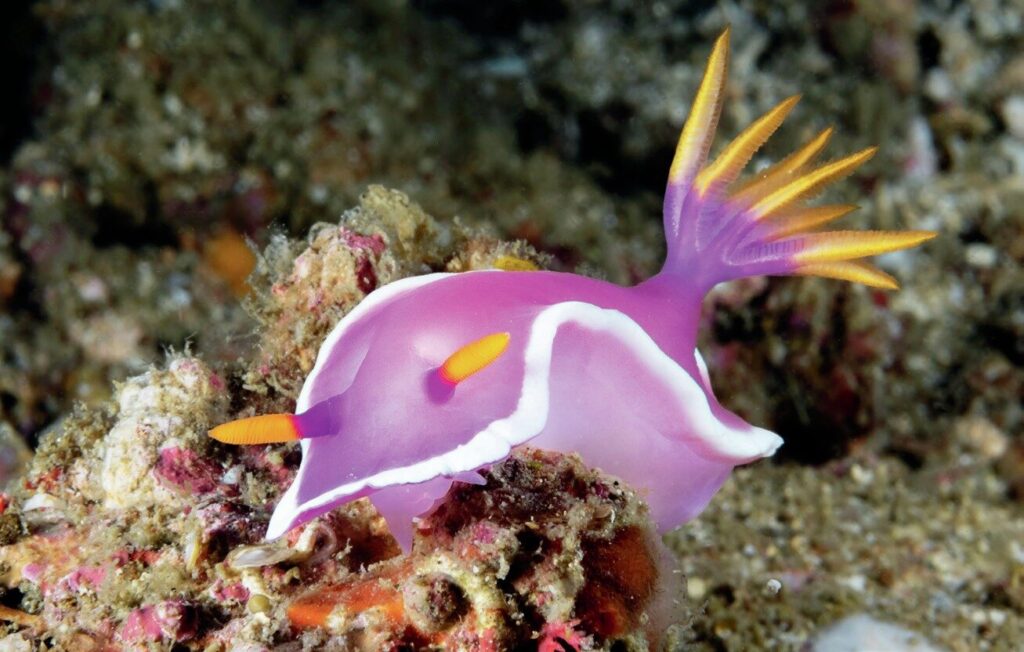

The popularity of the Pinisi schooner still holds today, as evidenced by the current selection of Indonesia liveaboard dive yachts built in this traditional style. And even though they may not let out the sails while motoring between dive sites, there is something romantic, even spiritual, about standing on the deck of a classic sailing ship while plying the waters of Indonesian’s southernmost archipelago.

Fast forward two decades and I am once again at the place where my love of Indonesian diving began. This time, there was no long sailing from Bali to Komodo. Instead, I flew in a Batik Air 737 to the port city of Labuan Bajo on the western end of Nusa Tenggara Island in the Flores Island group, where I met the Pinisi-style liveaboard Tiaré (www.tiarecruise.com). The name Tiaré is derived from a jasmine-scented variety of Tahitian Gardenia that is noted for providing a calming effect – much like the Tiare’s rich hardwood floor-to-ceiling interior creates a warm, soothing atmosphere for those aboard.

Aboard the Tiaré: One of Indonesia’s Finest Liveaboards
The Tiaré is a traditionally crafted, two-masted motor sailor. Like most Indonesian vessels of this type, it is fashioned from a mix of ironwood, oak and teak. Stretching 150 feet in length with a beam of 29.5 feet, it is designed to accommodate just 12 to 14 divers. This is a surprisingly small number of passengers for a boat with a displacement of close to 300 tons, and it makes for a spacious and more-personalized experience aboard.
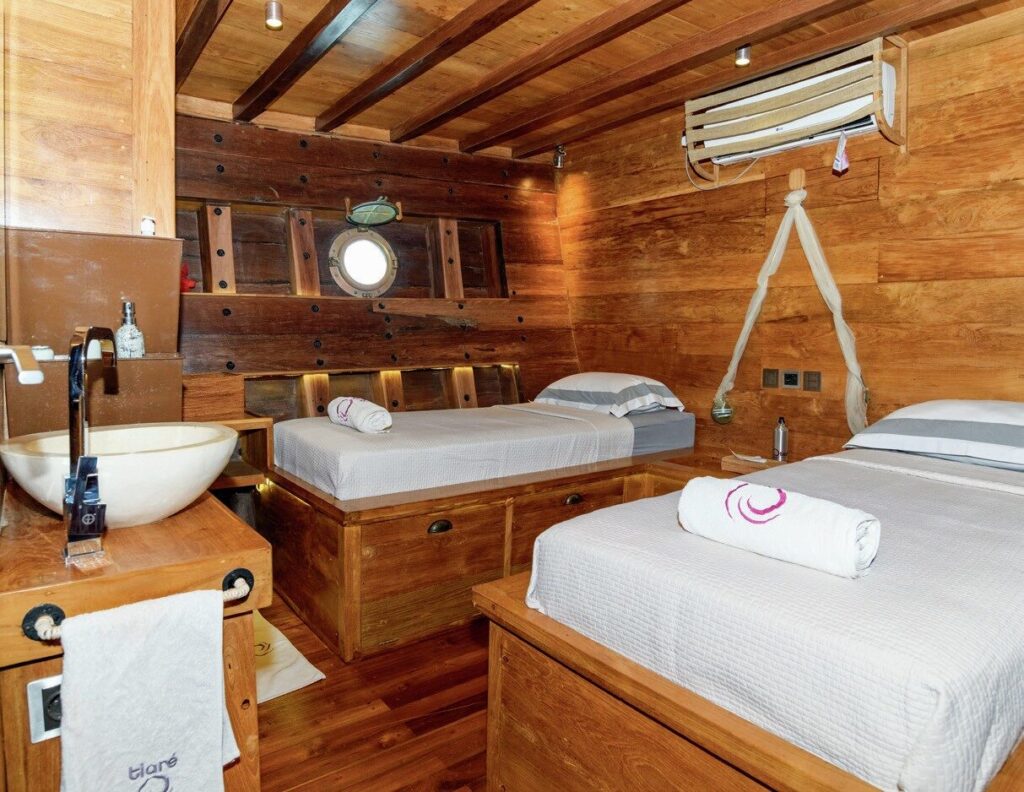
Guest accommodations on Tiaré include six very roomy, air-conditioned below-deck cabins with private ensuite bathrooms and showers. All cabins are roughly equal in size but offer several bedding configurations. Two cabins can be arranged for a group or family of three, two are fitted with single king beds and the remaining two feature a pair of full-size twin beds.

Did you know?
The flight to Komodo is as direct as you can get from Bali-Denpasar (DPS) to Labuan Bajo (LBJ) on the western end of Nusa Tenggara via Indonesia’s regional carrier Lion Air/Batik Air.
While I am not someone who requires a large cabin, I very much enjoy the limited passenger list, as it meant I was not surrounded by a horde of divers each time I entered the water.
Tiaré’s super-elongated bowsprit, a design characteristic shared by many twin-mast Pinisi sailing ships, takes up 30 feet of the vessel’s overall length, bringing the actual length of the deck area down to 119 feet. This by no means makes the boat feel small.
The main deck’s enclosed lounge features an espresso and American coffeemaker along with snacks and a full complement of juices, teas and libations. Generally, the only time the lounge is used for dining is when the weather is on the wet side. Otherwise, meals take place on the large center region of the main deck. One corner of the lounge is devoted to photographers, with a dedicated L-shape camera workstation with multiple outlets for charging batteries.
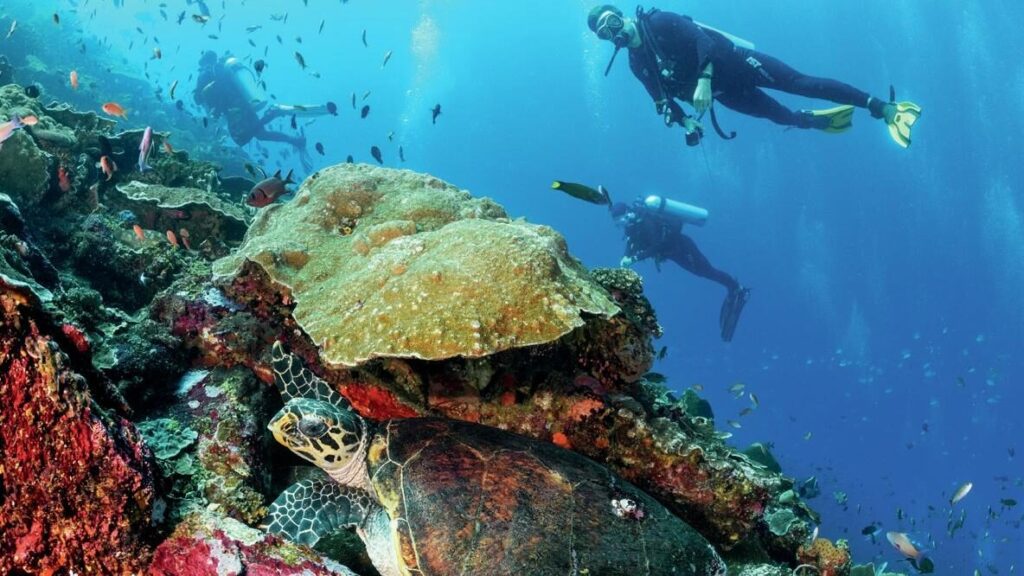
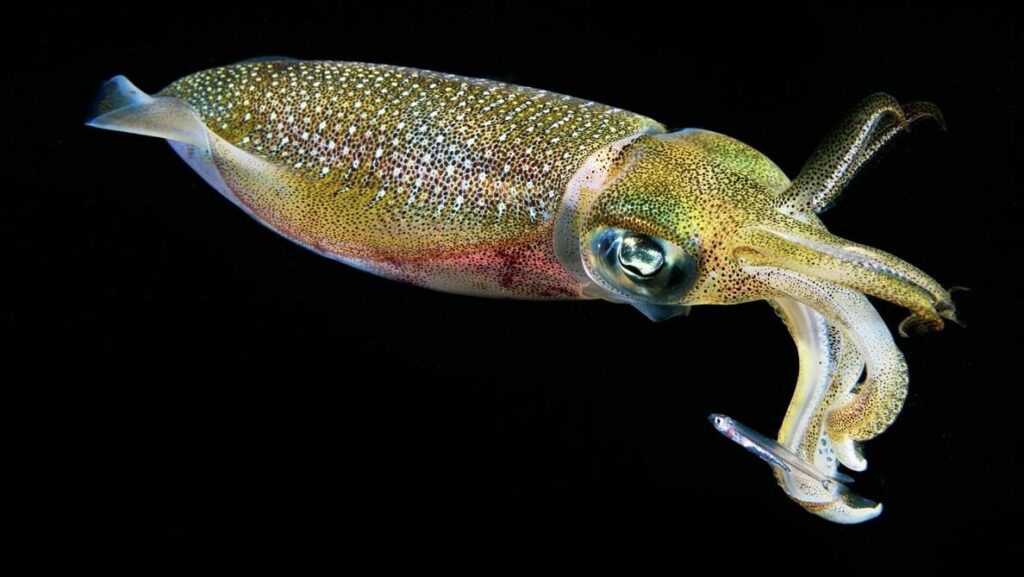
Diving Komodo can be exceptional with so many beautiful reefs to explore, however, it’s important to be prepared for strong currents
Life on Board: Comfort, Cuisine, and Crew
Tiaré’s daily schedule begins with a light breakfast at 6.30am followed by the first dive of the day at 8am, then a full breakfast at 9am-9.30am. Your second dive and third dive are at 11am and 3pm with lunch in between. Night dives generally take place around 6.30pm, pushing dinner to around 8pm instead of its normal 7pm sitting.
The dive staging area is at the stern where all dive gear and wetsuits are kept. After donning wetsuits (water temps can vary from 82°F down to 66°F), divers proceed back to the boarding stairs midship on the Tiare’s port side to board one of its waiting dive tenders. When there is a full boat of 12, divers are split into groups of six divers plus an underwater guide for each tender. Fortunately, the run to the dive sites is short, as there is not a lot of room on these tenders.
Dive profiles are kept to 55 minutes to an hour, with a max depth around of 80ft-90ft. In addition to standard aluminum 80cf tanks, the dive locker has a few 62s and 100s on hand. Nitrox (varies between 30 and 32 percent) is readily provided.
Diving Komodo’s Signature Sites: Drift, Depth, and Diversity
Diving Komodo can be exceptional with so many beautiful reefs to explore, however, it’s important to be prepared for strong currents. Komodo is located at the meeting of the Indian Ocean and Indonesia’s Flores Sea. With the mixing of these two bodies of water, the sea state can be choppy at times, and the currents during the tide change can certainly rage. As a result, almost every dive in this area is conducted as a drift.
An example of this is at a popular dive site known as Shotgun (also called The Cauldron), where part of the dive includes going through a channel separating the islands of Gili Lawa Darat and Gili Lawa Laut in the north side of the Komodo National Park. At the start of this dive the current is light, yet as you near the pass between the two islands, the reef becomes shallow and creates a natural bottleneck that accelerates the flow and shoots divers along at an exhilarating pace. Once on the other side of the restriction, the flow once again moderates.


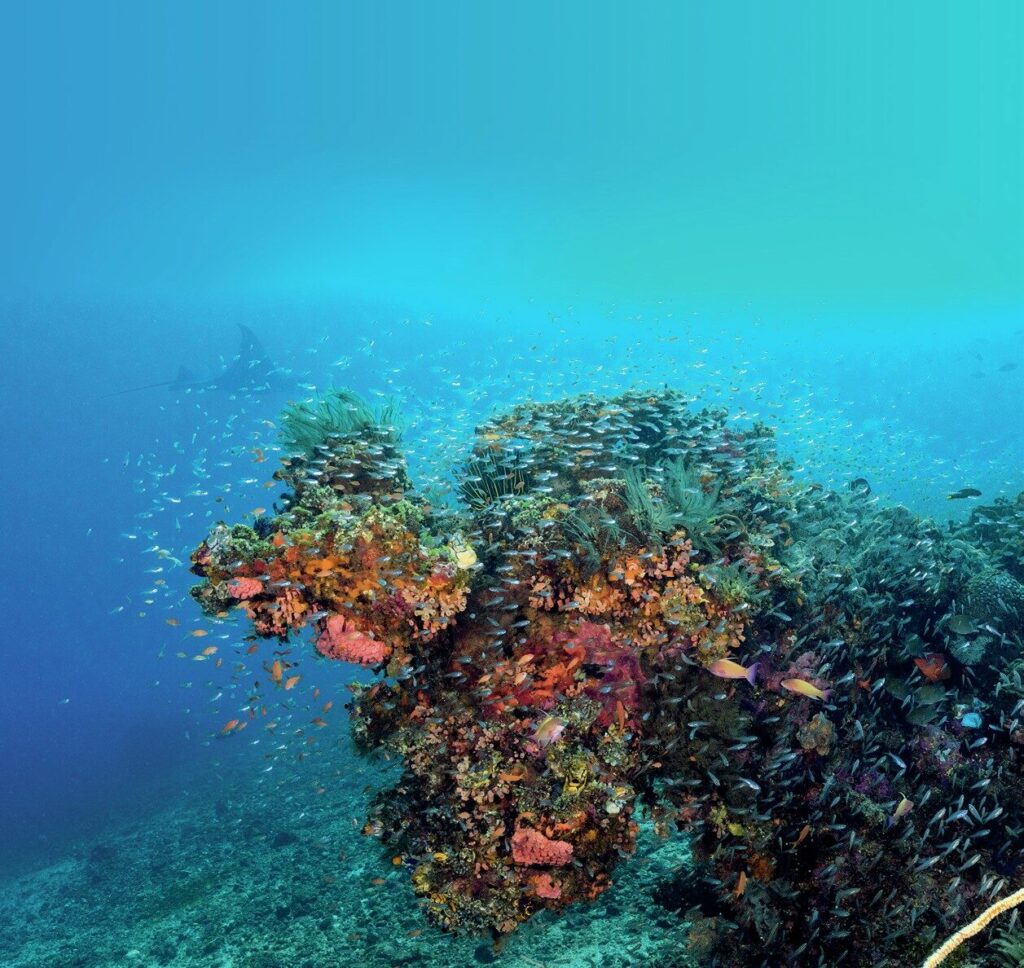
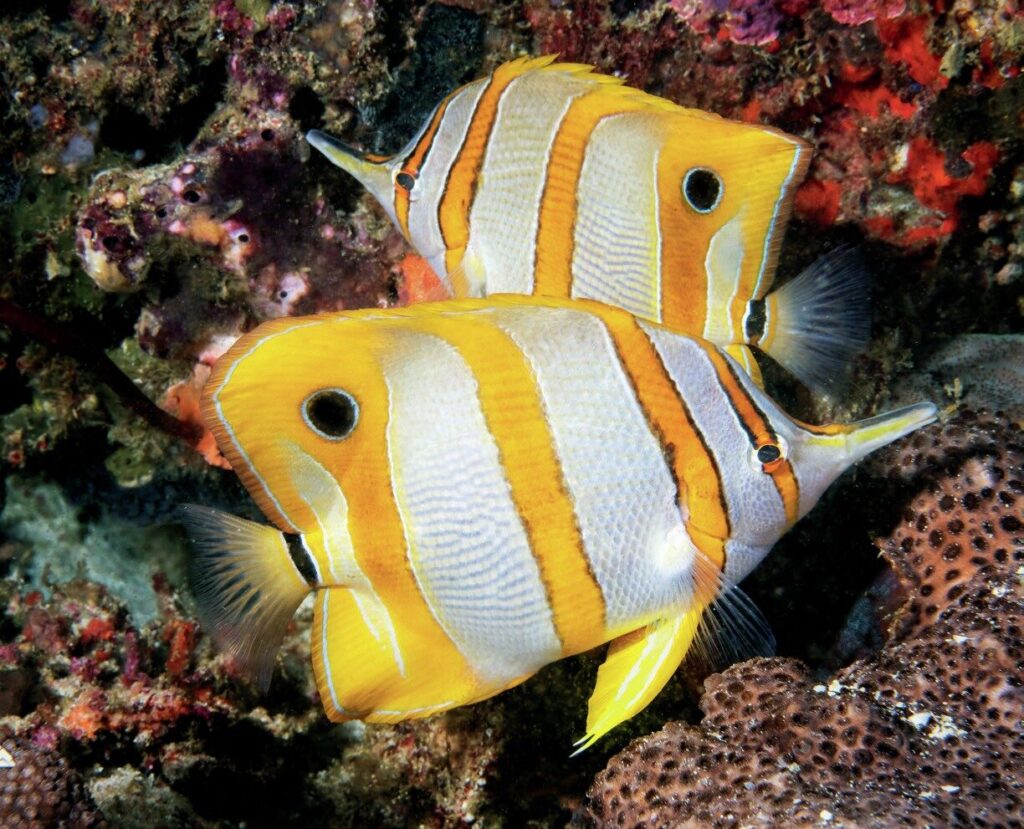
A week to remember
At the onset of our seven-day itinerary, our check-out dive took place at Sebayur Kecil. For a dive site that is within easy range of day boats out of Labuan Bajo, the shallow hard coral reef at this site was surprisingly healthy and populated with a lot of green sea turtles.
From there, we moved to the north side of Tatawa Island for a few dives on the sites known as Tatawa Besar and 6 LD. Between the two, Tatawa Besar soon became one my favorite reef dives of the trip. This site follows an archetypal profile of most reef systems throughout the northern side of Komodo National Park, starting right at the surface and following a 45-degree downward trajectory to 125ft-175ft before disappearing altogether into the deep. The feature that sets it apart from anywhere else we visited was the fantastic bright, orange-colored soft corals and sea fans that dominated most of the reef face between 25ft-80ft. Adding to the excellent scenery, the current is generally mild, making for an easy drift allowing for time to stop for scenic views and/or shoot pictures.
Next, Tiare’s itinerary provided four dives around the two islands of Gili Lawa Darat and Gili Lawa Laut in the north of the Komodo National Park. The first site was Shotgun followed by two more at Castle Rock, including the night dive inside a bay. While Shotgun strikes me as more of a novelty dive where you can pretend you are a flying superman,

Castle Rock’s small seamount was far more fascinating as it teemed with all kinds of marine life from schools of fusiliers and surgeonfish to roaming gangs of Giant Trevally. By day four, what I had previously enjoyed at Tatawa Besar was quickly overshadowed by Tanduk Rusa, which is off the northwesternmost point of Gili Banta Island. This reef features a very steep, semi-wall-like profile that drops from the surface down to 150ft with several very large boulders at its base. Moving to either side of the point, the reef takes on a gentler sloping profile covered by broad colonies of hard corals alternating with more flamboyant colored gardens of soft corals.
Manta Encounters and Marine Life Highlights
From there, one dive to the next was a continued affirmation of the richness of marine life in the region. Did I see manta rays in Komodo? Yes! While they were a no-show at the famed Manta Alley, they are certainly a common sight in Komodo’s more-southern region where the water is both colder and more abundant with plankton. Spending the better part of a day at Padar Island, a noted spot where mantas aggregate around cleaning stations to rid themselves of bothersome parasites, I witnessed something I had never seen before – two different species of manta ray at the same time.
The first, the reef manta (Mobula alfredi), most commonly seen around tropical reefs like Yap and Hawaii. The second, the even larger giant manta (Mobula birostris), which is generally a more open ocean nomadic species regularly encountered in islands in the Eastern Pacific from the Sea of Cortez to Galapagos, as well as around Bali. Now that was cool! n
Frequently Asked Questions
Where is Komodo National Park located?
Komodo National Park lies in south-central Indonesia between Sumbawa and Flores. It’s a UNESCO World Heritage Site and one of the New Seven Wonders of Nature.
What makes diving Komodo National Park special?
Komodo’s waters boast incredible biodiversity, vibrant coral reefs, thrilling drift dives, and encounters with manta rays, turtles, and reef sharks.
What is the Tiaré liveaboard and what makes it unique?
The Tiaré is a luxury 150-foot Pinisi-style motor sailor offering intimate dive trips for 12–14 guests, with spacious cabins, gourmet dining, and top-tier dive service.
How do you get to Komodo National Park for diving?
Fly from Bali (Denpasar) to Labuan Bajo, Flores, via Lion Air or Batik Air, then board your chosen liveaboard such as the Tiaré for multi-day dive trips.
What diving conditions can be expected in Komodo?
Expect strong currents, drift dives, and varying water temps from 66°F–82°F. Dive sites suit intermediate to advanced divers, with vibrant reefs and large pelagic sightings.
When is the best time to dive Komodo?
April to November offers the best visibility and calmer seas, though manta sightings peak during the cooler months between December and February.
This article was originally published in Scuba Diver Magazine
Subscribe today with promo code DIVE1 — enjoy 12 months for just £1!
