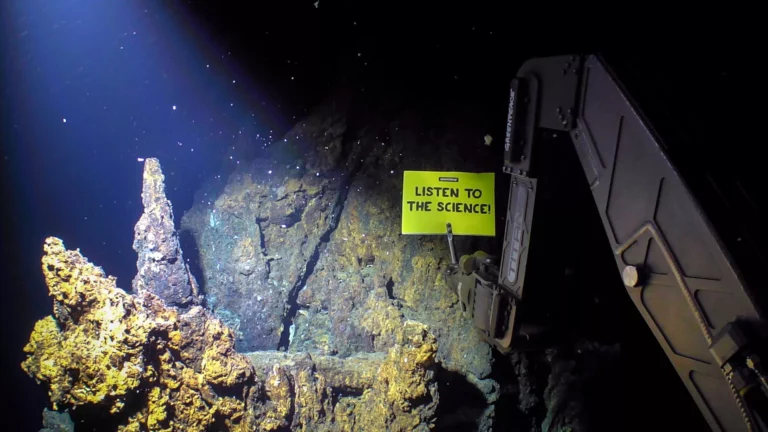
While conducting a scientific survey of unexplored seabed ecosystems along the Arctic Mid-Ocean Ridge, conservationist group Greenpeace International has deployed an ROV 2,315m deep below the surface to send the message ‘Listen To The Science!’ to global leaders.
“This marks the deepest banner protest in history, to speak for ecosystems that have no voice of their own,” said Deep Arctic Expedition chief scientist Dr Sandra Schöttner. “World leaders have already promised to protect 30% of the oceans – now they must listen to the science and actually do it.
“We cannot meet our global goals if we also allow industrial exploitation of unexplored and vulnerable ecosystems in the deep sea. It is high time that leaders keep their promises and give the oceans a chance to recover.”
Well beyond human diving depths the expedition’s ROV Holly displayed the banner in front of a hydrothermal vent field called Loki’s Castle, within which ‘black smokers’ emit fluid at temperatures as high as 320°C from deep within the ocean crust.
The Deep Arctic Expedition brings together scientists to explore seamounts and hydrothermal vent fields, with their activities ‘divestreamed’ on Greenpeace’s Youtube channel.
Norway had declared the area open for deep-sea mining in 2024, as reported on Divernet, but the plans were halted last year after protests from environmental organisations, scientists and the fishing industry.
Scientists believe that humans’ most distant ancestors might have resembled the microbes living on structures such as Loki’s Castle, and that they could hold the key to the origins of life on Earth.
With the Arctic one of the planet’s fastest-changing regions as a result of climate change, and the increasing threat of human disturbances such as deep-sea mining, Greenpeace as warned that such biodiversity hotspots could be irreversibly disrupted.
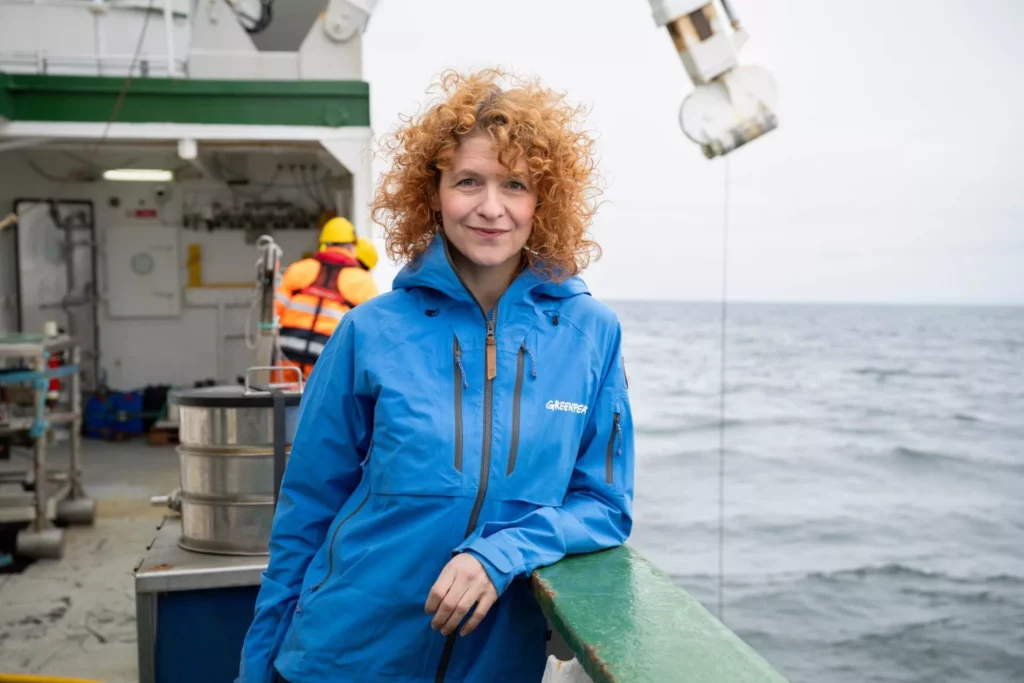
“It is not too late to act,” said Schöttner. “Science clearly predicts the limits of what our planet can endure, but human action determines our survival.
“By safeguarding these deep-sea ecosystems within a global network of ocean sanctuaries and establishing a moratorium on deep-sea mining, we can create a resilient safety net for marine life, and protect the health of our global oceans for generations to come.”