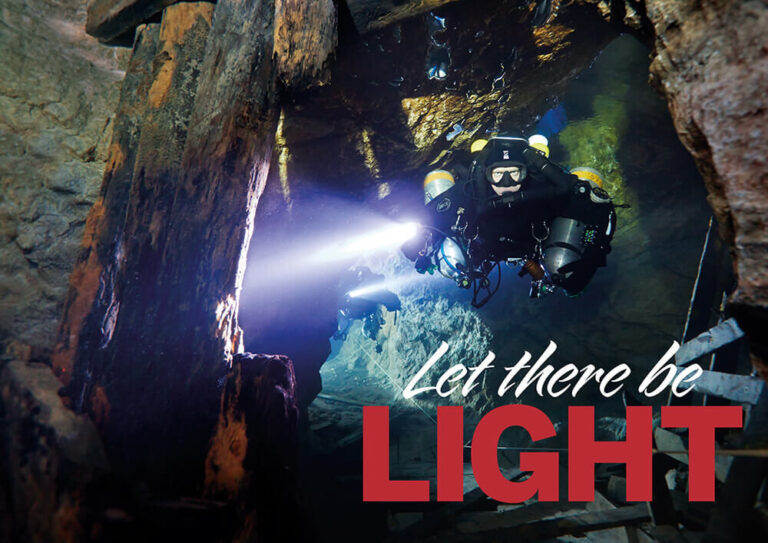
Filming in darkness, in a submerged world doesn’t come without its challenges, as TV adventurer extraordinaire Andy Torbet explains.
Photographs courtesy of Andy Torbet

Filming in Darkness: My First Cave Diving Shoot
My inaugural piece of professional filming in cave-diving came in 2013. The BBC had commissioned me to dive a flooded mine system in mid-Wales. The dive endeavoured to film some of the artefacts, machinery and even graffiti left by the miners in the late-1930s before the mine was closed, the pumps disabled and the lower levels flooded. The diving footage would become a vehicle to unpack pre-World War Two mining in Britain, the decline of the industry, and to allow viewers to visit a world that would otherwise be out of bounds to them.
In this situation you can’t follow the usual regulations for media diving operations. Careful consideration had to be given to the personnel, where we’d site them and what equipment we’d use to both capture the footage we needed in the single, two-hour dive, and to make sure we were safe and adhered to all the Health and Safety At Work criteria. It’s often more complicated doing these types of dives for work than recreationally, as there is a duty of care over everyone being employed. You’re there to get the right shots, but it’s more important to get everyone out. After all, and I have had to remind people of this, it’s only telly and it’s not worth dying for.
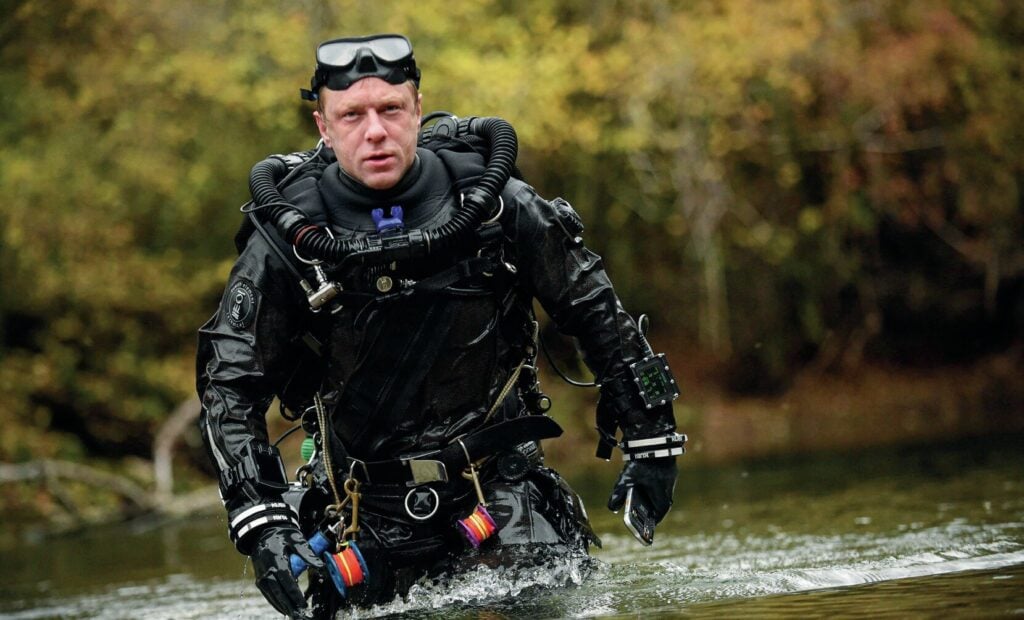
In cave diving sometimes less is more, and inserting extra divers into a confined space is not necessarily safer. The cameraman, Rich Stevenson, and I have been cave-diving and filming together for years, so we work well as a buddy pair. It helps, when you only have one dive to capture all the footage in some testing conditions, to be in tune with your partner.

“These dives are opportunities to show your audience something few people, even divers, will ever get to see, but if you can’t come back with the right shots, then there was no point going in the first place”
And these were testing conditions. The depth was only 30m so we were only using air as the diluent gas on our rebreather. The choice to go closed-circuit would give us sufficient time from our single dive and also produce no bubbles. There have been cases where bubbles, from the exhaled breath of a diver on scuba has caused the fragile roof of a mine, supported by the relatively dense water, to collapse.
Why Lighting Is Everything Underground
The visibility is generally good in mines and minimising team numbers also helped with this. But in the absolute darkness, the biggest problem we have is light. In the utter blackness of a cave or mine, it is easy to bring a torch or three, but when filming it can be difficult to deal with the extreme contrast of the bright light against the utter dark. Even the best camera can’t deal with contrasts as well as the human eye. By dropping lights in specific places, me keeping my personal torch on the lowest setting and Rich using two specialist underwater filming lights with wide beams on a low power setting, we managed to pull off some stunning images.
Did you Know?
Underwater caves have very little light, food or oxygen. Because of these unique conditions, they’re teeming with life that humanity doesn’t see often. Cave divers have discovered new kinds of bacteria that are helping us safely study antibacterial resistance.
The images were augmented by a small action camera mounted on my helmet and wrist. When you are constrained to a single dive and only one cameraman, you need to take every opportunity to grab footage, even if some of it is relatively low quality.
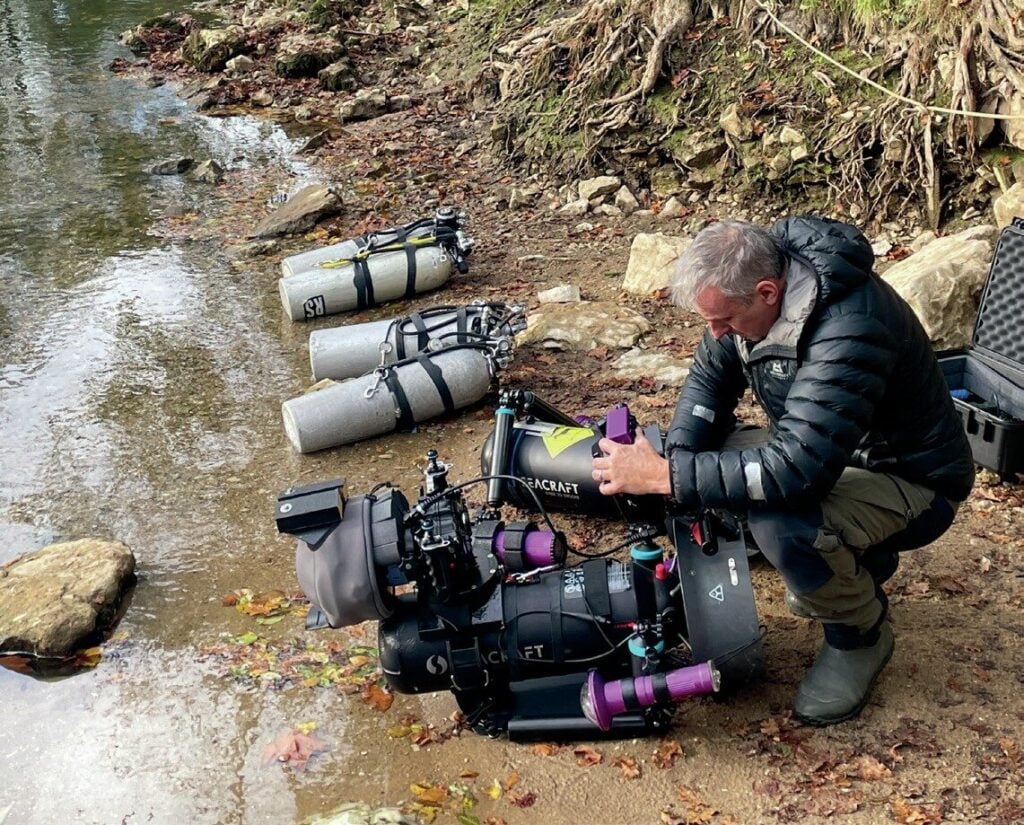
Since that first cave-diving filming dive, we’ve shot a huge amount of material underground both in the UK and abroad. But one of the most-intense and technical shoots was for an independent sci-fi short called Dive Odyssey. The film itself is a beautiful, cinematic experience. It was led by Finnish film-maker Janne Suhonen. The main action was shot deep in Ojamo Mine, near Helsinki, specifically at Hell’s Gate and Lucifer’s Pillar.
Did you Know?
Ojamo lime mine is situated 38 miles west of Helsinki and is a popular destination for cave divers and explorers alike. The deepest part of the mine is the bottom of the main mining shaft, estimated to be 250m down…
From Llangollen to Ojamo: Filming the Impossible
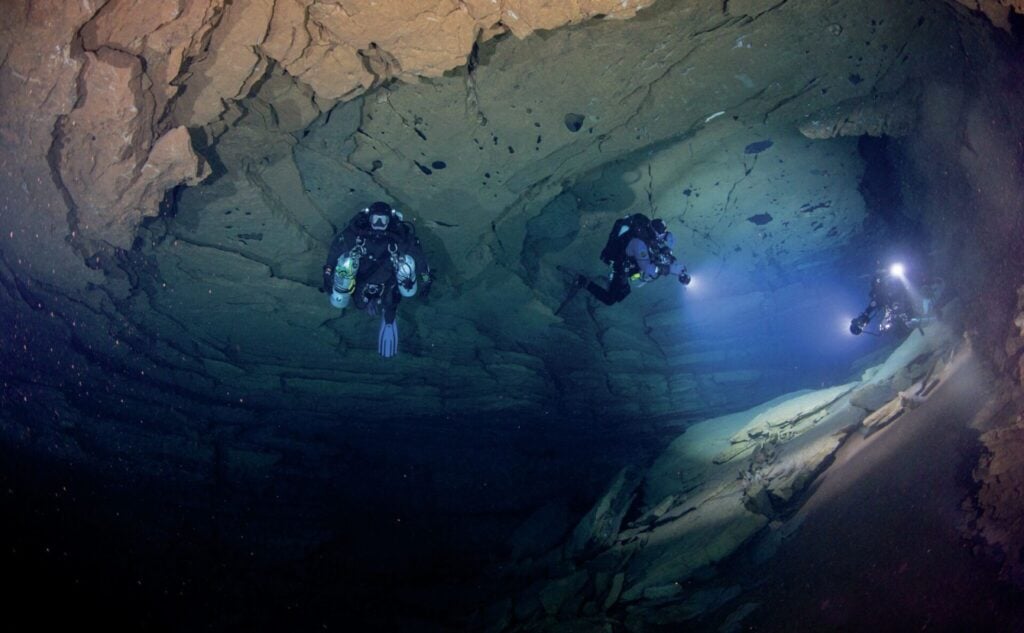
Unlike the dive in Llangollen, this operation required up to nine divers. We had two ‘actors’, two cameramen, and as many as seven support divers carrying lights to illuminate the huge underwater scenes. Hell’s Gate is the entrance through the megalithic concrete wall built by the miners to support the roof. As they burrowed beneath the earth, they realised they had under-mined the lake above and the roof would need supporting in order to prevent a catastrophic breakthrough of lake water. The wall, over 16 metres high, stretches across a vast chamber, cutting it in two.
“In the utter blackness of a cave or mine, it is easy to bring a torch or three, but when filming it can be difficult to deal with the extreme contrast of the bright light against the utter dark”
“The cameraman, Rich Stevenson, and I have been cave-diving and filming together for years, so we work well as a buddy pair”
Through Hell’s Gate and down deeper into the mine lies Lucifer’s Pillar, a gigantic concrete column designed to support the roof and prevent the same disaster as Hell’s Gate.
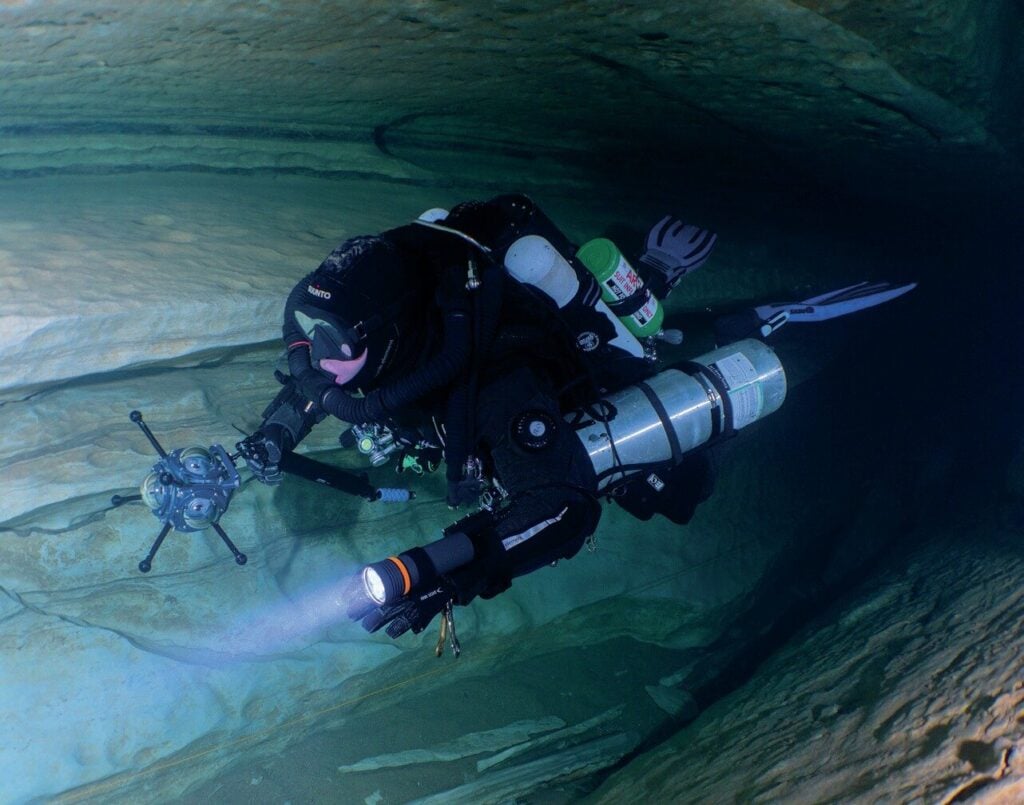
The problem with illuminating these locations were not simply the darkness, but the vast spaces in which it existed and the clarity of visibility. Often the problem with lighting a tight limestone cave is the torch-beams bounce off the white walls, and over-exposure becomes hard to manage. In Ojamo we had the opposite problem, which is why such a large crew of divers were required. So, before each dive, Janne would go through a long, detailed and often necessarily complicated brief to ensure every one of the team knew where they had to be, where their lights had to be pointed, and on which power setting.
It was difficult but engaging, as the team tried to ensure all the areas were lit correctly, some with just a hint of shadow, others in more detail, and the main focus of the action, usually the ‘actors’, were fully lit to ensure that was where the viewer was focused on. Of course, the necessity to overcome darkness in technical diving doesn’t only come when you enter the subterranean world. Sometimes submerging beneath the surface is all you have to do… provided you go deep enough.
Lighting the Britannic: Filming a Legend at 120 Metres
In 2016, we produced a documentary for BBC2 to mark the 100th anniversary of the sinking of HMHS Britannic, twin sister of Titanic and seconded into service as a hospital ship in World War One. The wreck lies, beautifully preserved and almost entirely intact apart from some damage near the bow where she struck a German sea-mine, 120m below the surface of the Aegean Sea. We dived Britannic near midday on a bright, cloudless day typical of Greece in the summer.
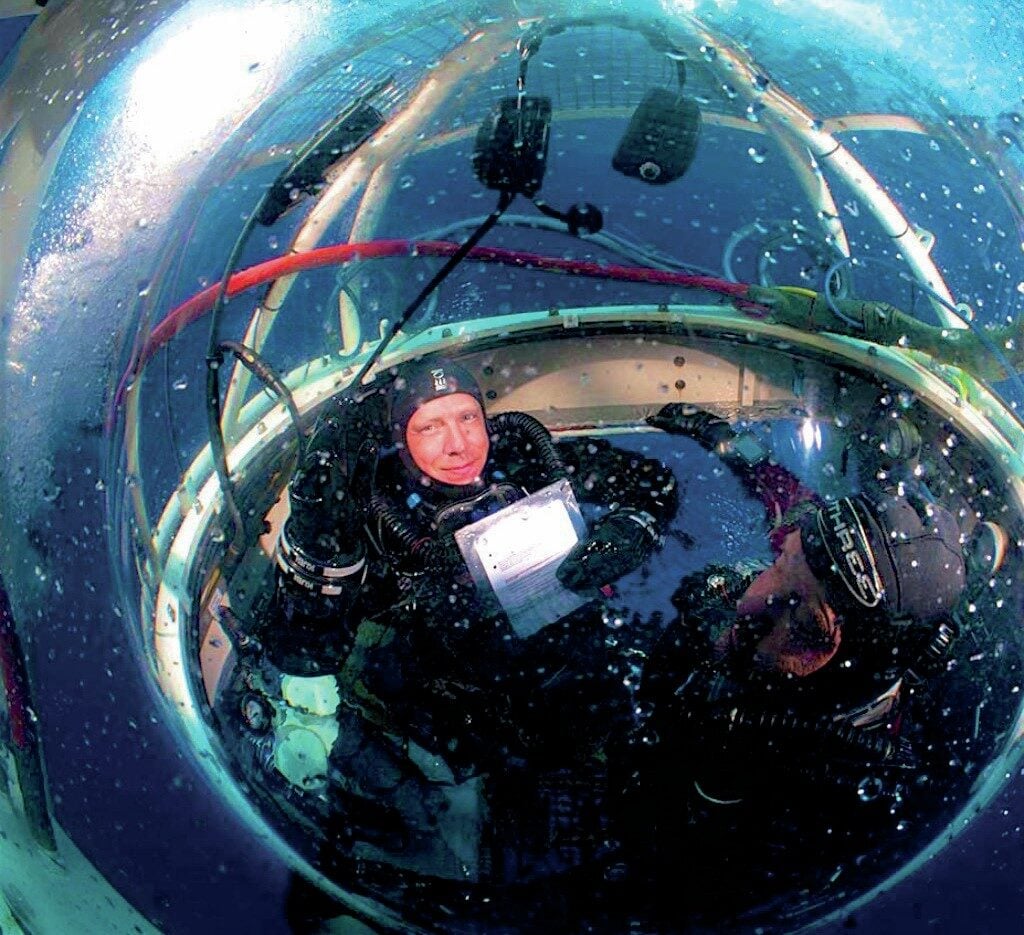
We stepped off the research vessel and dropped into the azure blue. But as we drifted down, freefalling through the water column, the abundance of natural light diminished. However, the combination of water clarity, with almost 30 metres visibility, and the over-head sun meant we could easily make out the shipwreck as we touched down on her port side. But this ambient light, although sufficient to navigate the shadowy remains of this giant vessel as she stretched out almost 300 metres in length, was not enough to discern the details, colours and textures we needed to film.
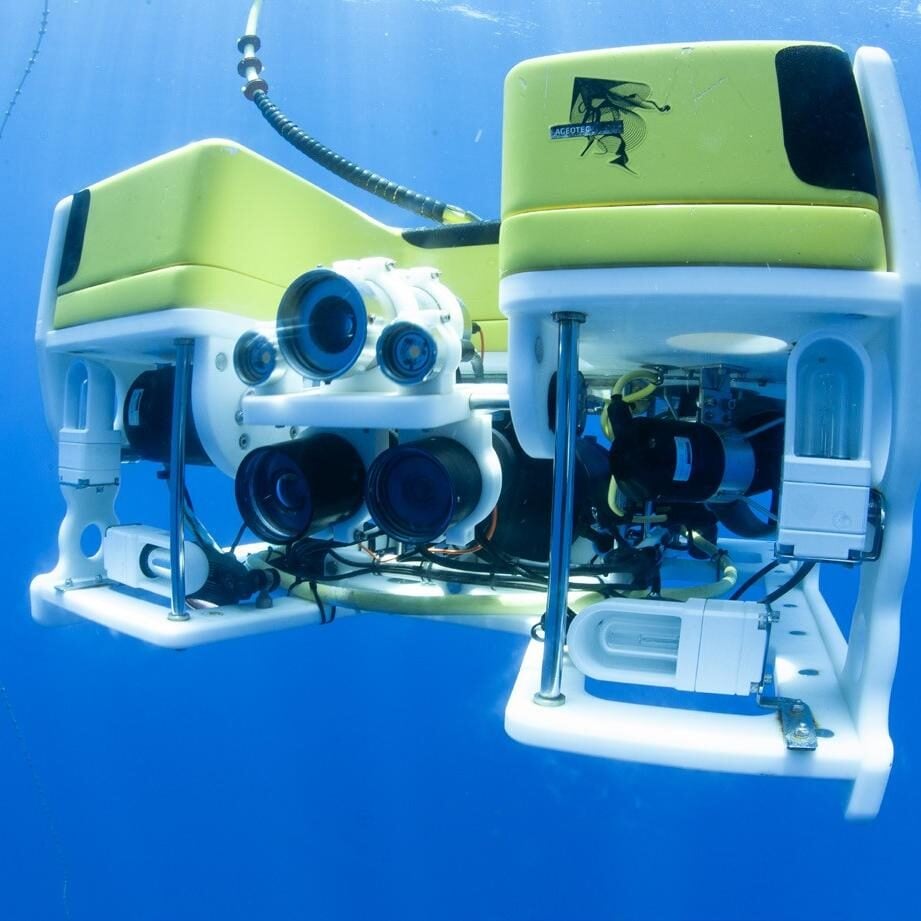
We had known this would be the case and Evan Kovacs, the cameraman on this trip, had mounted huge, twin filming lamps to his camera. And we had another ace in the hole. To be able to light up huge sections of the ship, to really capture the vast metallic landscape, we needed to floodlight whole areas. Fortunately, our dive boat was better equipped than any I’d ever been on. The crew deployed a large ROV and a three-man submersible, the latter of which had lights to illuminate panoramic shots of the ship, with the tiny divers among the wreckage, giving true scale to the scene.
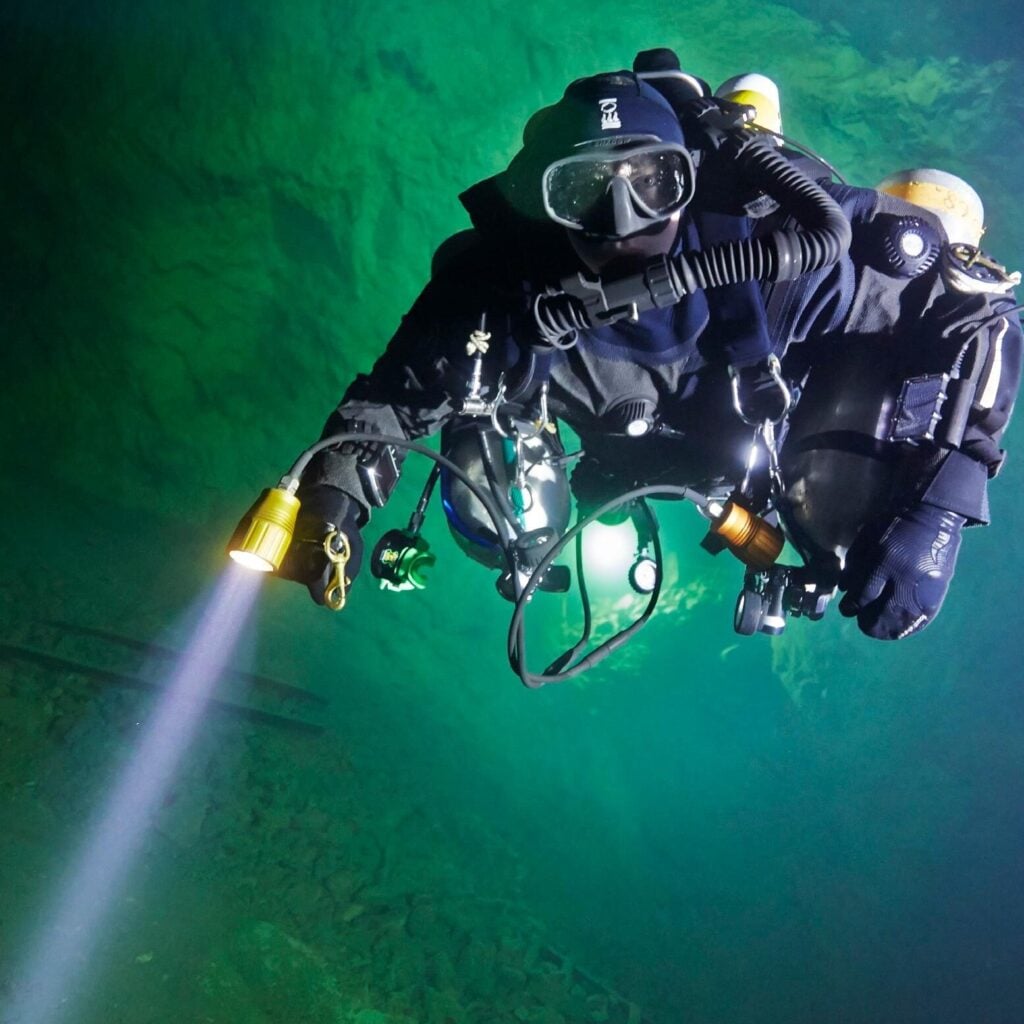
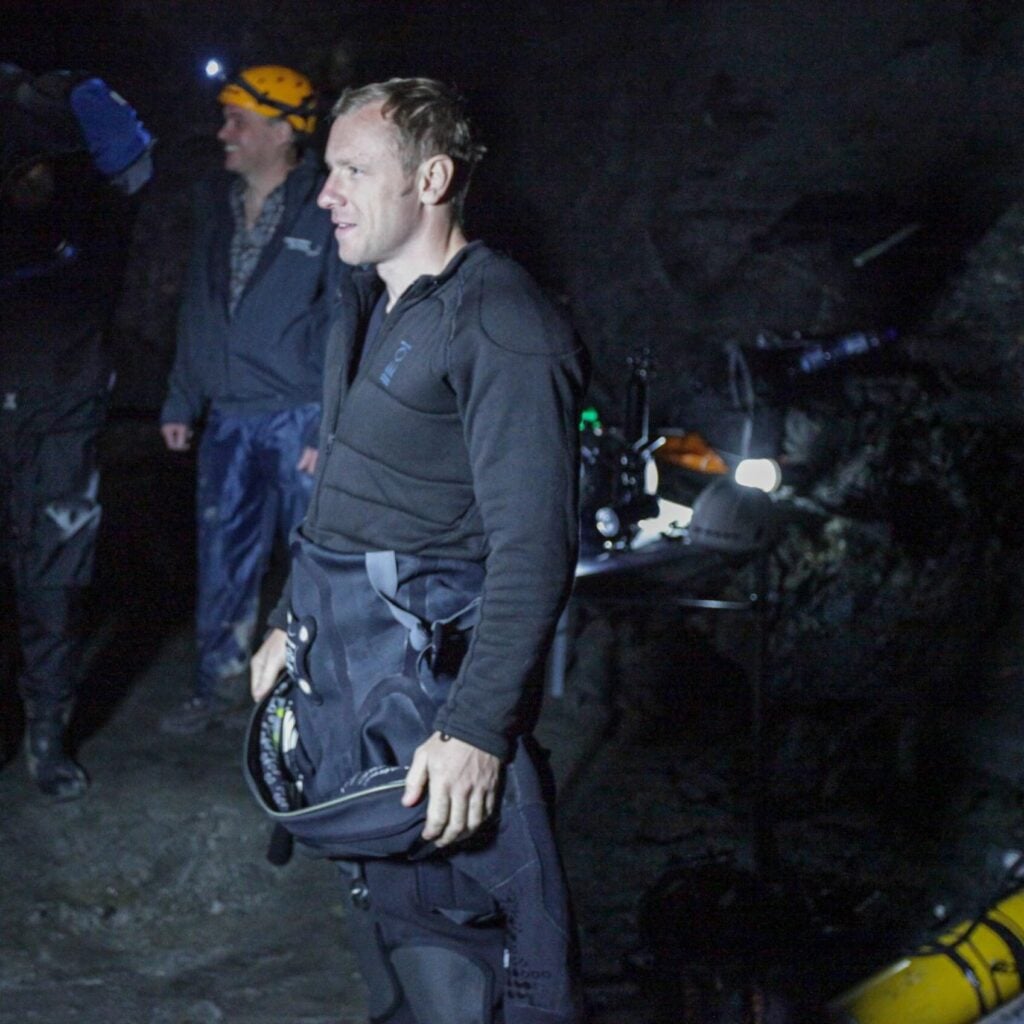
There is a lot to think about when deep diving or cave diving. Add to this the tasks of operating a camera, lights, presenting to camera underwater, keeping track of shot lists and scripts, improvising shots and scripts if the situation underwater is not as expected or something interesting happens, and you create a long task list. You are there to do a job, the diving is merely the vehicle to get you to your place of work. But when that place of work is in total, or near-total, darkness, the job becomes all the more difficult and often the lighting plan, regardless of how technical and difficult the diving may appear, will become the most in-depth part of the brief. These dives are opportunities to show your audience something few people, even divers, will ever get to see, but if you can’t come back with the right shots, then there was no point going in the first place.
Frequently Asked Questions
Why is lighting so challenging in underwater or cave filming?
Water absorbs and scatters light, reducing brightness and colour. In caves or mines, there’s no natural light at all—so artificial lighting becomes critical to capture usable footage.
What types of lights are best for filming underwater?
Wide-beam, high-intensity LED lights are preferred for even illumination. Many filmmakers also use multiple low-power lights to balance contrast and avoid harsh shadows.
How do cave divers prevent visibility issues when filming?
They minimise team size, position lights carefully, and use low-power settings to reduce backscatter. Proper planning and communication are vital for clear, cinematic shots.
What’s the difference between filming in caves and open water?
Caves are enclosed, pitch-black, and often silt-filled—so space, visibility, and safety constraints are greater. Open-water filming benefits from ambient light and easier access.
How do professionals ensure safety while filming technical dives?
They follow strict dive plans, limit personnel, use rebreathers to avoid bubbles that disturb the site, and maintain constant communication among the filming team.
This article was originally published in Scuba Diver Magazine
Subscribe today with promo code DIVE1 — enjoy 12 months for just £1!
