If you’re planning next year’s calendar for a dive-club or group and want to ensure that all qualification levels are catered for – and that you get to try something new – 2026 could be the year to explore some ‘dives with a difference’.
For members interested in history and nautical archaeology, and keen to learn about new wreck-sites and, potentially, acquire new skills, diving on protected wrecks can add purpose and variety. KAREN MOULE highlights some protected UK wreck sites worth including in your plans…
Diving in the UK offers far more than just reefs and familiar wrecks, because beneath the surface lies a world rich with stories of human ingenuity, scientific development and discovery.
When divers choose experiences that offer more than a standard dive-profile – whether that’s volunteering to join a survey project, exploring a virtual dive-trail or diving a protected wreck responsibly – they gain a deeper appreciation of our underwater heritage and its hidden stories.
Underwater heritage sites provide a rare opportunity to glimpse the past. Shipwrecks, ancient trade routes and forgotten structures reveal how society lived, travelled, fought and adapted to changing seas.
Safeguarding these sites from modern threats such as marine industrialisation, offshore development and unauthorised human interference means protecting knowledge – and diving them with care allows us to experience history first-hand.

Among these special sites are England’s 57 legally protected wrecks, shielded under the Protection of Wrecks Act 1973 and designated not to restrict access but to ensure that visits are carried out responsibly.
While rules and licensing can sometimes discourage divers, access is far easier than many believe – and these dives can be some of the most rewarding in UK waters.
Why protected wrecks?
Protected wrecks spark curiosity and a unique experience, delivering an unforgettable dive. With the right permissions any diver can dive these sites on a “look-don’t-touch” basis, enabled to photograph, capture videos and conduct non-intrusive surveys.
For clubs planning something special, protected wreck projects can also introduce new training pathways, such as archaeological skills, documentation, photogrammetry or participation in long-term monitoring under the guidance of a licensee.
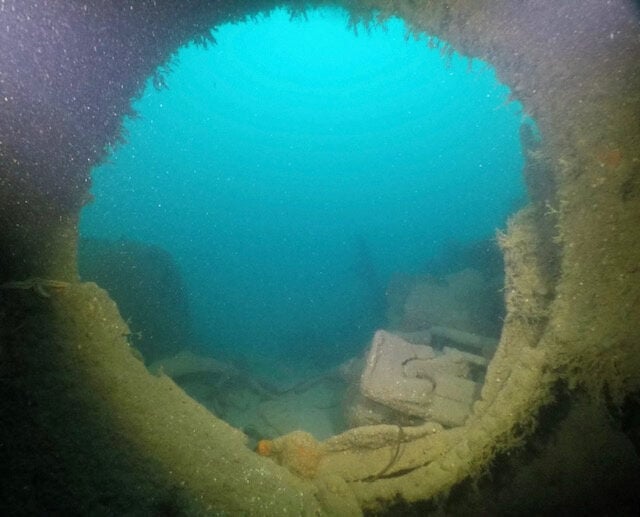
A licensee is a voluntary custodian, not the owner, of the site – and protects, rather than prohibits, access to it
Access is co-ordinated through heritage bodies such as Historic England, Cadw, DAERA (Northern Ireland) and Historic Environment Scotland, which liaise with wreck licensees to enable diver access and planned diving on a site. The systems in place are designed to enable responsible diving rather than prevent it.
Trails, tech and training
Thanks to a grant from the Garfield Weston Foundation, the Nautical Archaeology Society (NAS) has been visiting clubs across the UK delivering talks and hands-on skills workshops – from simple recording techniques to surveying simulated wreck layouts in pool sessions.
Many clubs that begin with these sessions later progress to diving protected sites, contributing meaningfully to maritime heritage research.
For divers looking to explore before getting wet, virtual dive trails offer immersive previews of protected sites, helping club-members to plan or simply enjoy them digitally.
These models – created via underwater video and 3D photogrammetry – allow both non-divers and divers of all grades to enjoy and study heritage sites. Take a look at the NAS dive trails here.
Some sites also feature physical underwater trails, guiding visiting divers safely and helping to protect fragile archaeology.

The NAS runs Protected Wreck Days, which are ideal for clubs wanting to experience these wrecks without the admin. It can arrange one with the licensees of HMS Invincible and HMS/m A1 (see below), because both wrecks are located near the NAS base in Portsmouth, a short distance offshore.
These opportunities allow divers to experience purpose-driven diving, with every visit helping to monitor wreck condition, document change or capture data for future research.
The following wreck-sites are ideal for introducing your club to protected wrecks and nautical archaeology:
HMS Coronation – Protected Wreck since 1978

HMS Coronation was a 90-gun English Second Rate warship built in 1685 at Portsmouth as part of the Thirty Ships Programme. Measuring 49m with a 14m beam and displacing around 1,450 tonnes, she carried a crew of 660 in wartime.
Coronation saw action at the Battle of Beachy Head in 1690, flying the flag of Vice-Admiral Sir Ralph Delaval of the Blue Squadron.
On 3 September, 1691, after patrolling for the French fleet, the English Fleet turned for Plymouth. Caught in a strong south-easterly gale while rounding Penlee Point, Coronation foundered with the loss of all but 13 crew, including her captain, Charles Skelton.
Contemporary accounts conflict: some witnesses claimed that she capsized, while others believed she stranded on the rocks. She might have broken apart as she went down, or after striking the land.
Her identity is certain, however – a large pewter plate bearing Captain Skelton’s personal crest confirmed the wreck as Coronation.
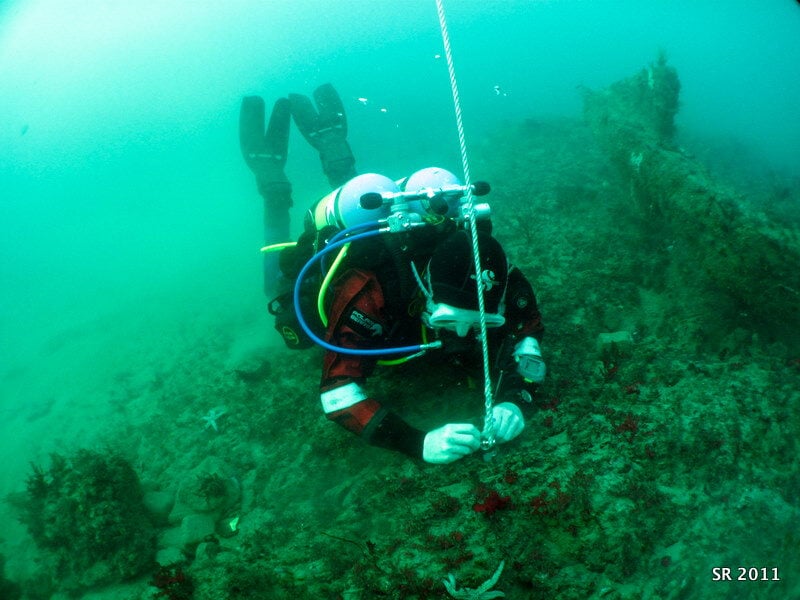
In 1977, the Coronation Archaeology Group located the site using a proton magnetometer, revealing iron cannon and that pewter plate. Surveys between 1981 and 1984 identified 83 cannon scattered across a 1,000sq m area off Penlee Point.
Further magnetometer work in 1996 and an acoustic 3D survey in 1999 expanded understanding of both the offshore and inshore sites, which continue to be mapped and monitored.
The offshore site lies about 16m deep and features a well-designed diver trail established in 2011. Ten buoyed stations guide visitors past cannon, anchors and other features, with Station 1 positioned at the impressive 5m-long Anchor A.


The site also features prolific marine life, with several cannon inhabited by conger eels. A full trail guide is available here.
Even today, after 335 years on the seabed, items of significant interest are still being found, such as an intact pewter chamber pot spotted this year! The diver trail is only one part of Coronation’s story, with a range of artefacts found to date being looked after at the Devonport Naval Heritage Centre.

Divers can visit the wreck using their own boat through the site licensees, or via local charter vessels. Individual divers can also request access via the website, ideally with a month’s notice.
During summer, organised “Coronation Evenings” offer extended guided tours of this remarkable protected wreck.
HMS Invincible – Protected Wreck since 1980

Originally built for the French Navy in 1744, L’Invincible was captured by Admiral Anson at Cap Finistère in 1747. Her design proved so influential that she became the model for the Royal Navy’s highly successful 74-gun class, giving her a significant place in naval history.
Recommissioned as a British Third Rate ship, HMS Invincible was lost in 1758 when her rudder jammed and she struck the Horse Tail sandbank in the eastern Solent.
Although flooding was initially contained, worsening weather drove her harder onto the bank. Pumps failed one by one, and despite efforts to lighten the ship by transferring stores and guns to hoys (small boats), all four chain pumps eventually broke. After three days she rolled onto her beam-ends and was completely wrecked.
The site was rediscovered on 5 May, 1979 when an Eastney fisherman recovered a timber with a treenail while trawling. Returning with two local divers, he helped to raise artefacts throughout that summer.
A pre-disturbance survey in 1980 identified guns of 9-, 24-, and 32-pounder calibres dating prior to 1760, along with rammer heads, tampions and a cartridge pouch marked with the George II crown.
The ship now lies on her port side at about 46°. This portion of the hull is intact, though the vessel appears to have broken her back.
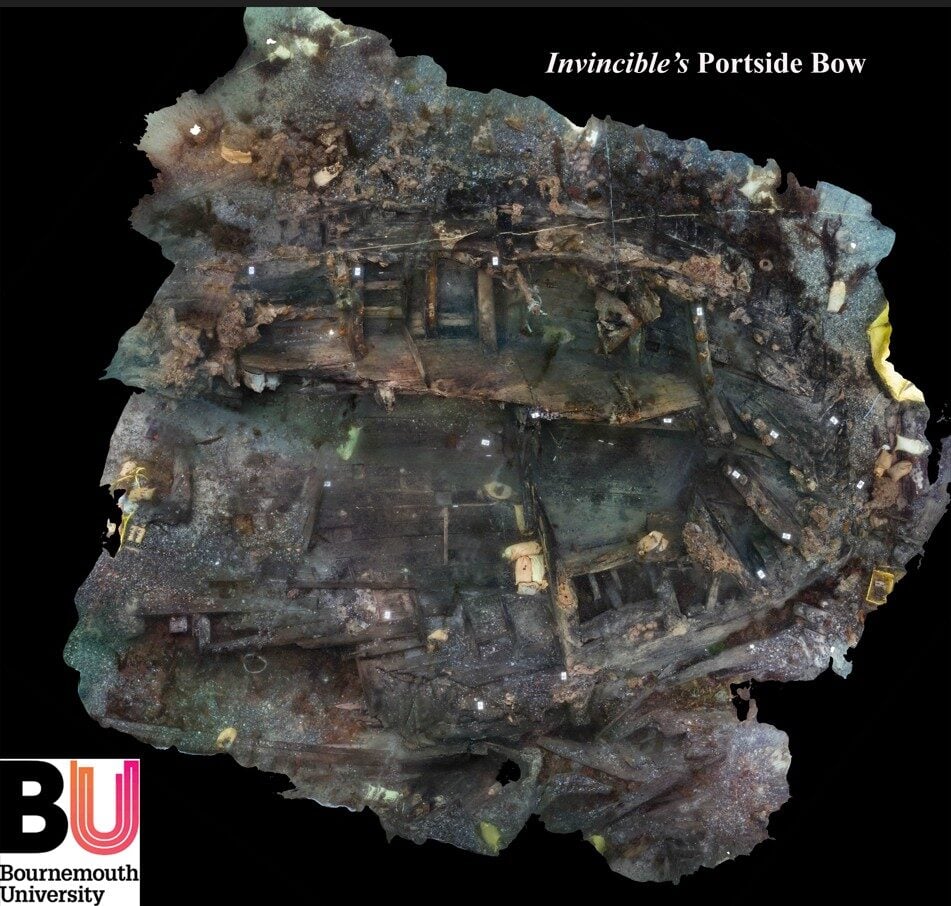
The wreck rests on the flat sands of Horse Tail Sand, where mobile sediments and fluctuating seabed levels frequently expose and conceal remains.
Depth across the site ranges from 7 to 9m, with additional starboard-side structure lying nearby. Finds have included sandglasses, a bronze adze, a cooper’s setter for opening barrels, cartridge cases and army buttons from 13 regiments.

Magnetometer readings show cannon scattered up to 200m south, consistent with 24-pounder guns being jettisoned during the stranding.
Shallow and historically significant, Invincible offers divers of all grades a rare opportunity to experience an important 18th-century warship that was last afloat 267 years ago.
Iona II – Protected Wreck since 1989
Built in 1863 at Govan for the Clyde ferry service between Glasgow and Ardrishaig, the 75m Iona II was an elegant iron paddle-steamer originally featuring luxury accommodation, a 22m dining room and 55m saloon. Her narrow hull and advanced twin-cylinder oscillating engine reportedly gave her a remarkable top speed of 24 knots.
Owing to her speed she was purchased by Charles Hopkins Boster of Virginia for use as a Confederate blockade-runner.
To make her fit to cross the Atlantic, she was stripped of her fittings and had strengthening plates installed along the length of the deck, along with additional hull-frames and the sides of the vessel increased in height.


Travelling from Waterford Harbour to Queenstown on 16 January one of the firemen, George McColl, noticed some water in the hold and a loose rivet, which was stopped up.
When the order was given to set sail on 28 January, 13 of the firemen refused to work on the grounds that they felt the vessel was unfit to cross the Atlantic.
Nine men were jailed and four returned to duty, setting sail on 30 January, 1864. They were bound for Kingston, Jamaica via Madeira, carrying an undisclosed cargo and a crew of 40.
Potentially running without lights to avoid detection, as the weather deteriorated the Iona II steadily took on more and more water, finally foundering a mile east of Lundy Island on her first transatlantic crossing.

Her clandestine role is supported by the absence of her name from official port clearance records and reports of rapid salvage attempts using a diving bell shortly after her sinking.
Even though the nine firemen who mutinied were proved correct in their assessment of the vessel’s seaworthiness, they still had to stay in jail for a month!
The wreck was rediscovered in 1976 by professional divers searching for the nearby mv Robert, lost the previous year. Lying upright in 24m south-east of Tibbett’s Point, the Iona II became the focus of early survey and recreational diving.
When assessed for designation in 1989, the Archaeological Diving Unit (ADU) recorded that the vessel survived up to the turn in the bilges from bow to stern, with boilers and machinery standing proud of the seabed.

The paddle-wheels had collapsed, though all components except the wooden paddles remained. Light angle-iron frames reinforce the hull-plating.
Subsequent surveys – including work by Potters Bar SAC, the ADU and Malvern Archaeological Diving Unit – documented structural collapse, anchor and fishing-gear damage, and unauthorised interference. Redesignation later adjusted the restricted area to exclude the Robert.
Today, the NAS frequently organises visits to the Iona II to help monitor its condition. With its modest depth and proximity to the Robert, it offers an excellent opportunity to introduce club divers to nautical archaeology.
HMS/m A1 – Protected Wreck since 1998
Built by Vickers in 1903, HMS/m A1 was the first British-designed and built submarine to serve with the Royal Navy. Though she never saw active service, her career was marked by misfortune.
In March 1904, during exercises, she collided with the liner Berwick Castle and sank with all 11 crew. Raised a month later by the Neptune Salvage Company, she returned to service for training and anti-submarine experimentation.

Her later years were equally troubled. An explosion in 1910, caused by gas build-up, injured seven men. On another occasion when around Land’s End while being delivered to Portsmouth the crew abandoned ship as seawater reacted with her batteries, filling the vessel with chlorine gas.
Declared unfit for service, A1 was used as an unmanned target during trials. In August 1911, operating under automatic pilot, she sank off Selsey Bill.
Although the wreck was marked, it disappeared overnight – likely carried several miles by strong tides through residual buoyancy. Efforts to relocate it failed, and the search was abandoned.
A1 was rediscovered on 12 May, 1989 after a fisherman snagged his nets on the wreck. Sold by the Ministry of Defence in 1994, today the submarine lies in about 12m of water, largely intact and partially buried in soft sediment.

When assessed by the ADU in 1997, the bow torpedo hatch was found closed and much of the pressure hull remained intact beneath corroded plating, though exposed pipework and missing sections indicated deterioration. Evidence of interference from divers, fishing activity and anchoring vessels was also observed.
The wreck was designated in 1998 with a 100m exclusion zone, but this did not deter divers from interfering with the site.
By 1999 the vandalism had worsened: the torpedo loading hatch previously secured by divers was forcibly opened, and internal inspections revealed that while wooden fittings survived in excellent condition, several artefacts had been removed.
Clearance divers from Southern Diving Unit Two subsequently resealed the submarine and the site’s exclusion zone was increased in 2004 to 300m.

Further surveys in 2003-2005 – including sub-bottom profiling, magnetometer work, multibeam sonar and targeted diving by Wessex Archaeology – helped to clarify surrounding seabed features.
Two anomalies lying close to the site were investigated. One turned out to be a corroded metal buoy, perhaps part of the A1‘s towing mechanism; and the other an unidentified metal object not belonging to the A1.
Accessible at shallow depth and virtually intact, HMS/m A1 offers divers of all grades a rare opportunity to explore Britain’s earliest submarine design and experience a unique and historically significant wreck.
How to get involved
For more information on joining the NAS for Protected Wreck Days, or if you’re interested in participating in any of the NAS training programmes, contact the society by email nas@nauticalarchaeologysociety.org or call +44 (0)23 9281 8419.
Also on Divernet: Pin Wreck the undersea highlight of 2025 heritage listings and The immersive world of underwater archaeology