
Diving in the dark is a very exciting part of our sport and so we wanted to load you up with some essential night diving tips. The thrill of kitting up under the lights on the dive deck, surrounded by inky blackness. The trepidation of a giant-stride into a black sea. The other-worldly effect of dive lights stabbing through the darkness during the dive. Even dive sites you are familiar with take on an eerie feel on a night dive, and you have to dive in a different way, focusing on what is illuminated by your dive light. But what should you ensure you always have when you embark on a night dive?
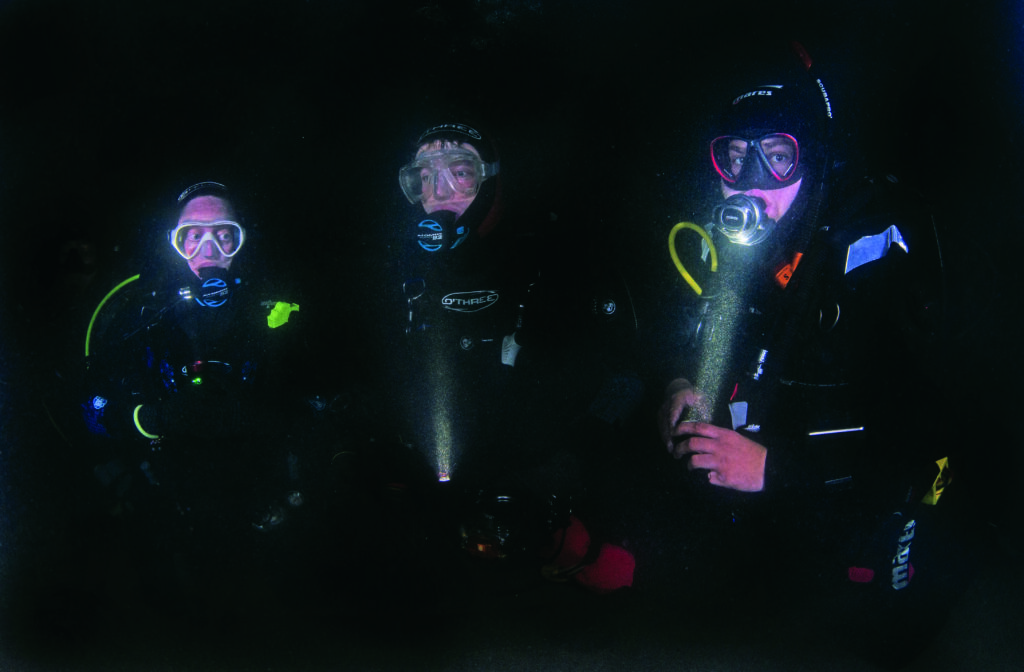
Essential Night Diving Tips – Equipment for Night Dives
Vikki Batten, PADI Examiner, Course Director and TecRec IT, said: “Invest in a really good light. Check out what tech divers and photographers have, and ask them the pros and cons of their choices. Battery and bulb technology has improved in leaps and bounds over recent years, so you can get excellent lights that are small enough to carry on every dive. Don’t forget to tailor your choice to the type of diving you do – e.g. if you want to use an action camera underwater to film creatures at night, you’ll need something different to someone whose main purpose is getting the best view of the underwater life that comes out in the dark and communicate with their buddy.
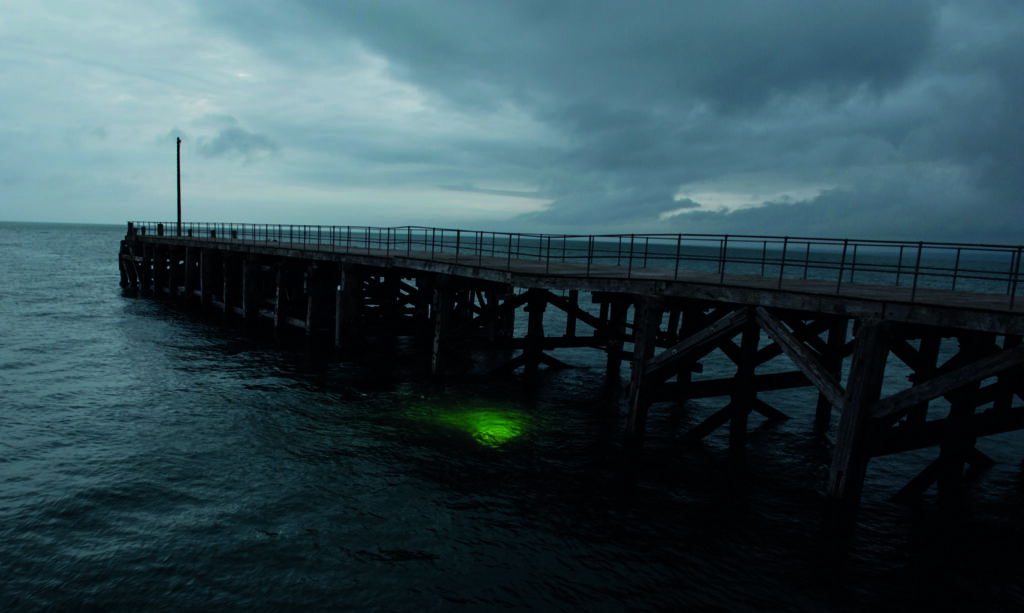
Emily Petley-Jones, PADI Regional Training Consultant, commented: “Night dives are my favourite type of dive. Observing the differences in critter behaviour at night is truly mesmerising. Having fully charged primary and back-up lights are the obvious considerations when preparing for a night dive. However, careful consideration should be given to the strength of the light you are taking down with you.
There are many lights which have super-strength flood which are so strong that they can dazzle the other tech divers and create the effect of daylight, but one could argue that if you want to replicate the effect of daylight, why are you on a night dive? This is very much a personal choice. For myself, the most-important thing is getting a torch with a robust switch so I can easily turn it off and on again should I need to. There are some underwater lights where to turn it on you have to rotate the torch head. It is possible for divers to fall foul of not being able to remember which way to turn the torch head, to turn the light back on again, and end up flooding the torch by unscrewing this too much.
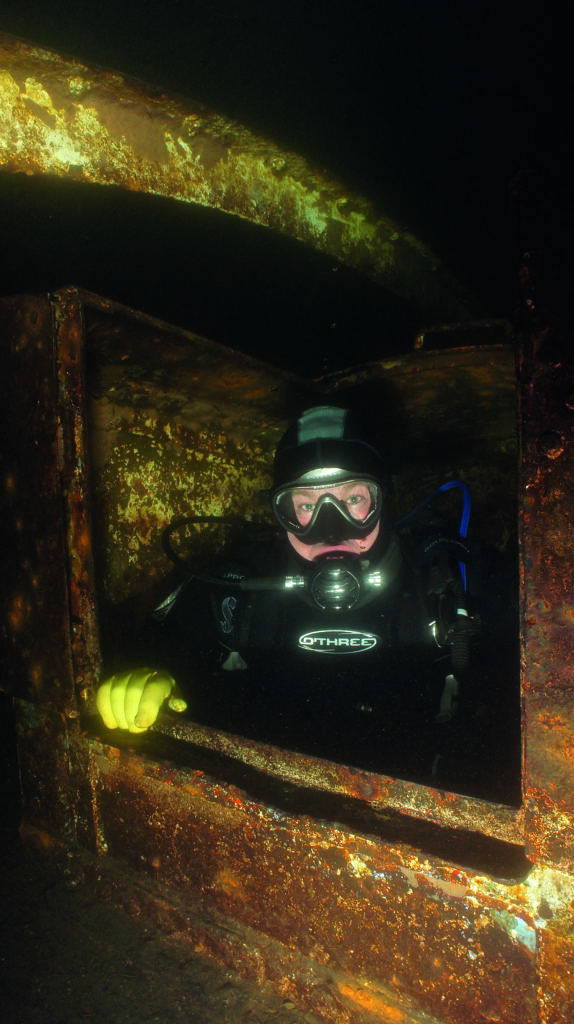
BSAC National Diving Officer Dai Atkins said: “Hello darkness, my old friend… my torch has failed on me. Again!I wish I had put a spare in my bag, Hopefully, this is what you’ve actually done, because night diving is ever so slightly more prep-heavy than day diving. Not only do you have to remember all the stuff you need for diving in the day, you also need to add some extras – and take some additional precautions too.
Essential Night Diving Tips – Getting The Right Dive Light
“There are some pretty standard practices when it comes to diving in low light conditions to ensure it’s safe. A good night diving tip is to only night dive on sites you are familiar with is one – so select sites you dive regularly during the day and you will be less likely to become disorientated now that conditions have changed. Stick to areas of calm water – different conditions at depth may not be readily recognisable from the surface, and surfacing in a remote area far from shore cover is particularly high risk if surface conditions are challenging. And finally – be seen! Give surface support a sporting chance of locating you, both when you’re at depth and when you finally pop up!
“Lights of all kinds are key here – torches and a back-up are obvious essentials for the kit bag, but also strobes and glow-stick type devices are handy to help your buddy locate you underwater and for surface support to spot you. To avoid the higher risk of separation, a buddy-line might be a good idea and unless you’re absolutely certain you’re going to remain static, a surface marker buoy equipped with a permanent light of some description will enable you to be tracked from the surface. The boat or shore cover should be equipped with a spotting lamp to help look for your bubbles and avoid hitting you, and while everyone likes to look cool in black, there’s a valid reason here for wearing your hi-vis day-glo orange 1980s exposure suit! Don’t forget it may be cooler at night too, so up the thermal protection to avoid catching a chill and pack something warming in your thermos flask.
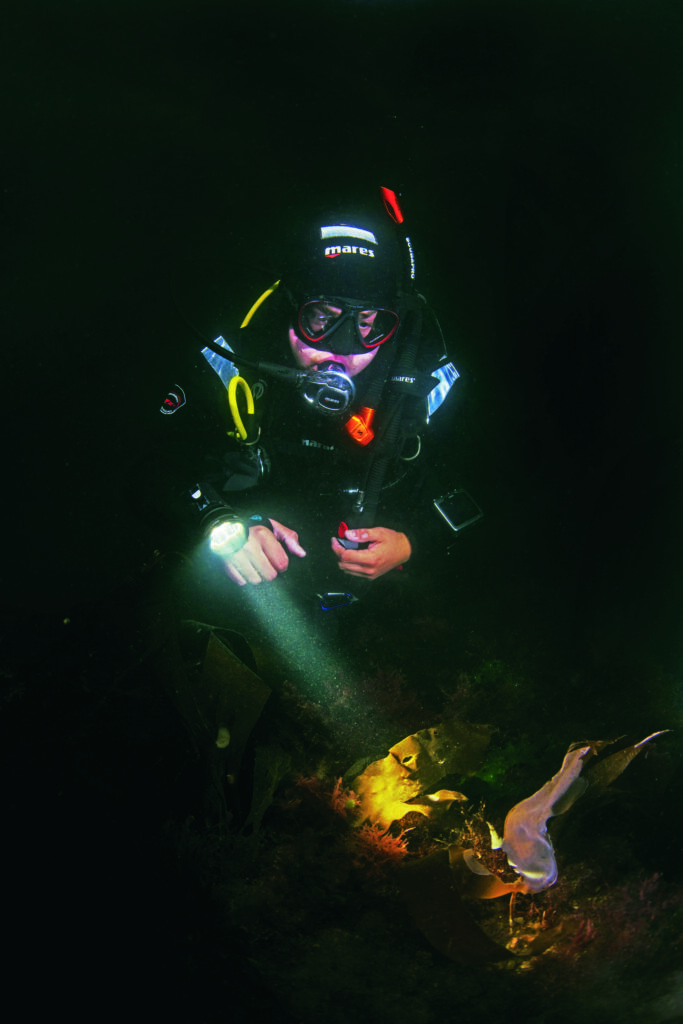
“Diving in moonlight often gives a lot more ambient light to the water surface, and other fixed points of reference such as a shore party or boat location can be improved by having some kind of beacon-esque device – so maybe a beach BBQ or a campfire can help you maintain a datum to the shore, or stick a strobe on the shotline. If you surface under a delayed SMB, this can be illuminated by sticking your torch inside it – but beware of subsequent reports of offshore alien beings to the local papers if you haven’t touched base with the proper authorities about your intentions (don’t ask me how I know).
“Sound on the surface is another way of pinpointing you position should you get separated from your group and your light has failed – so whistles, air-horns and other noisy things are all worth sticking in your jacket pockets, and if you have access to a personal locator beacon then all the better.
“As well as the safety side, don’t forget to take your camera and all the spare lighting paraphernalia you need to take those magic shots (video lights, strobes, reflectors) and ensure they are all fully charged! Focusing objects in a torch beam gives a different framing perspective, and the colour of marine life is often much more vivid against a darker backdrop. Wrecks look much more mysterious and often ghostly and some nocturnal marine life exhibit bioluminescence, which is certainly something you won’t want to miss!”
Essential Night Diving Tips – Planning and Preparation
SDI/TDI’s Business Development Manager Mark Powell said: “Diving at night may seem daunting at first. However, more often than not, I see divers fall in love with it. It truly is one of my favourite types of diving. With the proper equipment and the right planning, it can be a fantastic experience.
“So, why do we bother diving at night in the first place? The environment completely changes. The same dive site you have seen multiple times turns into a whole new world. As the sun sets, a shift in wildlife occurs. An amazing new array of creatures emerges from their homes. Octopuses come out from their hiding holes to hunt. Squid dart in and out of your vision and lobster travel in packs across the ocean floor. Many fish will settle down into any available nooks and crannies to rest for the night while others will be out and active. This means that you will see a completely different ecosystem when compared to diving the same site during the day.
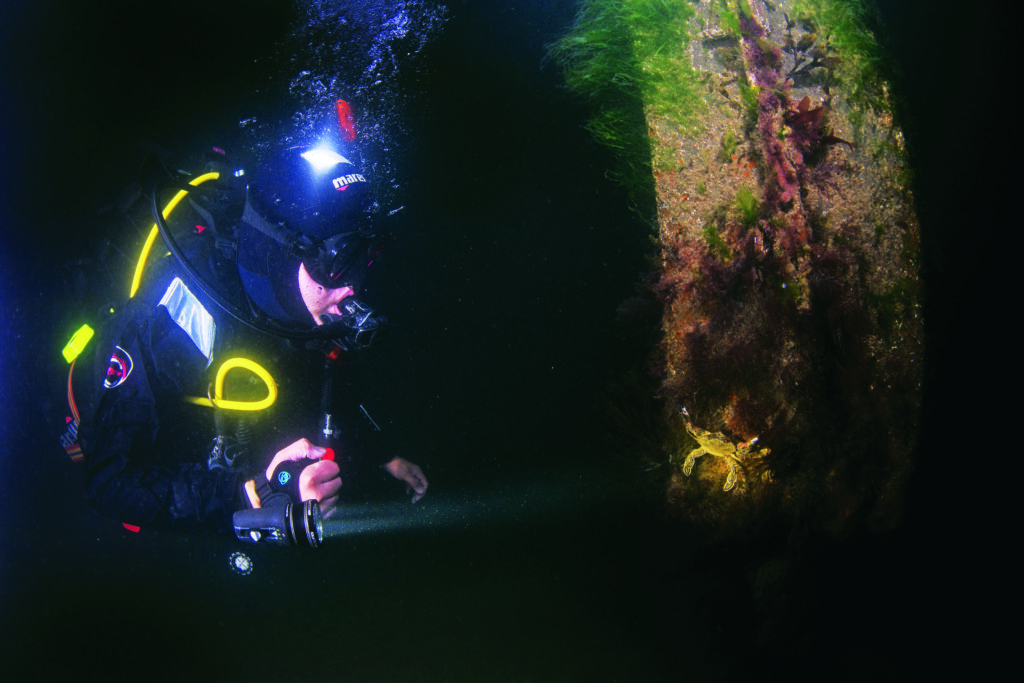
“As you learned in your Open Water course, colour becomes absorbed by water the deeper you descend. However, during a night dive, you are continually reintroducing the spectrum of light. This causes the scenery to be illuminated in a dazzling show of colour. My favourite feature of night diving is the bioluminescence. If you cover your light and wave your hand around, you will see a fantastic glow of blue and green specks similar to a field of fireflies. Many marine organisms such as bacteria emit light due to chemical reactions occurring inside of their bodies. Observing the underwater world at night is one of the most-unique diving adventures you can encounter.
“Going on a night dive begins with solid preparation. Make sure you are familiar with the site you are going to dive. Choose a location you have dived before or scope the site out during the day beforehand. Knowing the layout will make navigation a breeze and will help you feel more comfortable throughout the dive. After you have picked a location, try to arrive just before dusk. It is much easier to gear up and plan out your route while there is still light. While you set up, conduct a thorough briefing with your buddy. Go over the dive plan and review all of the key hand and light signals you will be using.
A circular motion with your light means ‘okay’ while a side-to-side motion means ‘attention’. Talking about these signals will ensure you and your team are on the same page. I also like to touch on buddy separation procedures. My dive partner and I have agreed to look around for no more than one minute before surfacing. Then we can reunite and continue our dive. Before you enter, mark your exit with a light or by using some prominent landmark. This facilitates an easy return by giving you a heading to swim for at the end of your dive. During the dive, try to stay shallow, stay close and go slow. Limiting your depth allows you to extend your bottom time and see all of the cool things night diving has to offer and you will have more fun knowing your buddy is nearby. Lastly, there will be a ton of new night life, and going slow helps you take it all in.
“There are some additional equipment requirements associated with night diving.Of course, a good light is necessary to enjoy the dive. Actually, two good lights are required. Dive lights come in water/pressure proof housings. They are rugged and capable of enduring the underwater environment. Over the years, light technology has improved drastically. Battery life has gotten longer and the bulbs are burning brighter than ever before.
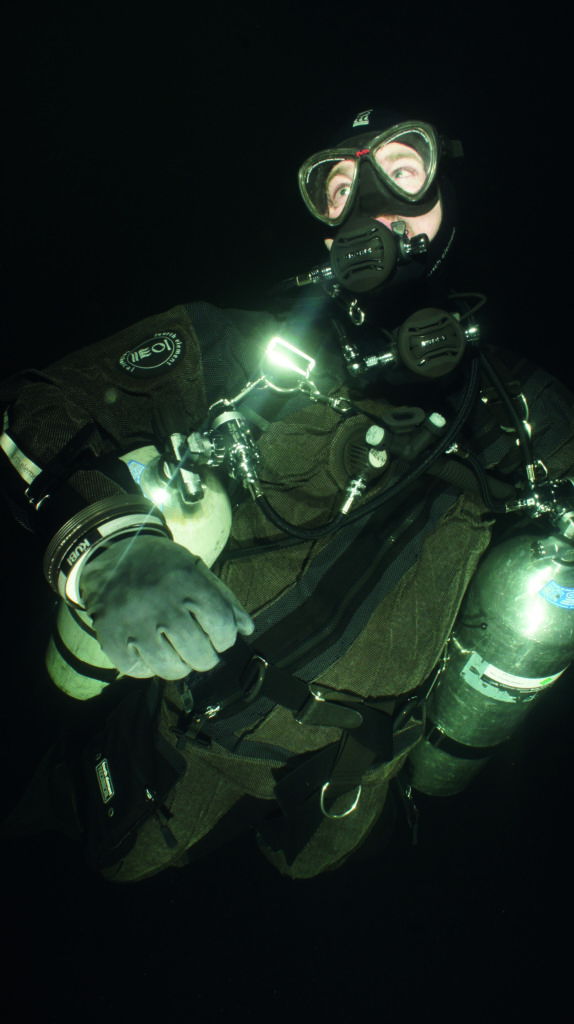
When purchasing your first dive light for night diving, look for solid construction, common battery types, sufficient brightness, and appropriate ‘hot-spot’ for signalling. AAA, 18650 Li-polymer and 26650 Li-polymer are common battery types for dive lights. ‘Hot-spots’ are the middle area of a beam where the light is most focused and brightest. These are critical in night diving for signalling your buddy, so you’ll want to avoid lights that have no hot spot. Your back-up light should have all these attributes and should be well taken care of as it is an important piece of backup equipment if your primary should fail. Your local dive shop can help you compare the myriads of different dive lights. One tip is to attach a boltsnap to your light just in case you want to clip it off.
“While you are using your light, be very careful not to shine your buddy in the eyes. He or she will not appreciate being blind for the next few seconds. Not only do you need a primary light, you also need a back-up light. In case your primary light were to ever fail, your back-up light allows to you make a safe, controlled ascent. It is important to call the dive if any team member experiences a light failure. Other useful pieces of equipment are light sticks or marker lights.
Light sticks can be attached to the tank valve. This makes you and your buddy easily identifiable underwater. Marker lights can be attached to an anchor chain or an exit point to help you find your way back home. Putting a marker light on your SMB allows for quick reunification in case you and your buddy get separated. Finally, compasses are very important tools to help you navigate underwater. Make sure to get one that has a glowing dial. They are far easier to use when they stay illuminated after a brief flash of your light.”
The Glory of Night Diving
IANTD’s Tim Clements said: “Night diving not only offers an additional insight into the underwater world, but it also challenges the use of our own major sense – sight. If you’re going to night dive ‘like a pro’, you’ll need to learn how to use additional senses, such as touch and have excellent navigational skills. By tapping into and developing these skills sets on recreational night dives, you can also prepare for more-challenging deeper dives.
“A pro would ensure that they have sufficient illumination for both orientation to the environment and signalling between divers. A pro would also ensure that torches were sufficiently charged and backed up with an additional torch in case of failure.
DSC08554.jpg
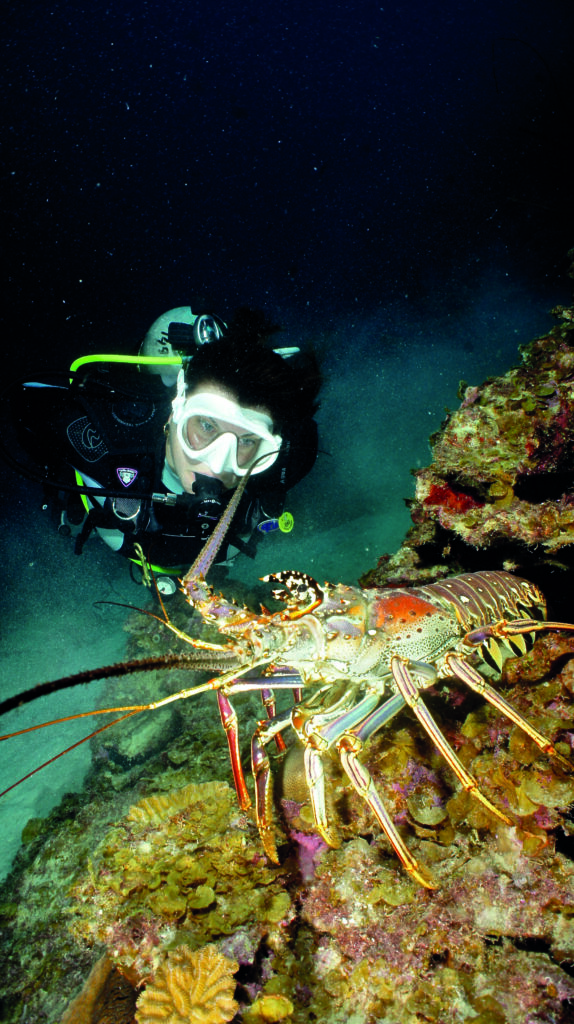
“Night diving like a pro also means more meticulous attention to preparation of diving gear, boat or shore access – any problems at night may be harder to deal with, so preparation needs to be better. Have you got a method everyone understands for diver rescue, or location at the surface? Do you have good shore support closer than the saloon bar of the ‘Pony and Freeflow’ local pub?
“Underwater, a pro will ensure that all team members stick together and, most importantly, that everyone understands anyone can turn the dive at any time – dark is an odd thing, and taking a diver for a first night dive may be unsettling. It could also be brilliant!”
Night Diving Tips – Frequently Asked Questions
Why is night diving special?
Night diving reveals nocturnal marine life, bioluminescence, and a totally different perspective of familiar dive sites.
What equipment do I need for a night dive?
Essential kit includes a powerful dive light, a backup torch, strobes or glow markers, a compass with a luminous dial, and surface marker buoys.
How do you stay safe during night diving?
A good tip for night diving is to choose familiar dive sites, dive with a buddy, use reliable lighting, and have clear hand and light signals before entering the water.
Do I need training for night diving?
Yes, most agencies (PADI, BSAC, SDI, TDI, IANTD) offer specialty night diving courses that cover safety, equipment, and navigation.
What marine life can I see at night?
Expect to encounter octopuses, squid, lobsters, and bioluminescent plankton. Basically animals and behaviours rarely seen during the day.
Photographs by Mark Evans
