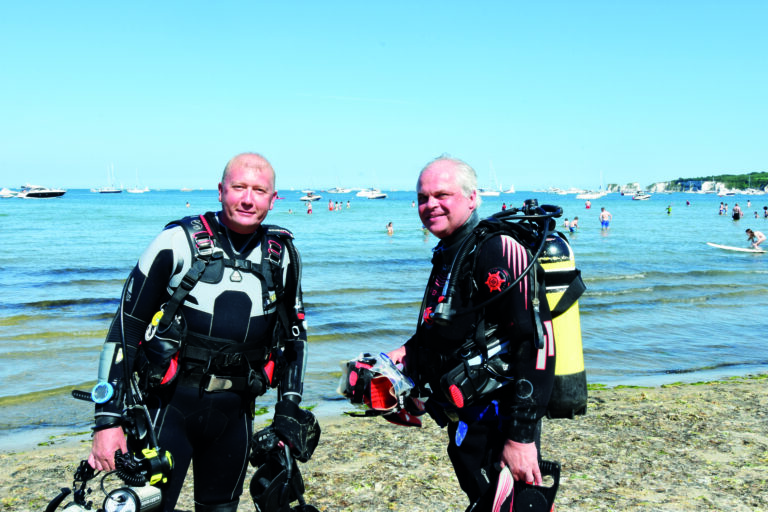
Jeremy Cuff samples the underwater delights of Dorset’s Studland Bay, famed for its seahorses but offering plenty of other marine life species to discover in its shallow waters.
Few people visit Studland Bay in Dorset to dive, choosing instead to visit more traditional locations such as Swanage just along the coast, but it’s an interesting area that enthusiasts of marine life may find rewarding. It takes a bit of planning, but can make for a different kind of diving day or weekend…
Studland is located in Dorset on the South Coast in an area known as Purbeck, between Sandbanks and the pleasant coastal town of Swanage. Its easternmost point forms the entrance to Poole Harbour, which is linked to Sandbanks by a car and pedestrian ferry.
It’s an interesting area to visit on all sorts of levels. Its fabulous beaches are popular with walkers, families and sunseekers, as well as having a quirky niche in terms of a designated nudist area (it’s about halfway between the main National Trust car park at Knoll Beach and the Sandbanks ferry, for those who wish to know it).

It’s also home to a National Nature Reserve (predominantly consisting of heathland) that boasts rare and diverse flora and fauna, including all six species of native English reptiles, such as sand lizard and smooth snake, avian rarities that include the Dartford warbler and the nightjar, and invertebrate species such as the silver studded blue butterfly.
In terms of the marine environment, Studland Bay is sheltered by the headland that culminates in Old Harry Rocks, is very shallow and largely devoid of current unless there’s an easterly wind (which would likely make diving difficult and not worthwhile). It’s also hoped that the bay will be afforded special environmental protection due in no small part to its population of seahorses. Apparently, 2017 yielded the first seahorse sightings in three years, according to the Seahorse Trust.
So why dive at Studland? Well, while researching some different shallow dives, and having previously tried a few interesting ones, such as Lulworth Cove, Bouley Bay in Jersey, Chesil Beach and Balaclava Bay in Portland, I fancied the idea of diving Studland to see what was there. It was, if you will, ‘my naked diving ambition’.
Arrival At The Site
At Studland, there isn’t a specific ‘focal point’ dive site as such, you have to choose where you’re going to go diving. To a fair degree, that’s likely to be dictated by the ease of getting yourself and all your kit to a chosen section of beach.

Those wishing to fulfil any ‘naked diving ambitions’ of basing themselves in the nudist area will soon find out that it’s a long way from the car park and therefore a difficult proposition. Even if you’re intending to indulge in some nude sunbathing between dives, the water temperatures (even in the height of summer) will quickly preclude anyone thinking of extending their nudity to the underwater realm – you’ll definitely need your dive suit for that part of the day, and it’s a very long way to lug all of your gear, tanks and supplies!
Joking aside, this is a dive trip that needs planning and preparation in order to make it a success. To best organise things, I decided to go and have a look, to work out the best way of tackling it. I did this over the winter, combining it with a long beach walk on a crisp sunny Sunday in January.
I needed to solve the issues of where to park, where best to be based, which general area to dive, the ease (or otherwise) of how to get the gear to the area you want to be and then back again, the proximity to facilities (such as car parks, toilets, cafes, etc), and the ability to store the gear while we went for lunch and so on. Added to that, there’s no dive centre at Studland, so visiting divers must bring everything they need.
My early scouting trip proved to be very worthwhile and established the need for some kind of hand-pulled trolley/trailer to transport the gear and supplies, such as a garden trolley with soft wheels (I subsequently purchased one and it proved to be invaluable).

The other ideal scenario was to be based out of a beach hut, which is possible to do via the National Trust. Though we had to wait until relatively late to establish availability, we were able to book a hut fairly close to the Middle Beach Cafe. The hut proved to be a masterstroke, allowing us to hang kit, change tanks and get kitted up in a relatively ‘sand free’ environment, and also giving us the ability to store stuff while we went to the café for lunch.
The other ‘must do’ is to ensure that you get to your chosen car park early enough, so that you’ve got the minimum distance to transport your gear. Studland is popular all your round, but can be packed on hot summer weekends, such as the date of our visit (the weekend of 17-18 June).
Dive Briefing
Once you’ve dealt with the logistics of getting set up in your chosen area, it’s really just a case of going diving in whatever section of the beach you’ve decided upon. It’s a shore entry, and easy for even the most-unsteady of divers, as there’s no incline and hardly any rocks. As already mentioned, we picked the area around the Middle Beach Café. Overall, the biggest considerations are diver safety and perhaps unusually for a dive site, aspects of law surrounding the seahorse population.
Diver safety is a serious point at this site, due to the very shallow depths combined with the presence of boats. As you can expect to get no deeper than 3m on a dive, divers are constantly within the ‘danger zone’ of boat traffic. During our visit, the sheer amount of boats and jet skis were phenomenal, resembling the marina at Monaco during Grand Prix weekend (boat size excepted!), rather than an area of environmental protection. It’s thus essential to ensure that buddy pairs stick closely together and use an SMB at all times to indicate their presence. To not do this would be foolhardy.

Quite rightly, the seahorse population of Studland is protected by law, but in terms of diving, the law puts you in a strange place. It works (I think) something like this – if you go for a dive but find no seahorses (which you weren’t specifically looking for), it’s fine.
If you go for a dive and happen to find seahorses (but weren’t specifically looking for them), it’s fine, provided you behave responsibly and don’t take pictures using flash. If you go for a dive specifically looking for seahorses, it’s not fine (as you need a licence to actively seek them), though if you don’t find them, the fact that you had that intent becomes somewhat diminished. If you go looking for seahorses and find them having previously applied for and been granted the appropriate licence, then fine, provided you abide by the terms of the licence.
As we didn’t go specifically looking for seahorses, nor did we happen to stumble upon them, we didn’t have to deal with any resulting dilemma. At the slight risk to getting a knock on the door, I would admit to hoping to stumble across one, even though I wasn’t specifically looking for them. It’s a grey area, but it’s done for the right reasons.
Though the seahorses are legally protected from the activities of irresponsible scuba divers, they’re probably more widely threatened by the plethora of other human activities in the bay, such as the excessive boat traffic and use of anchors, jet skis and numerous bathers able to walk out a long way due to the shallow depth.
The Dives
As there are little in the way of ‘underwater landmarks’ (if there is such a thing!), the dives themselves are really random explorations of the sandy expanses and weed/sea grass beds. As this can be disorientating (yes, I know we should use a compass), we found ourselves benefitting from the shallow depth at times in order to pop up and check our location, while listening and looking for any nearby boat movements.
There are a few rocks and patches of rubble around the areas between Middle Beach and South Beach which we checked out, and also (I suspect) at the far end of South Beach, though we didn’t try that area. If you visit either of these, you can expect some different kinds of weed growth and species such as edible crabs and tompot blennies.

Most of our time was spent out on the sandy expanses and among the labyrinths of luxuriant weed and sea grass beds where we noted spider crabs (some covered in weed growth themselves), whelks, blennies, flatfish such as flounders, and small secretive species of shrimp skulking in the weed. Perhaps the most-striking and memorable aspect to the dives was the incredible number of anemones; countless thousands of them were attached to the weed and sea grass in particular.
We also spotted schools of bass flashing by, and some sizeable wrasse (including one with a parasite). Other fish sightings included gobies skulking in the weed. We didn’t see any seahorses and perhaps surprisingly no pipefish either. One interesting, but very fleeting encounter was what I believed to be a tiny squid that jetted away, not to be seen again when I went to check it out. Owing to its sheltered geography, the bay also appears to be an important fish nursery, with numerous fish fry being present.
We seemed like somewhat of a novelty among the throngs of beach goers, with kids saying ‘Hello divers’ as we waded out of the water and it wasn’t unusual to strike up conversations with interested adults on the beach, who were curious about what we were seeing. We felt somewhat overdressed for the weather – and very much overdressed for the nudist area!
I would admit to hoping for a bit more, but it was definitely interesting and worth trying again sometime. Perhaps when it’s a bit quieter than what turned out to be the hottest weekend of the year!
“During our visit, the sheer amount of boats and jet skis were phenomenal, resembling the marina at Monaco during Grand Prix weekend (boat size excepted!), rather than an area of environmental protection”
“Most of our time was spent out on the sandy expanses and among the labyrinths of luxuriant weed and sea grass beds”
Dive centres:  -

The first thing to understand about diving at Studland is that there’s no convenient dive centre from which to procure fills, or to hire some piece of gear that you forgot to pack in your kit bag. You therefore have to bring everything you need, including sufficient filled tanks for the amount of diving you plan to do. In many ways, this type of diving involves at least as much planning as a foreign trip. Using a comprehensive packing list is a good idea.

As the dives are super-shallow, we managed two long dives on a single fill, but any visiting diver would have to judge it for themselves. That said, we planned around the ‘one dive, one tank/fill’ policy.

If you do need to get fills or other dive-related supplies while in the area, there’s a dive centre around the headland at Swanage, about four or five miles away. Swanage can be packed with visitors on summer weekends (and therefore difficult to park), so be wary of turning a pleasant day of diving into stress-filled runaround. Much better to bring everything you’re going to need. If you need them for any reason, visit: www.diversdownswanage.co.uk
Type of Dive:  -

Very shallow shore dive (only practical at high tide).

Depth
Depth will vary depending on tides and your chosen entry points. We spent most of our time in the 1.5m-3m bracket, so it’s really shallow. Due to this, you need to ensure you have sufficient weight to stay down.


Marine Life/What To Look Out For
I haven’t seen much written down about the marine life of Studland Bay other than the famed seahorse population, so can only rely on what we encountered on our three dives, which probably scratches the surface of what is possible. We encountered extensive weed/seagrass beds, anemones, spider crabs, tompot blennies (wherever there are rocks or rubble), gobies, schools of bass, wrasse, prawns, flounder, fry/larval fish, whelks and what I believed was a tiny squid. Though we didn’t see any, it’s probable that pipefish and cuttlefish inhabit the area during the summer months. Also, expect considerable seasonal variations as well.

Visibility
This is variable depending on wind direction, run off and other factors, but likely to be one to five metres. We experienced one to three metres at best during our visit. Generally, the further you are from the surfline, the better the visibility.

Seabed

Flat, sandy expanses, extensive weed/seagrass beds, occasional rocks and rubble patches.

Hazards

Boat traffic, jet skis, disorientation, low visibility and slippery rocks/boulders (if entering/exiting the water around some parts of the Middle Beach or South Beach areas).
Photographs by Jeremy and Amanda Cuff (www.ja-universe.com)
FAQ
Q: Why dive Studland Bay instead of nearby Swanage?
A: Studland offers super-shallow, sheltered shore dives with extensive seagrass/weed beds and surprising biodiversity (spider crabs, anemones, blennies, gobies, wrasse, flounder, bass fry)—plus the possibility of (protected) seahorses.
Q: What depths and conditions should I expect?
A: Expect 1.5–3 m max on most routes at high tide. It’s generally calm, but easterly winds can ruin conditions. Visibility is typically 1–5 m and improves farther from the surfline.
Q: Is there a dive centre on-site?
A: No. Bring everything you need, including enough filled cylinders. For fills/spares, Divers Down in Swanage is the closest option—parking can be busy in summer.
Q: Any legal considerations about seahorses?
A: Seahorses are protected. You must not actively search for them without a licence. If you incidentally spot one, observe responsibly and avoid flash photography.
Q: What are the main hazards?
A: Heavy boat and jetski traffic in very shallow water, low viz, disorientation, and slippery rocks around some entries. Always tow an SMB and stay tight with your buddy.
Q: Where should I base and how do I handle logistics?
A: Knoll/Middle Beach areas are practical. Arrive early for parking. A beach hut (book via National Trust) is ideal for kit changes/storage; a soft-wheel trolley helps move gear.
Q: When is the best time to dive?
A: High tide is essential for workable depth. Choose calm days without easterlies. Early or off-peak times reduce boat traffic and beach crowds.
Q: What marine life might I see?
A: Seagrass meadows with masses of anemones, spider crabs (often camouflaged), prawns/shrimps, tompot blennies near rubble, gobies, wrasse, bass schools, flatfish, fry—and occasionally squid/pipefish; seahorses are present but protected.
Q: What kit and weighting should I bring?
A: Standard UK shore kit, compass, towable SMB, audible signalling device, and a little extra weight to stay down in 2–3 m. Consider gloves/boots for rocky entries and a torch for spotting critters in weed beds.
Q: Can I do multiple dives on one cylinder?
A: Many divers manage two long shallow dives on a single fill, but plan conservatively (one dive/one fill) and judge by your gas use and conditions.
This article was originally published in Scuba Diver Magazine
Subscribe today with promo code DIVE1 — enjoy 12 months for just £1!