

@scheimong
#AskMark: So are there any benefits to diving sidemount in non-overhead environments?
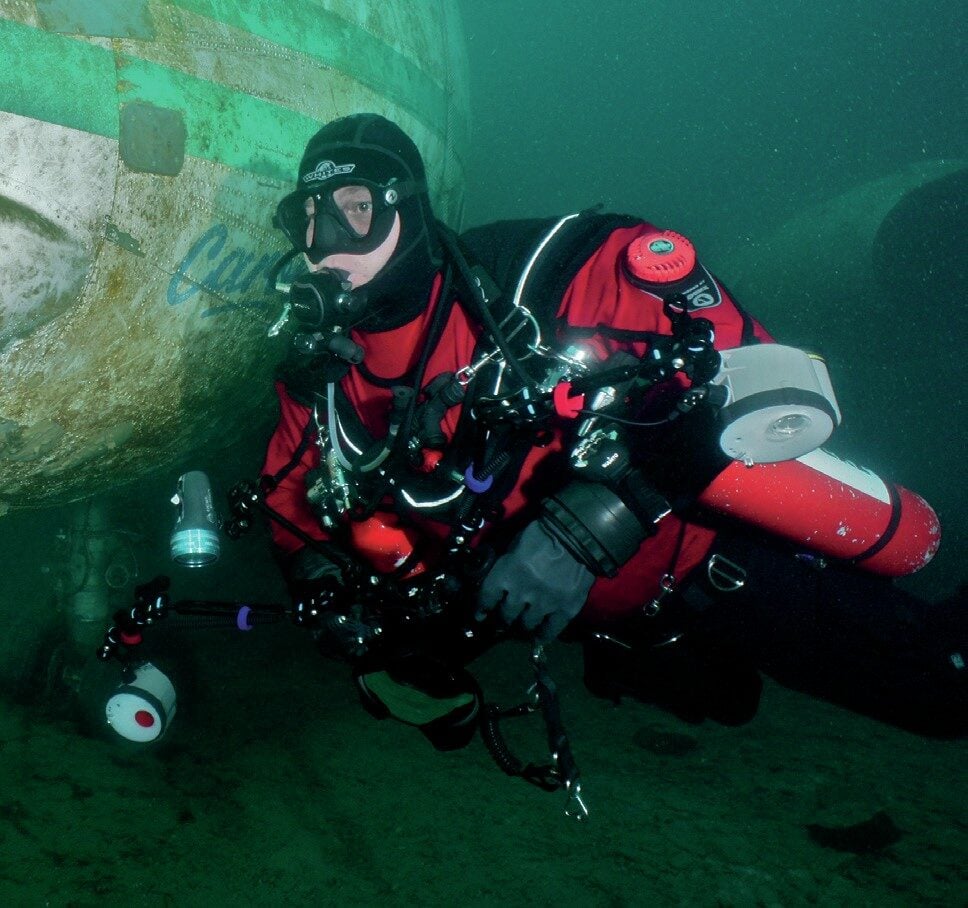
Sidemount does have several benefits over backmount, outside of squeezing through tight cave systems. The first being the stability. Because your tanks are lower and spread alongside you like outriggers, you’re less likely to turn turtle. And because the valves are under your shoulders instead of behind your neck, you can see and reach any leaks in front of you and close valves very easily.
But the best benefit for me is that you don’t have to fully kit up and carry the weight of your cylinders at the same time out of the water. It saves your back to be able to place your tanks in the water, and attach them in the water. At the end of the dive you can remove your tanks and clip them to a rope to be hauled out later. Unlike backmount, you don’t need to have your cylinders attached to you out of the water.
@ianjones5841
#AskMark: How can I become a certified equipment technician so I can service regulators, etc?
Message the manufacturer you want to service and they can point you in the right direction. It varies depending on what country you live in. Here in the UK, each manufacturer runs servicing courses periodically throughout the year, which are open to people who work for dive centers. Some manufacturers provide online courses so that you can learn how to service their equipment at home or at work, but you still must be affiliated with a dealer.
Here in the UK, you need to be affiliated with a dive center to service gear because that’s the only way you’ll be able to get official parts and tools. Many regulators have specific tools to be able to service them properly. And even if you complete a servicing course, it only qualifies you to service that particular brand, not just any brand of regulator.
It’s different for other brands and countries. So your best option is to contact the brand so they can inform you of the best way to become a technician for their gear.

@char-007-1
#AskMark: What is your opinion on brass bolt snaps?
I dislike brass boltsnaps. Brass is a great metal for scuba diving because it cannot rust, it’s lightweight and it’s relatively cheap. However, brass is a softer metal that will dent and bend easily. That’s okay for a first stage because it’s a solid block of brass.
For small, thin tools like a boltsnap, they can easily bend and leave an opening for something small to escape the hook.
I also find that the movement isn’t as smooth with a brass boltsnap and they can sometimes develop sharp edges, which can damage gear. Overall, a brass boltsnap will get the job done, but if there’s a stainless steel boltsnap available, I’d choose that over brass any day.

This article was originally published in Scuba Diver Magazine
Subscribe today with promo code DIVE1 — enjoy 12 months for just £1!
