
When you type “best travel torch 2025” or “best compact dive torch” into Google, what you’re really after is one thing: portable, powerful illumination that won’t leave you stranded in the dark mid-dive. Dive torches have come a long way since those bulky halogens and car-battery power packs. Today’s travel-friendly models are compact, often using compact rechargeable batteries, with LED bulbs offering variable beam angles, depths, and multiple modes, from daylight-bright spreads to narrow spots that penetrate deep into the blue… or black.
What makes the best travel torch?
Design-wise, key differentiators include bulb technology (LED vs halogen – though LED is now the clear winner for efficiency and size), battery type (rechargeable 18650 Li-ion has mini bulk but solid runtime, or disposable CR123As for ultra-light spares), and operating modes (constant brightness, SOS, flashing). There a trade-off’s to worry about though: narrow beam = further reach but less peripheral, wide beam = broader view but shorter throw. Rechargeable units save weight and plugs, but watch travel battery restrictions; disposables are grab-and-go, but you’ll carry extras and pay more in the long run.
This list spans budget picks to premium. And remember, we are looking primarily at solid travel options, which means less chunky than your dark murky UK water primary. Something that airlines won’t punish you too much for throwing in your bag. If you already know basic scuba equipment, think of this as where your “just-in-case” backup or travel upgrade lives: compact without sacrificing too much performance.
Top Travel Torches
Scubapro Nova 250 – £80 / $95
If you want a torch that feels more like carrying a pen than a flashlight, the Nova 250 is your guy. Scubapro designed this as an ultra-compact companion light: just 250 lumens with a 12º beam angle, so more than enough for poking into reef crevices or as a reliable backup. The single push-button operation is dead simple, and the over-pressure valve is a clever safety feature that vents in case of battery trouble.
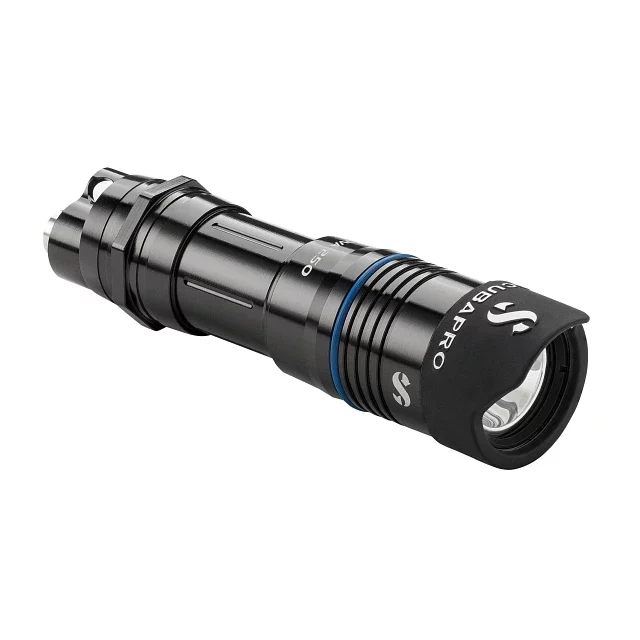
It runs on a CR123A battery, so with spares you’ll never be left hunting for an outlet in some beachside bungalow. Its aluminium housing is tough but lightweight, and it slips easily into a BCD pocket. At 150 metres rated depth, it’s almost overbuilt for recreational needs, but reassuring all the same. A perfect pick if you want something you can forget about until you need it.
Pros:
Super light and compact
Robust safety features
Easy to use
Cons:
Modest brightness
More of a back up than primary
OrcaTorch D710 Dive Light – £162 / $160
The OrcaTorch D710 is one of those rare “travel torches” that makes you wonder if you’re carrying a mini-sun. At a staggering 3,000 lumens, it has enough punch to turn a night dive into a midday snorkel. That said, it’s still surprisingly portable, using a rechargeable 21700 lithium-ion battery that charges via USB-C so no bulky chargers are required.

It features multiple brightness settings and a battery indicator, so you’ll always know how much burn time remains. The aluminium build is rugged and ergonomic, and while it’s not as tiny as some backups, it’s compact enough for checked luggage or a larger BCD pocket. The narrow 6° beam angle cuts through murky water, making it a strong primary light in dark conditions. And it comes in a choice of colours!
Pros:
Immense lumen output
USB-C rechargeable
Intuitive battery indicator
Cons:
A bit heavier than some backups
Limited beam angle
SeaLife Sea Dragon Mini 1200 – £120 / $150
You probably know SeaLife more for underwater cameras, but their Sea Dragon Mini 1200 proves they know lighting just as well. The Mini 1200 offers a compact, travel-friendly design with an anodised aluminium body, dual o-ring seals, and a smart pressure-release valve for safety. The beam can be adjusted between 8° and 6° and so cuts sharply through the water column.

The light runs on a single 18650 battery, giving excellent runtime with easy recharging via USB cable. There are multiple modes, including SOS and flashing, and a colour battery indicator so you’re never caught off guard. Despite the strong output, it’s small enough to fit in a pocket or clip securely to your BCD. For travel divers, the 1200 is the lighter companion to the beefier 1600 should you want something with more oomph!
Pros:
Compact but powerful
Safety features
Great beam penetration
Cons:
Battery not included (but can be purchased as extra with USB cable)
Narrow beam only
Dynamic Nord DL-1200 – £141 / $190
Engineered in Germany, the Dynamic Nord DL-1200 takes precision seriously. This compact dive light delivers 1,200 lumens via a neutral-white LED with a 9° spot beam that’s perfect for night dives and signalling. It uses a rechargeable 18650 lithium-ion battery and offers four power modes, including SOS, giving runtimes from 110 minutes at full power to a whopping 300 minutes on low.

At just 159 grams underwater (or 278g to your flight operator), it feels feather-light, making it an excellent choice for divers conscious of luggage weight. The DL-1200 uses a magnetic ring switch for intuitive, glove-friendly operation, and the anodised body is built to withstand serious travel wear. It’s rated to 100 metres, so you’re well covered for recreational depths. This is a perfect “serious but still travel-ready” option for divers who want robust performance without going bulky.
Pros:
Lightweight yet powerful
Great runtimes
Ergonomic magnetic switch
Cons:
Rechargeable only
Cressi Astra 1200 – £130 / $149
Cressi has long been a favourite for reliable, no-nonsense dive gear, and the Astra 1200 continues that tradition. Compact and streamlined, this torch offers 1,200 lumens of output in a durable aluminium body, making it ideal for both primary and backup use. The Astra is powered by a non-exchangeable rechargeable battery (with a magnetic charger), giving up to 5 hours of burn time, so suitable for multiple dives in a day.

Its 8.6° beam penetrates cloudy water well, while the simple push-button operation ensures easy use, even with gloves. At this price point, it strikes a nice balance between affordability and capability, particularly for newer divers looking for something they can trust without over-investing. Lightweight and travel-friendly, the Astra is built to take the knocks of regular diving holidays.
Pros:
Compact yet bright
Easy to use
Good mid-range value
Cons:
Fixed beam angle
Cannot switch the battery
Dive Rite BX2 Handheld – £120 / $109
The Dive Rite BX2 is a solid workhorse that doesn’t try to overcomplicate things. Delivering around 1,000 lumens, it’s bright enough for most recreational diving while remaining compact enough to serve as a reliable backup or travel primary. The body is rugged and ergonomic, built to take a beating from both baggage handlers and salt water.

Its compact size makes it a favourite among divers who want a no-frills torch that still delivers reliability and runtime. It’s powered by a rechargeable and changeable 18650 battery, giving convenience and longer-term savings over disposable options. The light has a smooth, even 6° beam that’s great for reef exploration, and its straightforward operation makes it accessible even for less experienced divers.
Pros:
Affordable and reliable
Nice and bright
Cons:
Lacks variable power and safety light
SEAC Sub R3 – £108 / $145
The SEAC Sub R3 is an elegant, compact dive torch that blurs the line between primary and emergency light, perfect for divers who refuse to be weighed down yet demand functionality. Built from durable aluminum with tempered optical glass, this pocketable torch delivers 400 lumens with crisp, neutral white light that renders reef colors beautifully accurate. Featuring a relatively narrow 9° spot beam, it’s ideal for night dives or signaling in low-visibility settings.

The R3 operates three modes – 100% power, 30% power, and a flashing mode, all toggled via a magnetic pulse switch. Recharge is handled via micro-USB through an external cradle and runtime is a solid 2 hours at full power and up to 8 hours in low power mode. It slips easily into a BCD pocket and doesn’t hurt luggage too much at only 255g.
Pros:
Compact and lightweight
Penetrating beam
Multiple modes with lock
Cons:
Narrow beam limits coverage
Lower lumen for larger scenes.
AquaLung Seaflare Mini – £105 / $140
If pack size is your top concern, the AquaLung Seaflare Mini is one of the most compact torches you can find. Small enough to slip into any pocket, it’s designed as a backup or travel-light solution for divers who want peace of mind without extra bulk. The output is modest compared to some on this list, but at up to 900 lumens, it’s still effective for close-quarters navigation or on night dives.

The beam angle is 11° but can be focused in using the included ‘beam deflectors’ that also act to personalise your torch. The build is tough yet streamlined, with AquaLung’s classic focus on diver-friendly ergonomics. At this price point, it’s pretty accessible, making it a sensible choice for newer divers. While not really suited as a sole primary, its size and reliability make it a good option as a back up or travel torch.
Pros:
Extremely compact
Lightweight
Rated to 150m
Cons:
Hard to fault as a travel unit, but
Rechargeable only
Mares EOS 10LRZ – £200 / $290
The most expensive on the list, but the Mares EOS 10LRZ punches well above its compact size. Delivering a strong 1,100 lumens through a single LED, this torch features a rotating “zoom” head to adjust from a focused 12° hotspot to a sweeping 75° flood beam – versatility mid-dive that’s ideal for both signaling and reef-wide illumination. It runs for 150 minutes at full power on a built-in rechargeable battery that fully charges via USB in around 6 hours.

The multifunction switch is both tactile and safe, double-click to turn on, then cycle through high, low , SOS flash, and off; a visual charge indicator keeps you informed at a glance. Built with anodised aluminum and rated to 120 m (393 ft), it includes a tubular grip, wrist strap, and a padded zippered case, perfectly travel-ready and robust for regular use.
Pros:
Adjustable beam offers real versatility
Robust and compact
Multiple modes with anti-accident switch
Cons:
Heavier than most in this range (at 544 g)
Not cheap as a dedicated travel torch
Summary – Standout Picks
- Best overall 2025: SeaLife Sea Dragon Mini 1600 – A great balance of power, compact design, modes, adjustable beam, and safety features.
- Best for light travellers: Scubapro Nova 250 – surprises you with power for its size and a slightly wider beam for night dives.
- Best backup torch: SEAC Sub R3 – solid battery life, flashing mode, a build quality you can rely on when things go pear shaped… or great to throw in a case for travel.
- Best compact primary: AquaLung Seaflare Mini – tiny, light, always fits in your pocket. A close runner for best overall.
- Best high-output rechargeable: Orcatorch D710 – when you want serious light without bulk.
Final Word
Choosing the right travel torch is about matching light to purpose. A light spread and compact form is key for travelling: choose rechargeable options if you’re near power, and disposables (like CR123A) if you’ll be flying to remote dive spots. Many on this list can live with either. Remember to check airline battery rules, rechargeables often need to be in carry-on.
Keep spare O-rings, rinse the torch after each dive, and verify seals (especially battery lids) before your first dive, they’re the weak link in salt-water. Tight beam or wide spread? Both have their days: spot for long distance and critter-pointing, flood for wide reef scenes… think liveaboard night dives. Keep your unit charged or with fresh batteries, and always pack a backup, because when the sun goes down 30m underwater, that torch can be your lifeline, not just a bit of flair.
Frequently Asked Questions
What’s better for travel: rechargeable or disposable batteries?
The days of carrying lots of D cells for your torch are gone. On the plus side, rechargeables save long-term cost and clutter, but can’t always be packed in the hold, so they are extra clutter in your hand luggage. Depending where you travel, if power is not an option, carrying old school standard batteries can be the way to go, or at the least a spare rechargeable or two.
How many lumens are enough for recreational night diving?
When we talk travel, we can normally assume clearer warmer water and so generally, 1,000 lumens is more than enough for spot-lighting and navigation. Under that, you may struggle with wide reef scenes, especially with a wider beam. Careful though, much more and you start moving to the point where you might as well be day diving and other divers might not thank you.
Do I really need SOS or flashing modes?
They’re not necessarily essential, but can be literal lifesavers if you end up separated from your buddy or during surface emergencies. The function doesn’t generally add much weight or cost to a unit, so it can be considered cheap peace of mind.

IMO, at least in the U.S., Amazon has a wide assortment of no-name dive lights that are significantly better values than the branded name lights sold at scuba stores/sites. And they all are manufactured in China regardless of who you buy it from.