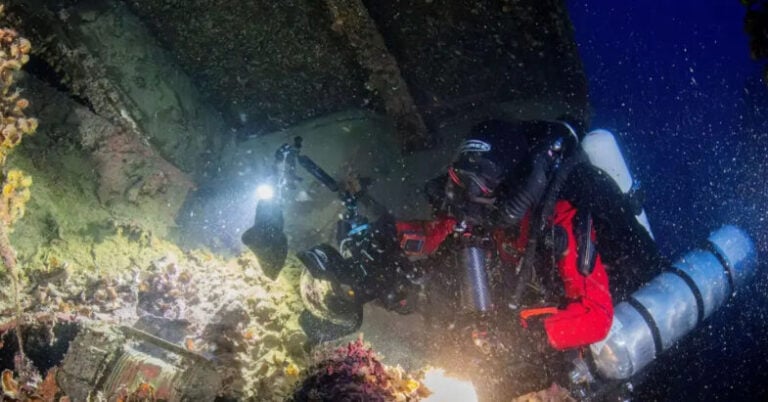
More than a century after the mighty ocean liner HMHS Britannic sank in the Aegean Sea after hitting a mine, a complex operation involving a team of highly trained technical divers has recovered a host of artefacts, including the ship’s lookout bell, binoculars, ceramic tiles from the Turkish baths, items from the first and second class cabins, and a portside navigation lamp.
The dives were carried out back in May, but have only just been made public by the Greek culture ministry. The recovered artefacts were secured in containers and cleaned of marine organisms, before being transferred to the laboratories of the Ephorate of Underwater Antiquities in Athens, where specialised conservation work will continue.

It is planned for the recovered artefacts to eventually go on display at the new National Museum of Underwater Antiquities in Piraeus.
The operation was organised by British historian Simon Mills, founder of the Britannic Foundation and owner of the wreck, who brought together 11 top-tier technical divers – Evan Kovacs, Richie Kohler, Katy Kohler, Stewie Andrews, Michael Barnette, Perry Brandes, Barry McGill, Edoardo Pavia, Richie Stevenson, Patrick Valkenborghs and George Vandoros – equipped with closed-circuit rebreathers to conduct the recovery dives.
“Since 2019 we have been working with the Ephorate and Simon to conduct the first-ever systematic documentation and exploration of the Britannic’s interior. We have found hints of her former opulence and seen the remnants of her last mission as a hospital ship carrying wounded soldiers. The recoveries this year are a remarkable achievement, especially considering the depth she lies at…” says Kovacs, expedition leader and owner of Marine Imaging Technologies, a company that specializes in locating, exploring and documenting historically and scientifically significant sites.
“Exploration at a depth of 120m, especially within an overhead environment, carries significant risk. Over the past 15 years, access to the Britannic has been highly restricted, and during that period, two divers have tragically lost their lives. Our approach is always team-oriented, prioritizing the safety of everyone involved. While some may attribute our success to luck, in reality it is the result of countless hours each year spent reviewing incidents, analyzing behaviors, and studying near misses in order to refine and improve our planning,” says the Dive Safety Officer Katy Kohler.
Photo credit: Greek Culture Ministry
