
Some of your favorite dive destinations demand extra caution. Claudio Di Manao explains exactly what you need to know to dive them safely and confidently.
Divers, as we all know, are travellers. The DAN Europe alarm centre regularly receives requests for assistance from members from all over the world. Interestingly, the distribution of calls on the world map shows which are the favoured destinations by European DAN members. It also shows that a substantial number of calls for assistance comes from a selected cluster of specific dive sites.
We decided to take a closer look at these sites, and selected the first six on the list. The aim is not to discourage divers from visiting those sites. On the contrary – we want them to continue to travel and dive there too, but with a few extra tips to improve safety. An increasingly informed community is a safer community
THE TOP SIX
#1 Blue Hole
Dahab, Sinai Peninsula, Egypt – Shore diving.
The Blue Hole in Dahab is a true Mecca for technical divers and freedivers from all over the world. It is a very deep (over 120m) karst sinkhole formed by erosion within the fringing reef. At 55m, an archway connects the Blue Hole’s inner waters with the open sea. According to several sources, the Blue Hole is the dive site where most fatal diving accidents occur in the world; it is one og these locations that undoubtedly demand extra caution.
Critical issues:
- Good visibility and good sea conditions can be deceptive about depth and the dive’s difficulty.
- A diver unfamiliar with the site may wander too long at depth, or even get lost, while searching for the arch.
- Unskilled divers venturing beyond the limits of their training level.
- Freedivers plunging without a safety team/buddy.
- Disorientation and/or Narcosis.
- Bets between divers.
- Dehydration.
Surviving the dive – Community notes by the author, who has 12 years of experience as dive guide and instructor in the Red Sea, Chamber Attendant at HyperMed in Sharm El Sheikh.
- For recreational divers: Much preferable is the tour of the outer wall, entering and exiting the Blue Hole through a shallow saddle (at 6m) or even starting the dive from The Bells. The inner walls of the Blue Hole are barren, completely devoid of attractions at recreational depths. Hydrate yourself. Attempting to cross the arch with a 12-litre exposes yourself to severe narcosis, disorientation, and running out of air.
- For freedivers: Do not dive alone (Ed. note: This is a cardinal rule of freediving; always have a buddy ready to effect a rescue). Always rely on some of the many local freediving centres.
- For all others: Rely on local technical diving centres or guides of confirmed professional rigour. Check your equipment. Get hydrated.
#2 SS Thistlegorm
Shaab Ali, Gubal Strait, Gulf of Suez, Egypt Wreck dive
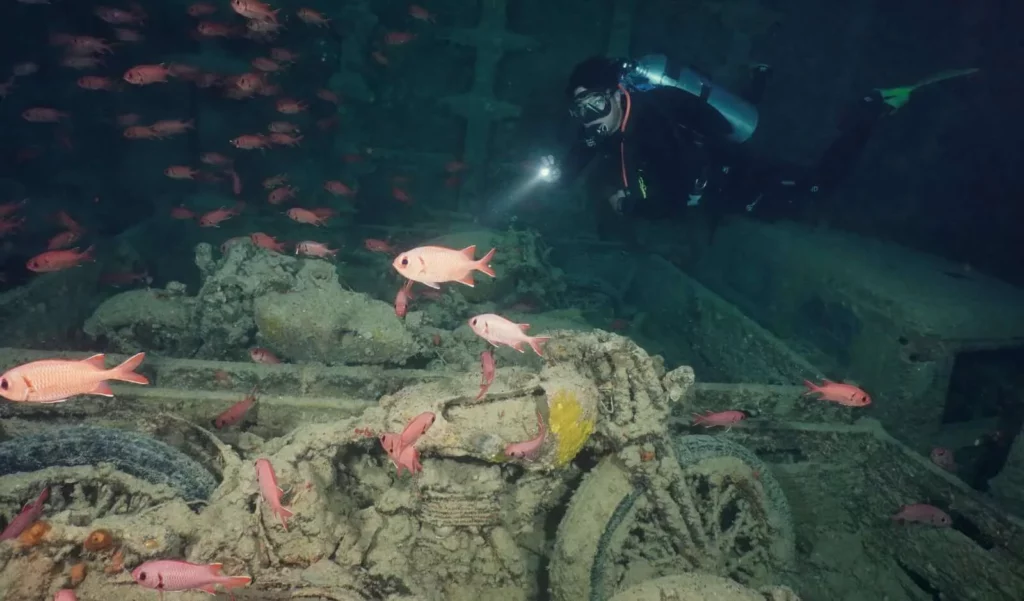
The wreck of the Thistlegorm is considered by many a time machine lying on a 32m seabed. As a British cargo ship, she was crammed with military supplies and ammunition when she sank in October 1941 after a bomb dropped by a German bomber. The wreck contains jeeps, trucks, small tracked vehicles, motorbikes, and weapons. A local saying claims that the Thistlegorm collects in more revenue than the Pyramids of Giza. However, the environmental factors here often demand extra caution. This site accounts for the highest number of diving incidents in the Sharm El Sheikh area. Critical issues:
- Strong currents, rough seas and poor visibility are the norm.
- Square profiles.
- Performing the safety/decompression stop at the same depth on the same ascent line can be a treacherous task for a large group of divers.
- Boats manoeuvring at the surface.
- Ladders and platforms are extremely mobile in rough seas.
- Lack of rest (the trip to the wreck can start very early in the morning).
- Dehydration and nitrogen accumulation can contribute to the onset of DCS.
Surviving the dive – Community notes by the author
- Memorise carefully the guide’s briefing.
- If you descend or ascend along a mooring line and current is present, never think to lose your grip.
- If you lose your group, ascend along the mooring line. If you can’t recognise your boat’s mooring line, don’t waste time and climb up from any.
- Floating platforms on the surface and propellers are your worst enemy: when ascending as well as descending always look up towards the surface.
- While entering the water, move away from the platform immediately.
- During the descent, and especially on the ascent, along the line check your buoyancy constantly.
- Follow the guide or the group, do not linger.
- Forget compressed air, use nitrox.
- Avoid clubbing at least the night before.
- Don’t wait until you are thirsty to drink, hydrate yourself beginning the day before.

#3 MS Zenobia Larnaca,
Cyprus, Eastern Mediterranean – Wreck dive
This Swedish-built ferry sank near the port of Larnaca in 1980 due to an error in the on-board software that pumped ballast water to the wrong side. About 170 metres long, she lies banked on her port side between 17m and 42m depth with her well-known cargo of cars still on board. As this dive is quite easy to perform, it is suitable for an external tour by open water divers. While it is one of the most visited wrecks in the world, its massive scale and internal layout demand extra caution for those attempting penetration. Critical issues.
- Sharp metal.
- Square profile.
- Disorientation due to severe wreck dislocation.
- Unskilled divers venturing beyond the limits of their training.
- Marine life stings.
- Failures on checking the no decompression limit (NDL).
- Dehydration.
Surviving the dive – Community notes by Chris Demetriou, Dive Centre Manager, DAN Instructor Trainer, Chamber Attendant, Chamber Operator, Cyprus.
- Before diving it is good to get informed, be fit and have insurance.
- Reliable centres can be found through the Cyprus Diving Centre Association (CDCA), DAN HIRA centres or ISO EN 24803-compliant centres.
- Listen and follow the dive briefings, you will see more and the guides know the best spots.
- Use mooring lines for controlled descents and ascents, wear a computer, use nitrox and monitor your NDL.
- Penetration dives vary in difficulty – be aware of your limits, your gas requirements and have the correct equipment for each dive.
- The wreck has sharp edges and marine life can sting, so good buoyancy control is essential to avoid both types of danger.
- Also, keep in mind that temperatures in Cyprus can get very hot, so stay hydrated. n
About the author
DAN Member since 1997, Claudio Di Manao is a PADI and IANTD diving instructor. He’s the author of a series of books and novels about diving, including Shamandura Generation, an exhilarating portrait of Sharm el Sheikh’s diving community. He collaborates with magazines, radios and newspapers, talking and writing about diving safety, marine life and travels.
DAN Membership
Before taking the plunge make sure your DAN membership is still active. If it isn’t, join DAN or renew your membership at: www.daneurope.org Your DAN membership ensures the services of the biggest international network for assisting divers anywhere, during any emergency.
Related: read Part 2 Sites #4 to #6
FAQs
What is the purpose of the DAN Europe safety column?
The column aims to inform the community about specific risks associated with popular sites that demand extra caution. By providing expert tips, DAN seeks to improve safety and reduce assistance requests.
Which dive sites featured in Part I demand extra caution?
Part I covers three iconic locations: the Blue Hole in Dahab (Egypt), the SS Thistlegorm wreck in the Red Sea (Egypt), and the MS Zenobia wreck in Larnaca (Cyprus).
What are the main “critical issues” at the Dahab Blue Hole?
According to DAN, the main risks include deceptive visibility that masks depth, narcosis, disorientation while searching for the 55m Arch, and unskilled divers exceeding their training limits.
How does DAN recommend “surviving” the SS Thistlegorm dive?
Key safety tips include using Nitrox, strictly following the guide’s briefing, maintaining a grip on mooring lines in strong currents, and staying hydrated to prevent Decompression Sickness (DCS).
What safety precautions should I take before diving the Zenobia?
Ensure you are fit to dive and have active DAN insurance. Use mooring lines for controlled ascents, monitor your NDL (No-Decompression Limit), and be wary of sharp metal edges and marine life stings.
Why do these world-famous wrecks demand extra caution?
Wrecks like the Thistlegorm and Zenobia present challenges such as strong currents, metal hazards, and deep depths that can lead to disorientation or decompression sickness if not managed properly.
This article was originally published in Scuba Diver Magazine
Subscribe today with promo code DIVE1 — enjoy 12 months for just £1!
