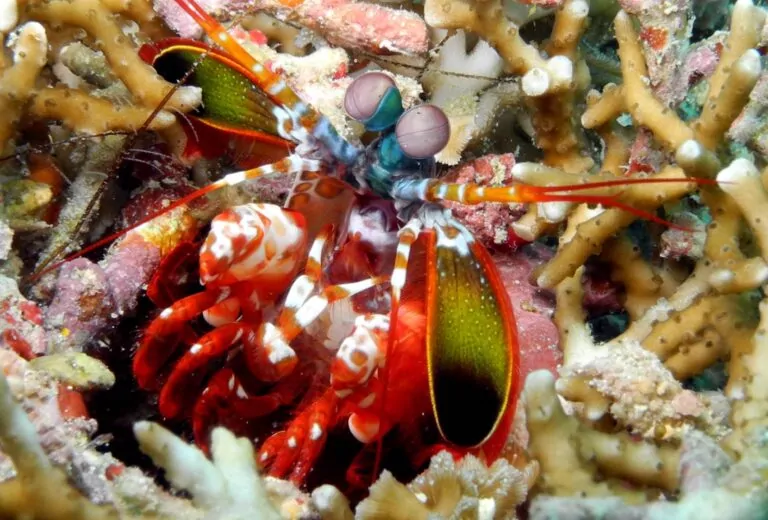
Belligerent mantis shrimps caught out of their holes have long been popular subjects for underwater photographers – though most know they risk a cracked dome-port if they get too close.
These large shrimps pack a powerful punch that they can use to kill prey or defend territory from rivals. Able to smash a mollusc shell or shatter aquarium glass, this punch has the force of a .22 calibre bullet, say scientists at Northwestern University in Illinois.
What they wanted to find out was how the shrimps’ own delicate nerves and tissues survive the intense shockwaves created during the process – and they reckon they now have the answer.
The punch is delivered via the shrimp’s two hammer-like “dactyl clubs”. These, it turns out, are covered in layered patterns that, by blocking specific vibrations, form a shield.
The team believe that the principles at work here could be applied to developing synthetic sound-filtering materials, or protecting against blast-related injuries.
Pressure waves and bubbles
“Most prior work has focused on the [dactyl] club’s toughness and crack resistance, treating the structure as a toughened impact shield,” says Prof Horacio D Espinosa, an expert on bio-inspired materials at Northwestern and co-author of the study just published in Science.
“We found that it uses ‘phononic mechanisms’ – structures that selectively filter stress waves. This enables the shrimp to preserve its striking ability over multiple impacts and prevent soft tissue damage.”

The dactyl clubs store their energy in spring-like structures restrained by latch-like tendons. When the latch is released, the stored energy propels the club forward with explosive force.
“When the mantis shrimp strikes, the impact generates pressure waves onto its target,” says Espinosa. “It also creates bubbles, which rapidly collapse to produce shockwaves in the megahertz range.
“The collapse of these bubbles releases intense bursts of energy, which travel through the shrimp’s club. This secondary shockwave effect, along with the initial impact force, makes the mantis shrimp’s strike even more devastating.”
The team analysed the microstructure of the peacock mantis shrimp (Odontodactylus scyllarus)’s armour and identified two distinct regions within the club.
The impact region that delivers the blows consists of mineralised fibres arranged in a reinforcing herringbone pattern. Beneath this, the periodic region is made up of twisted, corkscrew-like fibre bundles in which each layer is progressively rotated relative to its neighbours.
Crucial role
“The periodic region plays a crucial role in selectively filtering out high-frequency shear waves, which are particularly damaging to biological tissues,” says Espinosa. “This effectively shields the shrimp from damaging stress waves caused by the direct impact and bubble collapse.”
The researchers analysed 2D simulations of wave behaviour but future research is likely to focus on “more complex 3D simulations to fully capture how the club’s structure interacts with shockwaves,” says Espinosa.
“Additionally, designing aquatic experiments with state-of-the-art instrumentation would allow us to investigate how phononic properties function in submerged conditions.” Led by Nicolas Alderete of Northwestern, the study was supported by the Air Force Office of Scientific Research, the Office of Naval Research and the National Science Foundation.
Also on Divernet: Raja Ampat Creature Feature Peacock Mantis Shrimp, Critters of the Great Barrier Reef Mantis Shrimp