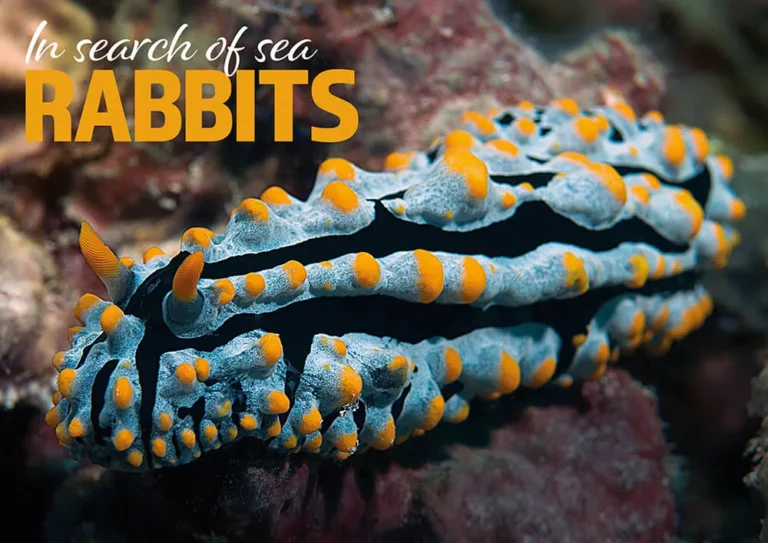
Lawson Wood takes a closer look at sea rabbits (Phyllidia), a curious branch of the marine gastropod molluscs of dorid nudibranchs
In Search of Sea Rabbits
There are around 80 different species of sea rabbits worldwide and all are members of the Phyllididae super family, found in all tropical and sub-tropical waters, including the Mediterranean and Atlantic Ocean.
The species was first described in 1814 by Constantine Samuel Rafinesque-Schmaltz, a French polymath who lived in the United States. He published over 6,700 binomial names of animal and plant species and because of the early dates of his observations, his name usually supersedes all other descriptions, but the common name was also attributed to Jean-Baptiste Lamarck, another French biologist who called the species ‘les Phyllidiens’ and ‘les Phyllidéens’. The name Phyllidium comes from the Greek phyllos meaning ‘leaf’.
The most-common attributes are that this sea slug is oval in shape slightly flattened and covered in coloured warty tubercles all over the upper body. The colours are usually contrasting and are considered a visual warning to any would-be predators. Size is variable, but some may get over 100mm long, although they are more commonly around 25mm.
Like other dorid nudibranchs, the rhinophores (feelers or antennae) atop the head are completely retractile and the anus is to the rear, but not surrounded by the gills like other nudibranchs, these are hidden underneath the mantle and along the sides of the foot. Having no hard jaws or radula, their mouth parts have undergone some modification and are adapted to sucking on various types of sponges, their main diet.
They are all very obvious sea slugs and tend to be out in the open, but their colours indicate to other predators that not only do they taste rater nasty due to a type of bioactive chemical defence. Known as ‘aposematism’, this poison is in their mucus and is highly poisonous to fish and molluscs if they get stressed. Apparently, if kept in an aquarium, should they get stressed, their mucus is capable of killing everything else in the aquarium! The peculiar chemistry of this little dorid has prompted study from researches for many years, specifically after Phyllidia varicose was seen secreting a ‘light-grey mucus’ that caused the fatal poisoning of a lobster! Here is a small ‘hit’ list of the most-common species that we will encounter:
Varicose Phyllidia (Phyllidia varicosa)
Distributed from the Red Sea to Hawaii, the species are the most-studied due to their mastery of chemical defence. Extremely toxic, they have no known predators, hence their very wide distribution.
A pale blue grey in colour with long black lines between the numerous rows of yellow-tipped pustules. They have yellow rhinophores and can grow over 7.5cm.
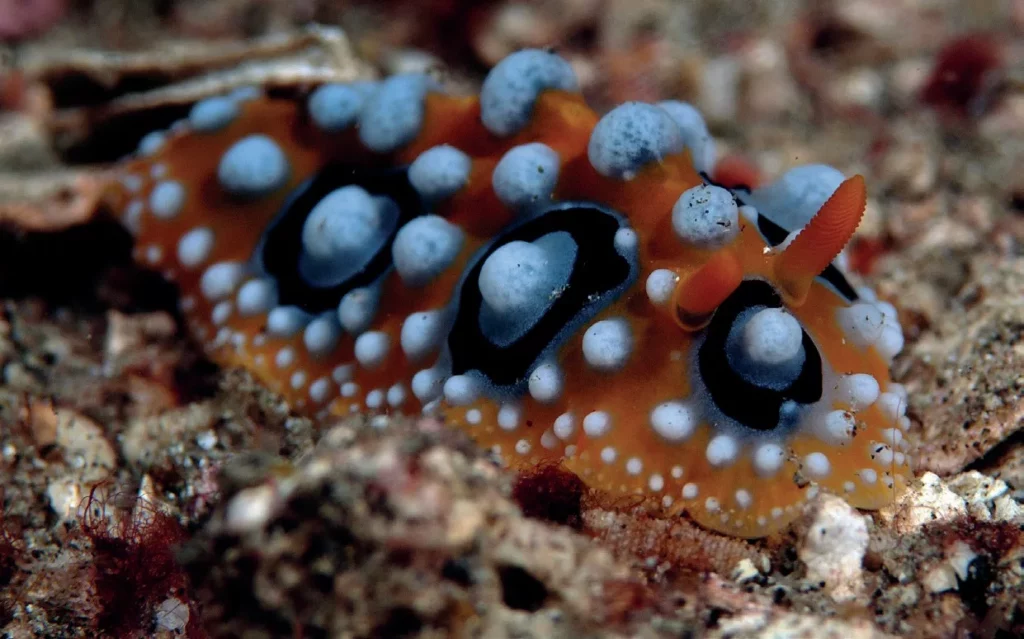
Ocellate Phyllidia (Phyllidia ocellata)
By far, the most colourful and recognisable of the species, it can be found from the Red Sea all the way through the Indo-Pacific, where its colour forms are as varied as its habitats. I remember first seeing this nudibranch in Eilat back in 1974! It is a brilliant yellow/orange in colour with rows of large thick tubercles, more often surround in white and black rings. Rhinophores are yellow and as it can grow to over 5cm, it is very obvious on the reefs.
Celestial Phyllidia (Phyllidia coelestis)
Very similar to P. varicosa, but has a ‘Y’-shaped ridge of blue grey pustules, tipped in yellow. The body is an overall blue/ grey with thick black lines between the pustules and starting behind the yellow rhinophores. Growing to only around 5cm (2 inches) it ranges from South Africa to Fiji.
Elegant Phyllidia (Phyllidia elegans)
Often mistaken to the very similar species P. varicose, but with much larger tubercles along the back, these are more varied in size with very few of which tipped in yellow. There are fine black lines between the rows of tubercles and the rhinophores are a bright golden yellow. Also growing to around 5cm, it can be found from the Red Sea to Fiji.
Exquisite Phyllidia (Phyllidia exquisite)
A small nudibranch growing to around 25mm, its range includes the area from Thailand to the Marshall Islands in the Pacific. It has striking large yellow rhinophores, a light blue/grey body and white tubercles (some of which may be yellow tipped). Black lines around the tubercles make this an obvious candidate for great photography.

Pustulose Phylliiella (Phyllidiella pustulosa)
A much more obvious species growing to over 5cm, being completely black in colour with numerous grey/white pustules which often grow in small clumps and therefore not seen as in rows, like other species. The Rhinophores are also black and it is an active predator on reefs found from the Red Sea to Hawaii.
“The most-common attributes are that this sea slug is oval in shape slightly flattened and covered in coloured warty tubercles all over the upper body”
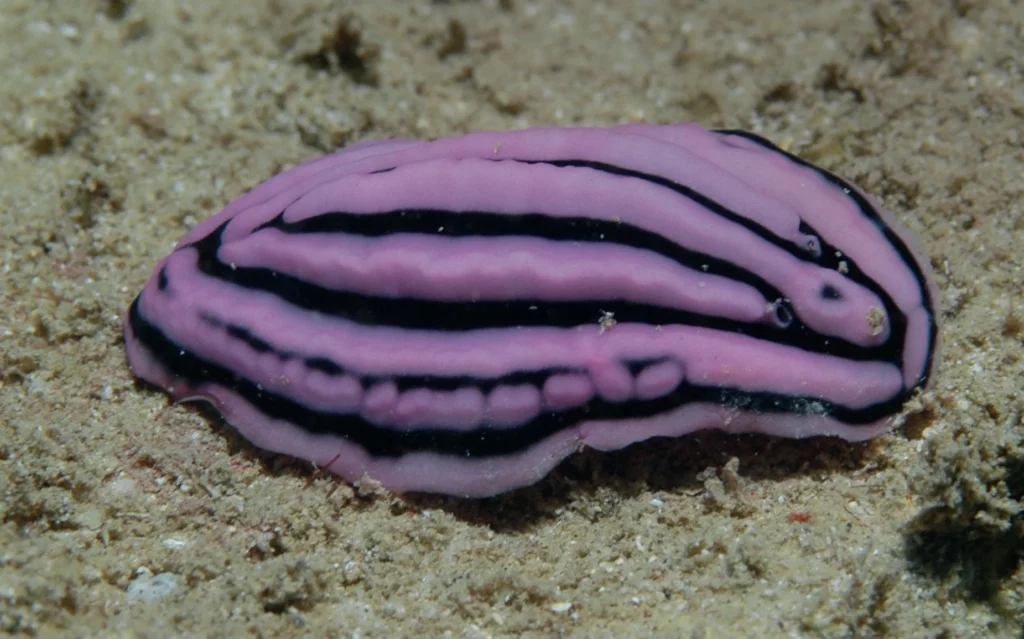
One of the biggest Sea Rabbits: Shireen’s Phyllidiopsis (Phyllidiopsis shireenae)
Reaching over 10cm long, this large and easy to identify nudibranch can be found from the Maldives to New Caledonia. It is a pale pink or pale blue/grey in colour overall, with small light tubercles, small pink rhinophores and thin black lines to the sides of the mantle.
Rosans Phyllidia (Phyllidia rosans)
Another very obviously coloured and easy to identify species due to the black body colour covered in lines of purple or brown low tubercles. It has small purplish-black rhinophores and can grow to around 35mm. It is found from East Africa to Hawaii. While these may not be the most exotic of the tropical nudibranchs, they are the most-commonly found species with an incredibly wide distribution and notoriety.
FAQs
What are Sea Rabbits in the context of marine life?
Sea Rabbits are a curious branch of dorid nudibranchs belonging to the Phyllidiidae family. They are marine gastropod molluscs known for their oval, flattened bodies covered in colorful, warty tubercles.
Are Sea Rabbits dangerous to other marine life?
Yes. Sea Rabbits use a chemical defense known as aposematism. They secrete a toxic mucus that can be fatal to fish and crustaceans. If stressed in a confined space, like an aquarium, their toxins can potentially kill other inhabitants.
How do Sea Rabbits differ from other nudibranchs?
Unlike many other nudibranchs, Sea Rabbits do not have gills surrounding their anus. Instead, their gills are hidden underneath the mantle along the sides of the foot. They also lack hard jaws or a radula, having evolved mouthparts specifically for sucking on sponges.
Where can you find Sea Rabbits while diving?
There are approximately 80 species found globally in tropical and sub-tropical waters. They are common sights in the Red Sea, the Indo-Pacific, and even parts of the Mediterranean and Atlantic Ocean.
What do Sea Rabbits eat?
The diet of a Sea Rabbit consists almost exclusively of various types of sponges. Their digestive systems are uniquely adapted to extract nutrients from these organisms through specialized suction.
This article was originally published in Scuba Diver Magazine
Subscribe today with promo code DIVE1 — enjoy 12 months for just £1!
