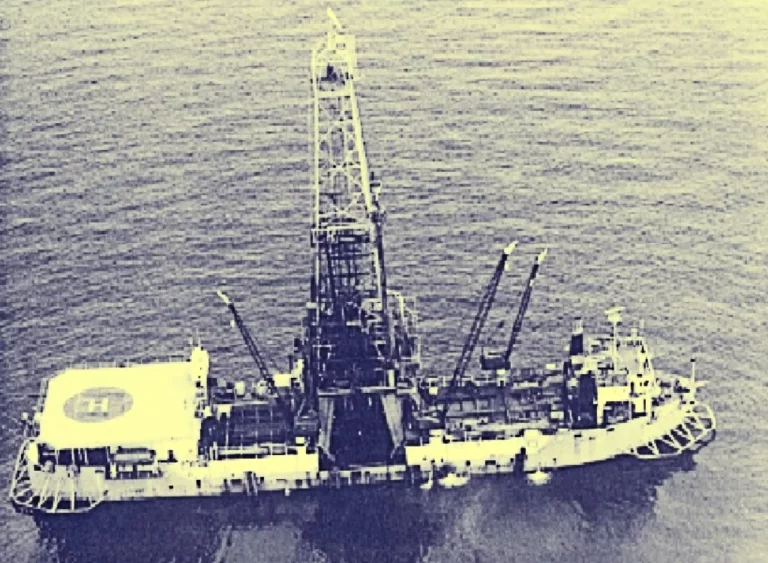
As Typhoon Gay raged on 3 November, 1989, the Seacrest sank with considerable loss of life, one of the deadliest oil-rig disasters in history. Its remote location and 70m depth in the Gulf of Thailand makes it a challenging dive to organise – but that’s the speciality of TIM LAWRENCE and his technical team
The race for the Earth’s resources began when humans first collected wood to make fire. Coal, oil and gas have all played their part in fuelling the engines of change and lighting the flame of exploration that was necessary for their discovery.
Today, petrochemical companies use rapidly evolving technology to maintain their competitive edge, funded by the vast profits generated from exploiting nature’s resources.
However, the Earth’s environment conspires to place barriers in the way of profit, and the rapidly evolving technology necessary to overcome these barriers can push our ability to understand the new protocols needed to use it safely.
Back at the start of the 1980s Unocal – the Union Oil Company of California – was a major oil and gas company that had been operating for some 90 years. It would gain notoriety for its “Taliban Pipeline” project in Afghanistan and major oil-spills, and be swallowed up by Chevron in 2005.
The Sea Crest, also known as Scan Queen, entered service with Unocal in the Platong gas field in the Gulf of Thailand in 1981. The company fitted the drillship – essentially a mobile oil-rig – with a helicopter-pad eight-point anchor system, derrick and moon-pool.
The moon-pool, a vertical shaft extending from the centre of the deck through the hull down into the sea, provided a sheltered environment in which to launch, retrieve and operate drilling equipment. It was intended to provide protection from wave action and reduce the sort of lateral movement found with side-mounted systems.
Seacrest was the last of five oil and gas exploration ships built by Far East Levingston Shipbuilding in Singapore during the 1970s, and displaced 4,400 tons. Her unorthodox outline enabled her divers to work in almost all conditions.
Modifying the ship
In 1988 Unocal had modified the derrick to improve its drilling capabilities, installing a 200-ton top-drive power unit. Placing this weight at the top of a derrick must have affected the vessel’s stability, and should have required an inclination test.
Modifications to the ship were common, to offset the potential negative effects of any change in the centre of gravity, or the pendulum effect. Areas of the hull could be converted to water ballast, allowing the captain to adapt to the ship’s pitch and roll during changing sea states.
Shifting water ballast could also reduce stress on the vessel’s frame – exacerbated by the gaping hole created by the moon-pool in the hull.
Captain Alistair Cooke and Chief Engineer Gunnar ‘Gus’ Gustafsson had both been involved in developing these ungainly vessels and were well-versed in making necessary modifications. Even so, their joint request for that full-scale inclination test fell on deaf ears. Sea Crest put to sea, heading out to the Patong field.
As the ship left the port, alarm bells rang for Gus as she rounded a bend in the river, listing heavily and taking what seemed an eternity to correct. It was a sure sign that the ship’s centre of gravity had shifted.
Unocal would later claim that the ship’s stability had in fact improved during laboratory tests after converting a diesel tank to water ballast, and that it was this modification that had eliminated the need for a full-scale test.
Unocal did not renew the two men’s contracts during their next scheduled rotation to shore, and to this day it remains unclear whether it was installing that top drive unit that compromised the vessel’s stability.
Following the Seacrest‘s sinking, an official investigation conducted by Failure Analysis Associates for Unocal revealed that the laboratory test results had been based on erroneous instructions in the operator’s manual. A large financial settlement paid to relatives of the victims defused the impact of the investigation.
Six from 97
Typhoon Gay evolved rapidly in the vicinity of the Patong gas field. The 6m wave height caught weather forecasters off-guard, leaving no time to enact evacuation protocols.
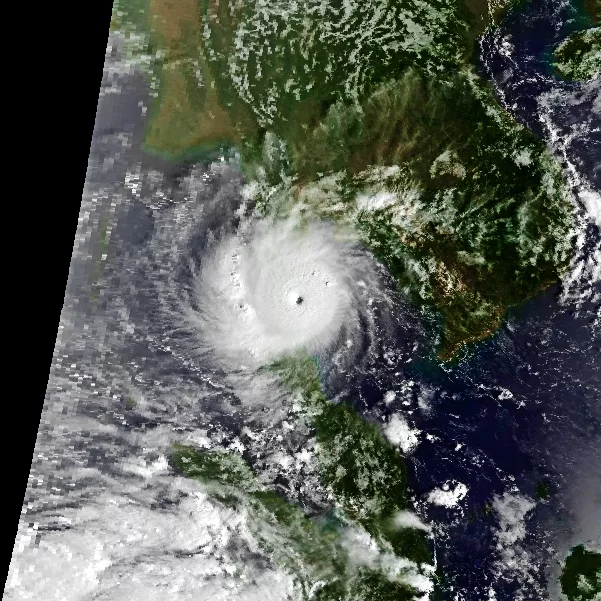
The intensity and speed of the developing typhoon impeded the safe transfer of men into the boats and helicopters, and the trapped crew were forced to ride out the storm.
Typhoon Gay, small and powerful, approached the Seacrest from east-south-east. The force of the wind and waves caused the ship to drift south-west, a result of the Coriolis effect. That eight-point anchor system, designed to hold the ship steady over the work-station, struggled.
Anchor 1 had been released; anchors 2, 3, 4, 5, 6 and 8 failed under load. The port forward quarter anchor, 7, remained intact, dragging and leaving a deep rut in the sandy seabed.
An unsettling calm befell the ship as the eye of the storm passed directly above. At 12.17pm Seacrest contacted marine control to report that she was listing 5° to port as pipe-casings that had broken free shifted on the bottom of the derrick.
The respite from the full effects of the storm violently shifted the force from what was now south-west to north-west. The once-dragging anchor 7 reached beneath the hull as the changing wind pushed the ship over the top of the anchor-cable.
A survivor later testified that he saw the new chief engineer, Gus’s replacement, trying to no avail to sever the cable immediately before the capsize.
At 1.50pm the anchor caught either in a subsea pipeline or debris from the top of the derrick, and held fast. The ship quickly keeled over and crew gathered on the aft deck, thrown into the turmoil of the storm. The ship’s clock stopped as time ran out for Seacrest.
Later inspection of the wreck-site showed some of the hydraulic watertight doors to be damaged. It is not known whether these had been closed as per protocol during rough seas.
Water had entered the “mud room” and emergency-generator room through ventilation openings port and starboard, indicating that these at least had not been closed.
Erroneous drift-trajectory predictions severely hampered thee rescue of the men who survived the capsize, with precious time wasted searching the wrong area. Once the sea had calmed, only six of the 97 crew turned out to have survived.
30 years on

The years pass and Seacrest’s memory fades, another footnote in the human story of the pursuit of the Earth’s riches at sea.
I was fortunate to meet Gus Gustafsson in person, through business. His son had mentioned to him that we divers were about to document the Seacrest, and the chief engineer was keen to tell his story, 30 years on.
The pain of losing so many friends, while still raw in his mind, had led him to feel some guilt for not pushing that story more forcefully, he told us. In fact he claimed to have received a visit from the company, warning him of potential blacklisting within the offshore industry should he speak too openly.
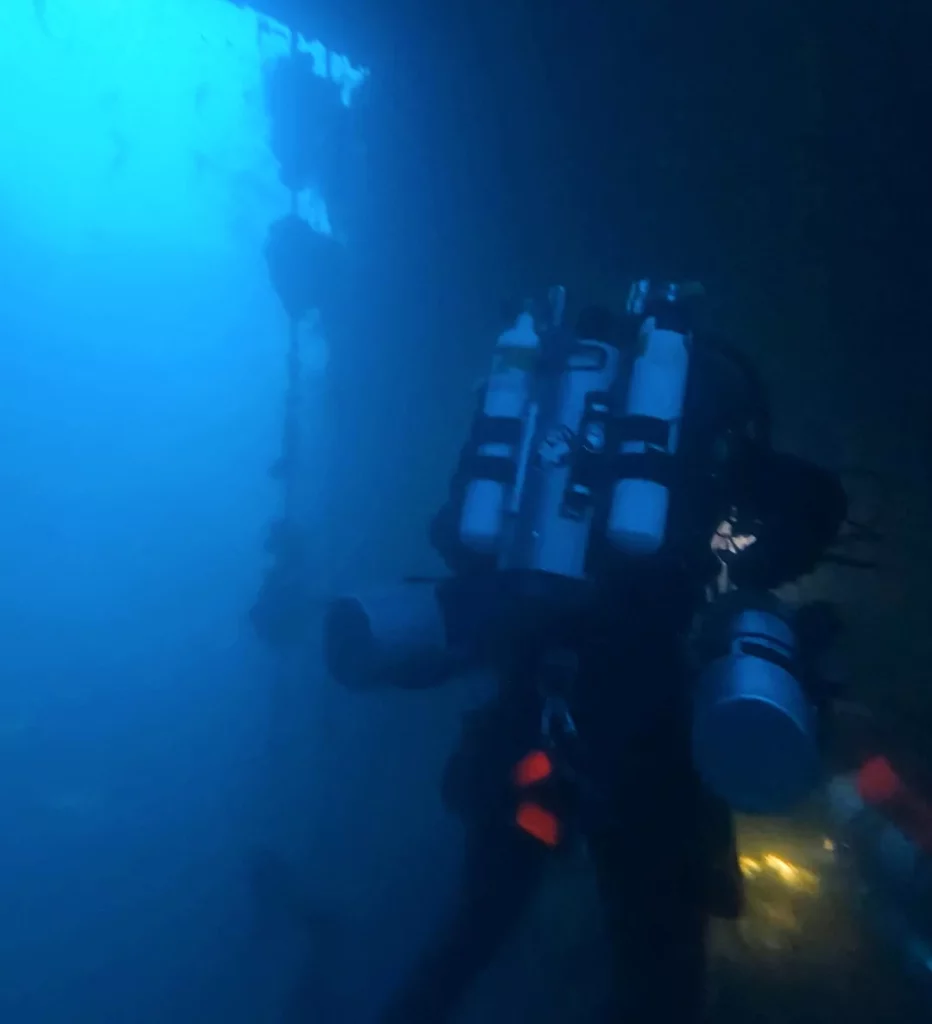
The location of the Seacrest, 97 nautical miles from the nearest land, prohibits regular diving, fully exposed to the elements s the site is. Localised squalls have given the Patong gas field the fierce reputation that had originally necessitated Seacrest’s ungainly design.
Planning for the change in monsoon winds offers chances of calm seas in the area, but it remains hit-or-miss.
Large fishing boats are the only vessels that regularly venture this deep into the Gulf of Thailand, and having to book six months in advance makes planning a lottery.
With eyes on the weather, our chosen date approached. A super-typhoon hit mainland China, disrupting weather patterns in the region. Given our available timeframe, we could delay for no more than two days, loading the boat in the hope that the sea would settle.
After three days punching into the sea state, we retreated to an old wreck mark closer to shore, diving it before returning to Sattahip in Thailand bowed but not broken.
We planned for the next window. Six months passed. Once again, we loaded the fishing-boat, this time with a very different forecast for the days ahead.
Feeling the difference
The overnight journey passed so pleasantly that, when morning broke, my eyes not yet accustomed to the light allowed my imagination to envisage a swish hotel room.
However, a trip to the head and the gurgling, spitting sea-toilet quickly dispelled these delusions of grandeur. It always seemed odd to me that the nicest boats offer the tours while the roughest boats offer the adventure.

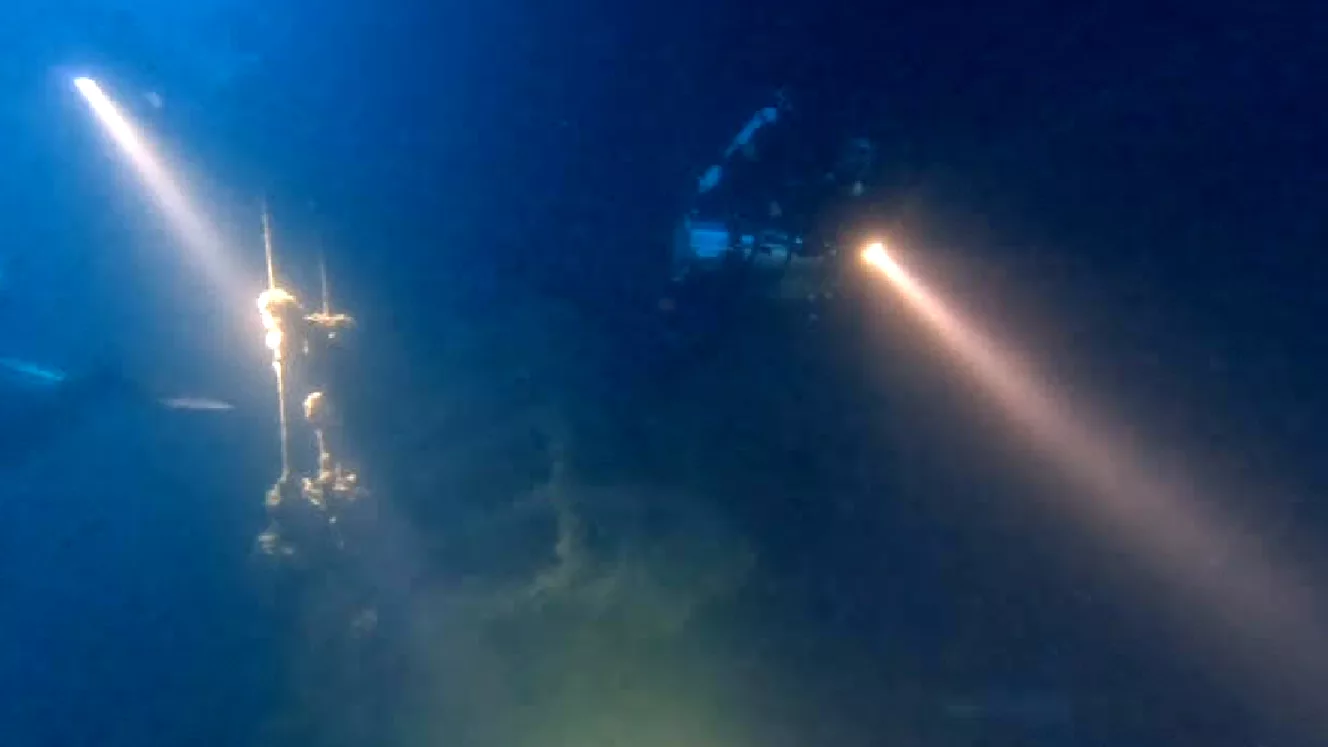
A poorly positioned shot could mean a wasted dive around the hull. The captain, reading the sea state, placed it slightly upcurrent of the bridge area. The team entered at the same time, staging gas and placing strobes on the exit-line.
What a difference six months can make! The visibility at depth was easily 35m, serving to reveal both the sheer size of this ship and some of the horrors that nature must have unleashed on the day Seacrest sank.
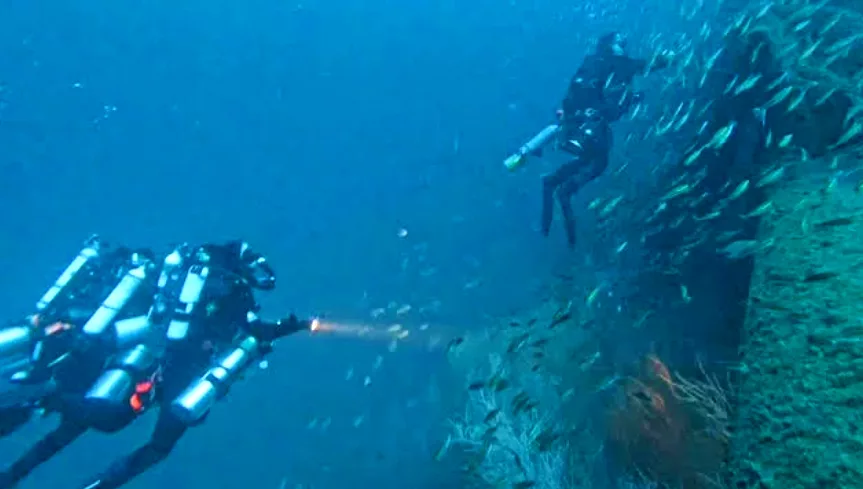
I had a diver’s interest in the moon-pool, so headed directly for this area, swimming through the hull towards the deck. A small crane had fallen into the pool, confusing the picture until the commercial divers’ workstation corrected it.
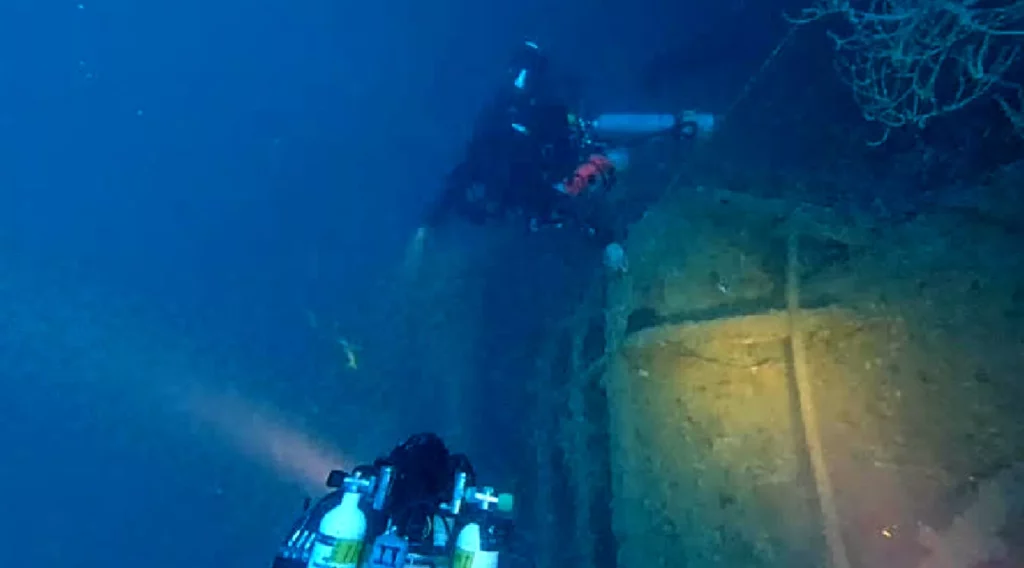
Here, the huge machinery still lashed to the deck gave a glimpse of the enormity of the tasks this ship once endured. It also helped me to focus as I picked my way through the equipment.
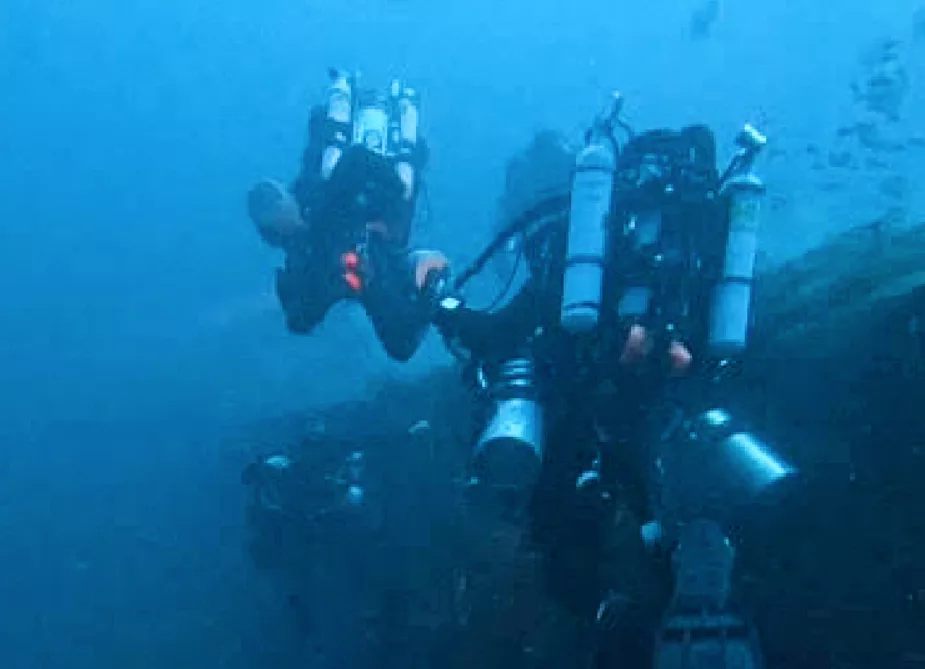
We made a gas projection of 70m for 40 minutes. Our team cut the plan to 90 minutes to the surface. Running a TTS plan gave us the luxury of trading off depth for time: 55m at the top and 75m at the sand, and this approach worked well.
We held up the profile to 65m to cover more ground and get a little more bang for our buck. The hull was almost inverted, but stopped from turning a full 180° by the derrick buried into the bottom.
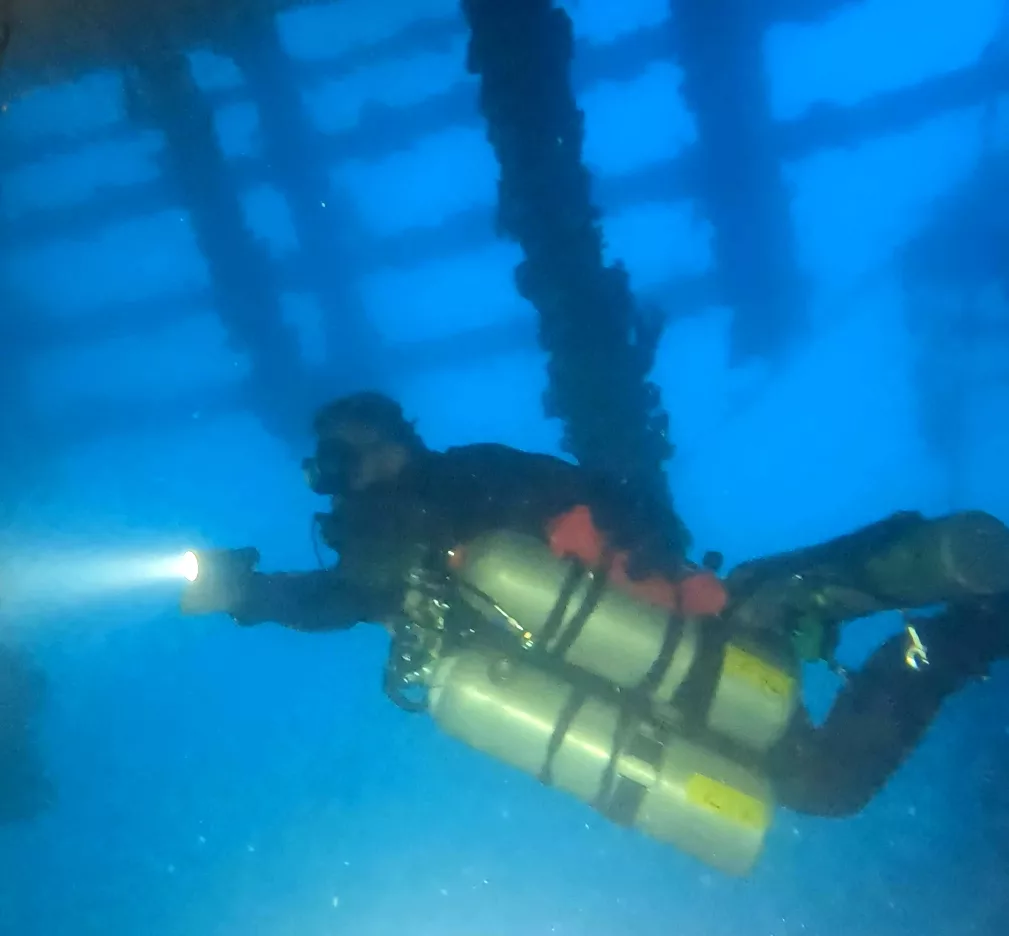
We swam through the moon-pool, emerging into the ambient light, then headed along the gunwale towards the bow, completing a quick flyover of the bow to confirm the location of the bridge and helo pad. The strobes were easily visible and guided us back to the relative safety of the ascent-line.
Today’s simplicity
During decompression, I marvelled at the advancement of our industry. This dive 20 years ago would have required an hour of blending gas for each diver, while the simplicity of closed-circuit rebreather logistics had us premixing gas and boosting the mix back into our 3-litre tanks in minutes.
The pain endured by the victims of tragedies such as befell Seacrest is short-lived in comparison to the suffering keenly felt over time by the families and friends of those lost. The members of the team besides me were Julia Alberione, Chris Haslem, Dougie Docherty and Julien DK. In memory of Gus Gustafsson.
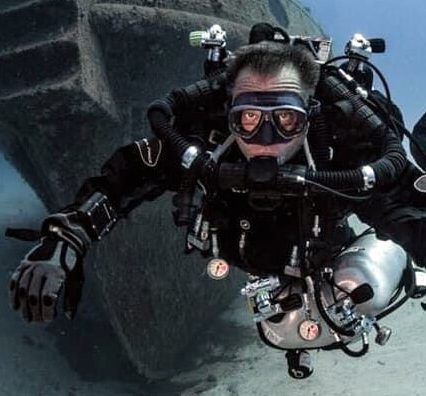
TIM LAWRENCE owns Davy Jones’ Locker (DJL) on Koh Tao in the Gulf of Thailand, helping divers take their skills beyond recreational scuba diving. He also runs the SEA Explorers Club.
A renowned technical wreck and cave explorer, and a member of the Explorers Club New York, Tim is an ANDI and PADI / DSAT Technical Instructor Trainer.