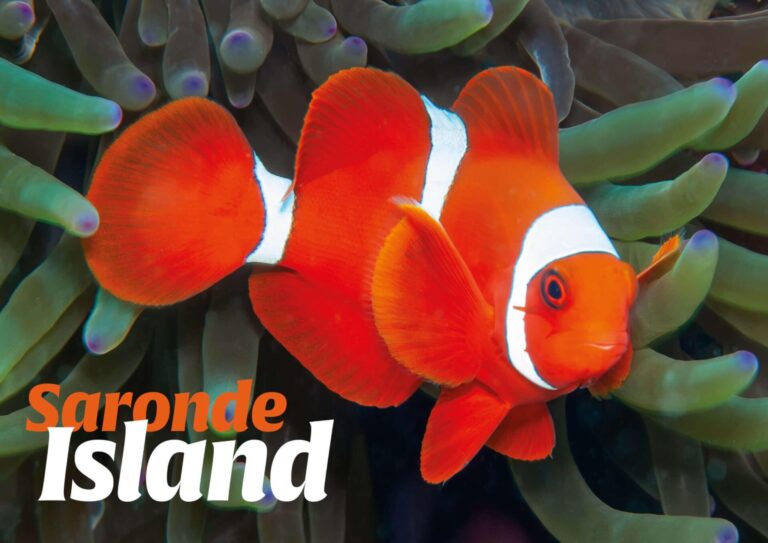
Jak and Corinne Denny head for North Sulawesi to explore the waters around Saronde Island, and find it is a particularly rich hunting ground for nudibranchs and other macro critters
Photography by Jak & Corinne Denny. Words by Jak & Corinne Denny, David & Annette Smart
Over the past 30 or so years, we four Tasmanian divers had previously visited a significant number of prominent dive holiday locations in the Western Pacific region as well as the Indian Ocean. Consequently, it was with enthusiastic interest that we were informed that the Saronde Island dive centre in Sulawesi had a lot to offer divers keen to discover a pristine and not overly congested dive region. Planning for a trip to Saronde commenced early in 2024.

Reaching Saronde Island: Travel Logistics and First Impressions
The travel arrangements for getting to Saronde Island necessitated an international flight from Australia to Denpasar in Bali, and then two further internal flights in Indonesia terminating on the equator at the Jalaluddin Airport near Gorantalo in Northern Sulawesi. We were met at the airport by representatives of the Blue Bay Dive Resort from Saronde Island and driven northwards across the island to the coastal village of Kuandang. From here we loaded all our gear onto the dive centre’s boat and headed out for the final 40 minutes of travel to arrive at Saronde Island.
The greeting we received from the staff on arrival at the Saronde Island jetty was delightfully welcoming, as was to be the treatment we received over the next two weeks.
We were shown to our beachside villas to discover the standard of our accommodation was truly luxurious, leaving nothing to be desired.
Daily Diving: Sites, Schedules and Conditions
Dive days typically included three different dive sites involving boat travel to locations within a few-kilometre radius of Saronde. We usually did two dives in the morning and returned to Saronde for lunch, and then a third dive was carried out mid-afternoon. When greater distances were involved, the three dives were conducted without returning to base until after dive number three. All dives had surface intervals of around one and a half hours between dives. Although night dives were on offer, our group typically decided that the three daytime dives were ideal and that the evenings were to be dedicated to relaxing and socialising in the idyllic resort facilities, including the bar.


The dive sites we visited varied from coral reef sites and rocky walls to sandy bottom ‘muck’ dives. Dive depths seldom exceeded 30m, and most dives were limited to a dive time of between 60 -70 minutes. The dive boat typically had six or fewer divers on board, plus the dive crew.
Did you know?
The anemonefish is one of the only marine creatures that can withstand the toxins of the anemones in which they live. Sea anemones are highly poisonous but the anemonefish is covered with a protective mucus membrane which keeps them safe.


The marine conditions were invariably calm to moderate, and visibility underwater ranged from ten to 20 metres, although we did encounter a couple of low-vis sites.
Our impression of the marine environment around Saronde was that the coral was in very good health with practically no obvious signs of bleaching despite the water temperature being consistently between 29 and 30 degrees C. The varieties of hard coral were impressive and extensive, whereas the soft coral species were somewhat more limited. Particularly impressive were the large and colourful varieties of gorgonian fans.
Marine Life Highlights: From Reef Fish to Cephalopods
The fish life we encountered was dominated by small reef species such as damselfish, anemonefish, wrasse, parrotfish, pipefish, angelfish, goatfish, butterflyfish, frogfish, and numerous others typically associated with their habitat of acropora and other hard corals. It would be fair to say that, despite a diverse range of reef fish species, many of the fish were shy and sought cover when divers approached, making the taking of photographs a little more demanding.


Comparatively few larger fish species were sighted, as was the case with pelagics, with only one or two reef sharks being spotted during our total of 23 hours underwater.
Among the broad range of invertebrates were many crab and shrimp species, plus we had several encounters with cephalopods, including octopus, cuttlefish and squid.
Nudibranch Paradise: A Macro Photographer’s Dream
However, undoubtedly, the marine feature that created very great interest for us photographers was the extensive number of nudibranchs sighted. The 40 or so species encountered included several species we’d not seen before.

Did you know?
The robe hem hypselodoris is a type of nudibranch, or sea slug, that lives in the tropical reefs of the West Pacific and Indonesia. They can be pink, purple, orange, or yellow, with a variety of spots and stripes.
The Divemasters who guided us throughout our dives all showed exceptional skills in locating nudibranchs as well as other invertebrate and fish species too. In some instances, the nudibranchs they located were of such minute size they were barely visible to us without access to a magnifier.
The dive operation throughout was controlled very efficiently and the assistance given to us by the boat crew and Divemasters was excellent, with every effort made to ensure the dives were safe, interesting and totally enjoyable. During surface intervals, hot drinks plus snacks and lunches were always available.
A Day with Whale Sharks in Gorontalo
Midway through our stay at Saronde we were given the opportunity of participating in a shore-dive with whale sharks. This dive day necessitated a major logistical operation of transporting eight divers plus Divemasters with all our dive gear, plus 20 or so cylinders, to a coastal section at Gorantalo. There was a considerable additional cost incurred for this ‘special’ opportunity.
The dive location involved a semi-enclosed and highly crowded marina area where whale sharks have been encouraged to enter as they are hand-fed small fish by a local boatman, who circles the marina area in a small kayak with the sharks following waiting for food.

For our day’s experience which entailed a total of around five hours of travel we had contact with just one whale shark. It was possible to get up quite close to the medium-sized whale shark when not impeded by surface boats and other divers. Unfortunately, the visibility on our day’s dive was less than desirable. Despite these factors, we were all very grateful to the Saronde dive crew who did a superb job in organising and undertaking this logistically demanding exercise.
Life on Saronde Island: Relaxation Beyond Diving
Even if you were not a diver, two weeks on Saronde Island would surely be serene. In terms of accommodation, the villas are perfect with every luxury and comfort imaginable. On non-dive days we had the opportunity to relax on the beach furniture outside the villa’s front deck or swim, snorkel or kayak in the tepid waters just a few metres away. At low tide it’s possible to walk around the island, an interesting exercise taking less than an hour.
Frequently Asked Questions
Where is Saronde Island located?
Saronde Island sits off the northern coast of Sulawesi, Indonesia, near Gorontalo. Divers typically reach it via Bali and two internal flights.
What type of diving is Saronde Island known for?
It’s best known for pristine reefs, rich macro life, varied topography and exceptional nudibranch diversity—ideal for photographers and critter hunters.
How many nudibranch species can divers expect to see?
During a two-week visit, it’s common to encounter 30–40 species, including rare or tiny individuals located by skilled Divemasters.
Are there opportunities to see larger marine life?
Large fish and pelagics are limited, though occasional reef sharks appear. Whale shark encounters are possible during special shore-dive trips near Gorontalo.
What are dive conditions like around Saronde Island?
Expect warm 29–30°C water, calm to moderate seas, and visibility between 10–20 metres. Depths typically stay below 30m with relaxed dive times.
This article was originally published in Scuba Diver Magazine
Subscribe today with promo code DIVE1 — enjoy 12 months for just £1!
