
Sipaway is the new star when it comes to thresher sharks. The facts – significantly more than ten animals between teenage shark and Methuselah, hit rate of almost 100 per cent, protected area, and no other divers for miles around. Even months after its discovery, the cleaning station off the Philippine island of Negros is one of the three best places in the world to observe Pacific thresher sharks (Alopias pelagicus) at close range, as Daniel Brinckmann explains.
Why Sipaway Is a Global Thresher Shark Hotspot
Are they there yet? Even before the sun is high enough above the horizon to send its first rays into the depths, we feel our way towards the reef edge of Camote Reef and stare intently into the blue-green abyss. At a depth of 35m, the rocky cliff ends in the sheer endless sandy desert of the Tañon Strait, and this is exactly where three elongated silhouettes float through the twilight today, casting diffuse shadows as they circle above the sandy bottom.
With pectoral fins like wings and a striking tail fin, the upper lobe of which is almost as long as the rest of the body, the thresher sharks wag onto the reef, seemingly as light as a feather despite their hundreds of kilos of live weight, to have parasites plucked from their skin by hungry cleaner fish in a symbiotic ritual dating back thousands of years. Guide Eric beckons us over and we sink into the back of the wall in slow motion, our hearts racing and breathing carefully.
Shortly afterwards, a three-metre female spontaneously leaves the waiting loop of the underwater washing system, floats up gracefully but straight as a die and, after three photos with a thunderstorm of lightning, calmly turns away only when she is within reach. So much for the supposed ‘hare’s foot sharks’.
Before the 20-minute bottom time has elapsed, five specimens will have arrived, one of which starts a relaxed overhead flight and another stalks unnoticed from behind. Predicate: curious to affectionate. They are also kind of cute with their big saucer eyes and little mouths full of tiny teeth. No wonder Thomas Oswald calls them ‘cute little foxes’. ‘Have you seen the teen shark over the reef top?’ asks the head of Sipaway Divers (www.sipaway-divers.net) to the group on board and first receives blissful nods, then laughter: ‘There’s something wrong with it – it prefers to swim in the light!’ The euphoria of the 50-year-old transplant from Mainz, Germany, is understandable: after all, the close encounters were not the exception, but the rule during a third of a total of 12 cleaning station visits within a week. And in the months before.
Because thresher sharks prefer early morning grooming at dusk but it only gets light late at the deepest point of the ‘sunken island’ Camote, at least individual animals often stay long enough for a quick flying visit on a repeat dive before disappearing into the open water to chase after the numerous shoals of sardines in the narrow strait between Negros and Cebu.
What Makes Sipaway Different from Malapascua
At a quarter of an hour’s drive from the dive centre at the Whispering Palms Resort on the small island of Sipaway, the journey is short enough that you don’t have to set sail until just before sunrise. Other divers or diving centres? Not a thing. And that’s how it should stay. Oswald, who has sold diving holidays himself for many years and knows how much of a rush a biotope can take, wants to avoid a hustle and bustle like the world-famous ‘thresher shark island’ Malapascua with a race to the dive site every morning at all costs: ‘I don’t want more than 20 guests at a time at the base, especially as the district capital San Carlos controls tourism on the island and thus indirectly also the diving operations via registrations and accreditations.’ Fortunately, Camote Reef itself has been designated as a protected area for 15 years. As the coast guard’s marine conservation authority, the ‘Bantay Dargat’ monitors the area with several boats and a viewing platform.

Because people know each other on a 5km-long island, the local guides from Sipaway Divers are informed directly as soon as the Bantay team has observed a number of sharks jumping out of the water to shake off boat owners, or a baby fox has once again bitten a fishing line and been released, because shark fishing in the Philippines is punishable by prison sentences.
The fact that sharks with the distinctive tail fin are found around the island off the coast of Negros has always been known from chance catches. Basically, this applies to large parts of Southeast Asia – but without a regularly frequented cleaning station, the search for them is as fruitful as the search for a needle in a haystack. Shortly before the pandemic, Neptune brought Sipaway Divers a thresher shark for the very first time, causing a great deal of excitement, but before the final success, there was so much sweat that a touch of comedy was added. ‘The sharks educated us,’ recalls Thomas Oswald with a laugh. ‘For a long time we didn’t find anything in the target area, but at some point we had seen enough animals to realise that they came from the north, whereupon we followed them there and didn’t find any more because they were swimming south.’
Did you know?
All three thresher shark species kill their prey – preferably mackerel or sardines – with a precise swipe of their long tail fin into the heart of the school. Their small teeth are used primarily for collecting and eating their prey.
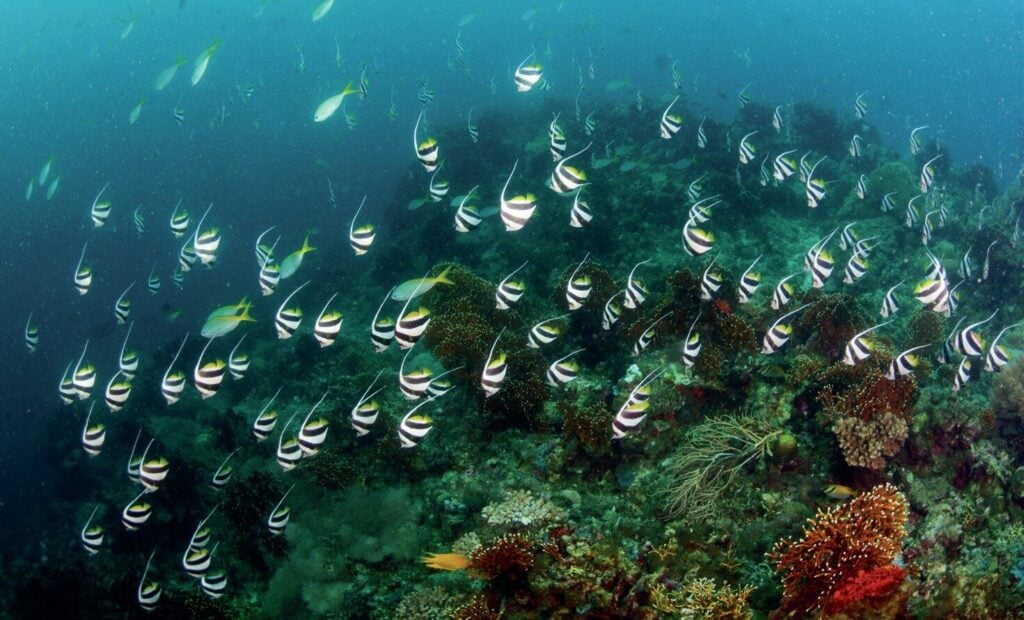
Bannerfish vs Wrasse – A Unique Cleaning Dynamic
The educational rigour of the sharks paid off. Oswald and his team have been familiar with the hotspot for six months and have also known the accepted modus operandi for impressive close encounters for a few weeks now. During the week of exploration with Scuba Diver Germany, however, the realisation dawned that the site may be a small marine biological sensation. The thresher shark washing line is not operated by the typical small wrasse like those off the island of Malapascua, 150km away as the crow flies, or elsewhere, but by long-finned bannerfish, which usually migrate across the reef in large shoals. The black and white banded coral fish also act as a cleaning crew in small groups – preferably with sunfish, such as off the Indonesian island of Nusa Penida and in the Maldives – but not with sharks, for which a 20cm careless reef fish would be a welcome snack. ‘There are actually no reports of this in the scientific literature and observations so far only show that they participate in cleaning sunfish, jackfish and rays,’ confirms Max Baum from the shark and marine conservation organisation ElasmOcean. ‘My colleagues in the Maldives, who are also investigating thresher shark cleaning stations there, have also not observed any such activities among thresher sharks; it is mainly the wrasses that are active here.’ What sounds like sophistical nitpicking may actually make a serious difference. As large reef fish, bannerfish follow thresher sharks over a considerable distance on the sandy bottom and into the open water and therefore have a much-larger radius than cleaner wrasse, which are bound to individual coral blocks.

Did you know?
As a deep-sea dweller, not much is known about the Pacific thresher shark. The smallest of the three species, they have a maximum length of 3.7 metres and inhabit the Indian and Red Seas. The noticable differences from its relatives are characteristics such as fin position, color, eyes, and head shape.
The steep wall at the dive site is around 300 metres long, but the area where thresher sharks are sighted measures more than a kilometre – plenty of space for ‘mobile cleaning columns’, which may not even be comparable to classic cleaning stations, as Max Baum reports: ‘If they cover a larger radius, the bannerfish could adapt more dynamically to the migrations of large fish.’
An exciting hypothesis that suggests connections with the localised thresher sharks in Malapascua and occasional sightings in the south of the strait between Cebu and Negros. One thing is certain: Throughout Camote Reef, bannerfish in small groups as well as large schools are the most-common larger reef fish. It remains to be seen whether the local animals go through a phase in which shark cleaning is part of their life cycle, but theoretically there is plenty on offer.
It is also unclear what the demand is like – specifically, how many of the deep-sea hunters from the Tañon Strait turn off towards Sipaway at night – how big the car wash is, or whether there are other coral formations with hungry bannerfish out there on the sandy bottom.
“The thresher shark washing line is not operated by the typical small wrasse like those off the island of Malapascua, 150km away as the crow flies, or elsewhere, but by long-finned bannerfish, which usually migrate across the reef in large shoals”
The Future of Thresher Shark Research in the Tañon Strait
From January 2025, marine biology master’s students from the University of Bremen will be looking for answers to such questions. ‘Cleaning stations are of immense value for research because we can observe natural behaviour or work with camera traps,’ says Max Baum, sensing an opportunity for his colleagues in Bremen. ‘These natural aggregations of sharks can be used to create photo IDs that can provide important data on population dynamics.’ Given so many things on the horizon, is dive centre manager Thomas Oswald really to be envied? ‘All I really want to do is dive every day,’ murmurs with a laugh, before climbing back into the water to meet the foxies.
That was merely a sample of his dry humour, the man is not only super-dedicated but on a mission… he wants to finally get up close and personal with ‘Methuselah’, the almost four-metre-long grey thresher shark eminence. The catch? ‘Every time I come down to him, he moves back five metres.’ Although three juveniles eventually made an appearance – the smallest measures less than two metres – Oswald didn’t get to see his dream shark this time. To add insult to injury, Captain Jun-Jun can’t help but tease him as he climbed up the outrigger ladder: ‘You should have just stayed on board, two have just jumped out of the water!’
Frequently Asked Questions
Where is the best place to see thresher sharks in the Philippines?
Sipaway Island off Negros is emerging as one of the world’s top locations, offering near-guaranteed sightings at a protected cleaning station.
What species of thresher shark is found at Sipaway?
Divers encounter Pacific thresher sharks (Alopias pelagicus), known for their long tail fins and deep-water habits.
When is the best time to dive with thresher sharks at Sipaway?
Early morning dives are best, as threshers visit cleaning stations around dawn before heading offshore to hunt.
How close can divers get to thresher sharks at Sipaway?
With calm behaviour and controlled diving practices, close-range encounters are common without disturbing the sharks.
Why is Sipaway considered different from Malapascua?
Sipaway has fewer divers, a protected marine area, and a unique cleaning interaction involving long-finned bannerfish rather than wrasse.
This article was originally published in Scuba Diver Magazine
Subscribe today with promo code DIVE1 — enjoy 12 months for just £1!
