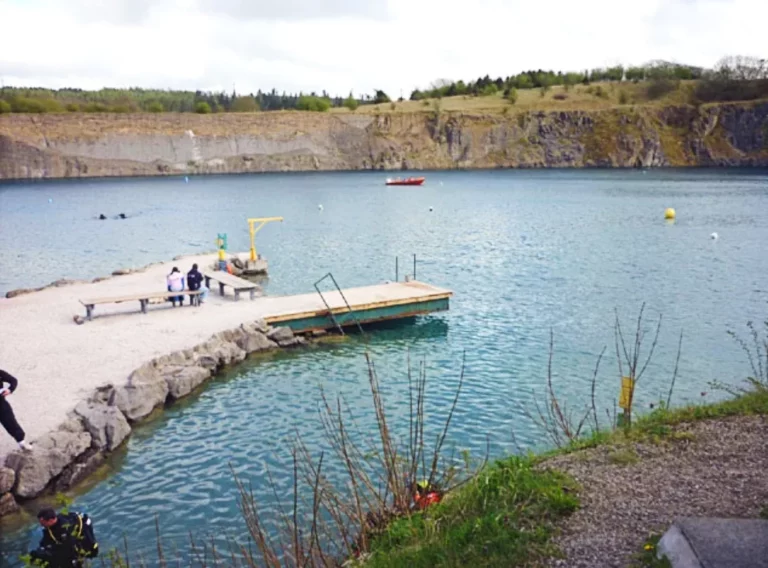
A man who died after surfacing from an Advanced Open Water Diver training dive at an inland site in Lancashire last year was suffering from immersion pulmonary oedema (IPO), a coroner has found.
The diver had expected to be able to breathe more easily once he reached the surface – and appeared to panic when that proved not to be the case.
Mark Powell, a 52-year-old private landlord from Cumbria, was on the first day of his AOWD training at the Capernwray Diving Centre quarry site near Carnforth. Three divers were leading the course for a group of four students.
At Preston Coroners’ Court on 30 April, area coroner Kate Bisset heard that Powell had completed two dives on the morning of 3 May, 2025, according to a report on the proceedings by Lancs Live.
After lunch he had entered the water for his third dive, buddied with divemaster Nicola Hopkins. They had descended to one of the lake’s submerged aircraft wrecks at a depth of 18m.
When Hopkins had seen that Powell’s air was down to 70 bar she had signalled that they should ascend. On the way up Powell had shown signs of needing help and Hopkins had offered him her alternative air source, which he had accepted.
At the surface Powell had momentarily seemed all right, but had then started calling for help. Hopkins had told him to inflate his BC but said that the student had been “thrashing and flailing”.
Powell had grabbed Hopkins, pulling her beneath the surface and causing her to swallow water. Experienced diver Jak Spedding who was nearby had seen what was happening and swam over to help.
He and Hopkins dived to the lakebed and located Powell, recovering him to the surface where a boat brought him ashore. CCTV footage later showed that Powell had been at the surface for just under one minute, and had been brought back up from the lakebed within three minutes of sinking.
Attempts were made to revive him by means of CPR and a defibrillator, but he was later pronounced dead at the Royal Lancaster Infirmary.
IPO ‘common cause’
Instructor-trainer David Keany, who had been providing surface cover, said that when Powell had started shouting and thrashing about “it threw me a bit because he was at the surface. I shouted instructions to Nicola but she was already doing what she needed to do”.
Health & Safety Executive inspector and diving specialist Jules Tuvey commended Hopkins and Keany for reacting correctly in the circumstances – and, according to the Lancs Live report, he described IPO as “the most common cause of diving fatalities”.
“People with IPO hit the surface and panic because you think you’ll be able to breathe better but the problem only worsens as the pressure decreases,” he explained. “You can’t think about what you’re doing, you just try and get out of that situation and if you can’t breathe on the surface you panic.”

Powell’s equipment was found to have worked correctly, and the amount of air remaining in his tank had been “more than enough” for the ascent, which was made at the correct rate. Hopkins had been right to offer air to the student.
“The law requires me to find as fact any act or omission which contributed to death,” said the coroner. “I can find none on the evidence available to me.
“I suspect, though we will never know, the most likely event was that Mark felt he was struggling for oxygen, hence accepting the regulator of Nicola Hopkins and expecting relief when he surfaced.
“Given we know now that he was suffering from immersion pulmonary oedema, he would have still struggled to breathe and in the consequence of the lack of oxygen he was not able to think rationally about the next steps.”
Pressure in the lungs
IPO can occur when immersion, especially in cold water, causes blood from the limbs to shift into the chest, increasing pressure in the pulmonary circulation. Combined with factors such as exertion, tight wetsuits, over-hydration, elevated blood pressure or individual susceptibility, this can raise capillary pressure in the lungs enough that fluid leaks into the air-spaces.
The result is rapid onset of breathlessness, usually with coughing and a feeling of suffocation. Crucially, surfacing does not relieve the problem because the fluid remains in the lungs. The drop in ambient pressure can even worsen symptoms, leading to panic and, in severe cases, loss of consciousness and drowning.
The inquest was the second in April to consider the role of IPO in a scuba-diving death. At a 16 April hearing into the death of Belgian diver Luk Heyvaert on a deep wreck dive in north-west Ireland in 2024, the coroner concluded that his death was by drowning, likely as a result of IPO.