Scuba Diver North America Editor Walt Stearns traveled to Cuba’s Gardens of the Queen and was suitably stunned by what he found awaiting him underwater
Photographs by Walt Stearns
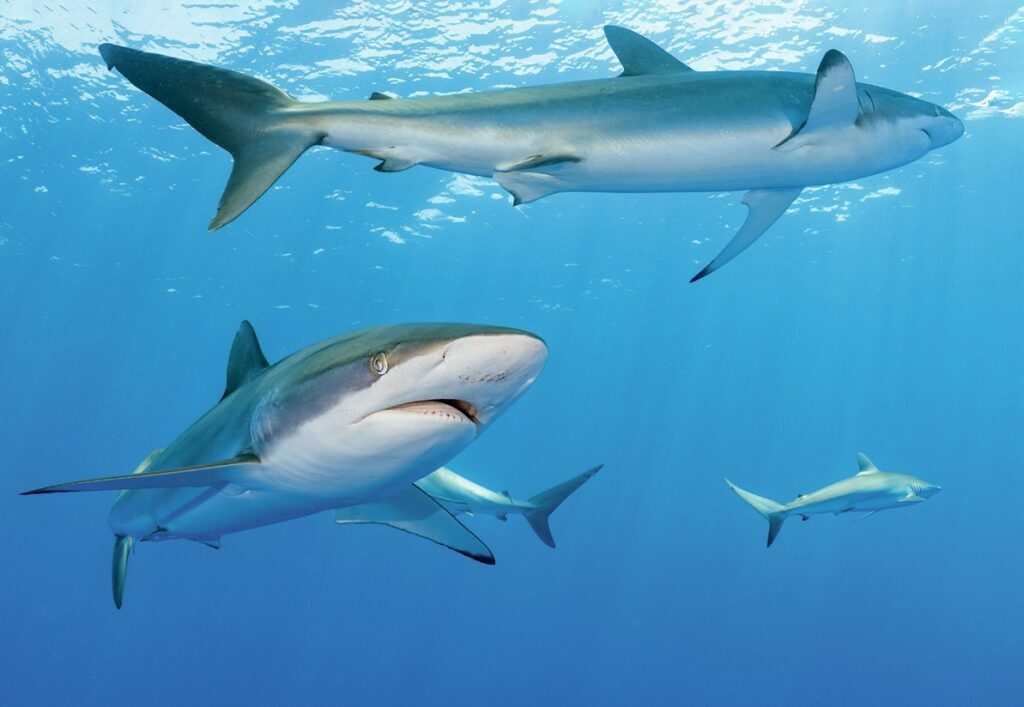
Glancing over the side of the boat as we suited up for the dive at a site known as Montana Rusa, I could see we had company. They were easy to discern by their bronze coloration, which had a silky radiance. Sure enough, as soon as we entered the water, the silky shark welcoming committee was there to meet us.
At this and several other dive sites in Cuba’s Jardines de la Reina (Gardens of the Queen) marine park, silky sharks (Carcharhinus falciformis) seemed to favor areas where the reef skirts the edge of the continental shelf.
Below us, a mini wall beginning at a depth of 55ft took a steep drop down to a depth of 90ft before turning into a gentle slope to around 125-140ft.
Between this mini wall and the abyss, a series of 45–55-foot-tall coral formations seemed to be the favorite haunt of our pelagic friends. But the terrain below was also home to a variety of large reef predators.
One predator that you won’t escape here is the Caribbean reef shark (Carcharhinus perezi). During an entire week of diving in the Gardens, I recall only one dive that I didn’t see at least one of these sharks.
More often, reef sharks seemed to make a concerted effort to photo-bomb the shot every time I set out to shoot a wide-angle scenic. Don’t get me wrong, I found it to be a good thing.

Did you know?
Caribbean reef sharks are decidedly dangerous predators, however they don’t tend to attack humans. Marine biologists have observed that this particular shark species tends to ignore humans, simply seeing them as deliverers of food in feeding dives, rather than food themselves!

Did you know?
Cuba is known for producing high-quality cigars, rum, and coffee, and is home to classy, vintage cars. It is also known for its beautiful beaches, lush forests, and interesting cities.
A tall, majestic stand of pillar coral looks nice in the lens, but it needs something extra. Cue the reef sharks and wait for it! Now the shot looks more interesting. But sharks were not all that was there. Also on the list are horseeyed jack, tarpon, large cubera and dog snapper.

The most attention-getting was the resident population of Nassau, black and yellowfin grouper. While Nassau’s can still be readily seen in places like Little Cayman and the Brac, the Bahamas and the Turks and Caicos, other species of large grouper native to the tropical Atlantic and Caribbean have become a rare commodity.
But here in the Gardens of the Queen, it’s a different story. No matter what reef site we visited, the abundance of big grouper patrolling the reefs was truly impressive
Adding to the pleasure of seeing a robust grouper population, the likes I have not witnessed in close to 35 years, was the lack of fear they had for divers. Several stayed with us from start to finish of nearly every dive.

In addition to the Garden’s robust population of Nassau, black and yellowfin grouper, there is a high probability of meeting the largest member of the grouper family – the Goliath grouper. Goliaths (Epinephelus itajara) can grow to weights in excess of 400lbs.
During both my first visit in 2019 and my more-recent return visit, we were rewarded with the company of a few highly social puppies in the 80-120lbs range that made a habit of being completely underfoot.
Think about it! Where else can you go in the Caribbean to see that?
Cuba’s Gardens of the Queen
For years, this huge island south of the Florida Keys was a forbidden fruit for Americans to visit due to sanctions imposed by our State Department.
It was in the late 1990s that I began hearing reports and rumors from a few who made the journey inside the island nation.
But as things tend to change, parts of the sugarcane curtain came down opening the door and providing opportunities for intrepid divers who felt Cuba was ripe for exploration.
Today, the simplest way is by means of a Cultural People-to-People Visa. One of the most-desirable destinations accessible under this plan is the Jardines de la Reina – the Gardens of the Queen.

Named by Christopher Columbus to honor the Queen of Spain, Isabella I of Castile, the Gardens of the Queen is part of Cuba’s second largest archipelago, running parallel to the main island’s southern coast for 93 miles in a north-west to south-east direction.
Separated some 60 miles from the mainland by the Gulf of Ana Maria, the Garden’s collection of small islands and mangrove forests spans an area of approximately 840 sq miles in size.

From the 1960s through the 1980s, the archipelago was known as the personal playground of Fidel Castro, who held a strong interest in scuba diving.
While that helped in keeping commercial fishing interests at bay, a more-concrete form of protection came into play in 1996 with the establishment of a large swath of the archipelago as a marine reserve. In 2010, Jardines de la Reina was reestablished as a national park (Spanish: Parque Nacional Jardines de la Reina) making it one of Cuba’s largest protected and most-pristine marine environments.
More than 60 percent of the park is comprised of seagrass beds, which serve as vital nursery areas for young fish and lobster. Today, under the regulatory eye of the Cuban Sciences and Environment Ministry, the park is opened to a single liveaboard dive operation -Avalon Outdoor.
The purpose of this access is twofold. First, limiting access to about 2,000 annual visitors mitigates pressure on the marine ecosystem.
The other reason is that it takes considerable funds to enforce protection. The problem here is that the Cuban Government does not have the finances to do it alone, which is where Avalon comes in.
Avalon Outdoor
Avalon Outdoor’s presence in Cuba began sometime around 1992 with a 110-foot double-deck houseboat named the Tortuga, which stayed permanently inside the park along with a refurbished 70-foot 1970s-era yacht configured for diving.
Cut to the present, both the houseboat and vintage yacht are gone, replaced by a sizable fleet of modern dive yachts. Looking over the list, there is the 110-foot Jardines Avalon I (JA1) introduced in 2010, the 120-foot Jardines Avalon II (JA2), as well as the 130-foot Jardines Avalon F Iand F2 in 2014.
And it doesn’t end there. There is also the 160-foot Jardines Avalon III (JA3) brought online in 2019, followed by the 180-foot Jardines Avalon IV (JA4) going online the following year.

Going to Cuba
Entry into Cuba from the USA is done under one of OFAC’s 12 General Licenses. Since the foundation of the Avalon Program is conservation, protection, and education of this critical and fragile Marine Protected area, any participants in the program qualify for legal travel under the Humanitarian Projects 515.575 License.
Agents for Avalon Outdoor, Aggressor Fleet and All Star Liveaboards will provide assistance with everything that is required to enter Cuba. From the US, American, Delta and JetBlue provide services into Cuba.
The closest entry points to Jucaro, where the boats are based, is Camaguey (CMW) followed by Santa Clara (SNU).
Transportation between both airports and Jucaro is generally two-and-a-half hours in duration. Your arrival on the same day the boats depart (typically 6pm) from the dock should be planned for that morning, and no later than early afternoon.
Otherwise, fly in the day before. For this, Avalon, Aggressor or All Star will help arrange an overnight stay. Flights into Havana (HAV) will require an overnight stay as ground transportation to the boats is early am, which entails a six-and-a-half hour bus ride to reach the seaport town of Jucaro.
Transportation to and from the boats is provided by a large 40-foot, air-conditioned tour bus. In addition to the comfort of the bus taking some of the sting out of the long ride, the trip allows you to see some of Cuba’s countryside.
For the record, Aggressor Fleet’s two boats, the Jardines Aggressor I and II are actually the Avalon JA1 and JA2, which are operated by Avalon Outdoor. Either way you cut it, you have a total of six vessels, making this the single largest liveaboard fleet in the Caribbean.
In addition to Aggressor Fleet’s presence, All Star Liveaboards promotes their diving excursions to the Gardens of the Queen through Avalon Outdoor.
Avalon’s large-scale presence not only gives divers access to some of the most-exciting and varied diving in the Caribbean, it also creates a symbiotic relationship with the park. In addition to helping finance the park, Avalon’s trip programs fund marine biologists working in the Jardines de la Reina.
Biologists are hosted on each boat and provide guests with short presentations nightly about the history, marine ecology, and current ongoing conservation measures.
When visiting Cuba in 2019 and again in 2023, I had the pleasure of staying on Avalon’s two biggest boats, the JA3 and JA4.
The JA3 can accommodate up to 30 guests in 15 cabins (11 standard and four balcony suites), while the JA4 accommodates a total of 40 guests split between 20 cabins (12 standard, four demi suites and four balcony suites) spread out between two deck levels.
All cabins feature air-conditioning, two beds (double or twin), and ensuite bathrooms with full showers. A 12-member crew provides daily housekeeping and laundry service All electrical outlets on board provide 110/230 volts AC, 60Hz with American-style flat two-pin plugs as standard, along with USB ports.
You can obtain all that info and more by visiting Avalon’s, All Star and Aggressor Fleet’s websites.
The diving itself is not conducted directly from the ship as it is generally done in the rest of the Caribbean. Instead, divers are transported to dive sites via one of their 33-foot dive tenders.
By making use of launches, Avalon seldom needs to reposition their boats once on station, treating the larger boats more like floating hotels than dive cruisers. The dive schedule begins with a morning two-tank departure, generally followed by a single-tank afternoon and/or night dive.
Dive times are kept to around 55 to 65 minutes based in part on the profile site, with the deepest dives first. Maximum depths are kept to 120ft.

Post-dive at the floating hotel, divers have access to fresh hot water showers on the aft swim step along with a towel straight out of the dryer. Should that dive be the last one of the day, the crew will likely offer you a freshly made mojito to wash away the leftover salt taste from the dive.

Did you know?
Cuba is home to a sub-species of the American saltwater crocodile found in parts of the Bahamas, South Florida and Mexico. Fortunately, they are quite passive and cautious around people, so snorkelers have the rare opportunity to meet one face-to-face.


FAQ
What is the Gardens of the Queen?
Jardines de la Reina is Cuba’s largest marine reserve, spanning 840 square miles of pristine reefs, mangroves, and islands.
What marine life can divers expect?
Silky sharks, Caribbean reef sharks, Nassau grouper, Goliath grouper, tarpon, snapper, and healthy coral ecosystems.
How do you get to the Gardens of the Queen?
Access is only by liveaboard, primarily through Avalon Outdoor, Aggressor Fleet, and All Star Liveaboards, departing from Jucaro.
Why is diving here special?
Strict protection limits visitors to about 2,000 per year, ensuring vibrant reefs, large predators, and one of the Caribbean’s healthiest ecosystems.
This article was originally published in Scuba Diver NA #16
Subscribe today with promo code DIVE1 — enjoy 12 months for just £1!