
It has been a very busy start to the diving year for me. I’m writing as I wrap and pack at the end of a trip to Tiger Beach in the Bahamas. The Bahamas is a fantastic destination for shark photography. The Bahamian Government showed great leadership in declaring their territorial waters one massive shark sanctuary back in 2011. And this legislation isn’t just a Paper-Park, but has real bite.

In 1993, long-lining was banned in the Bahamas, and then in 2011, with the threat of a shark fishery opening up, the Government brought in this extra protection for sharks and their habitats, which prohibits commercial shark fishing and the sale, import, and export of shark products. One of the main reasons this legislation received widespread support was because Bahamians could see the benefit of sharks. Not only do sharks help maintain a healthy and productive marine environment, but shark-tourism has long been big business across the archipelago.
Nassau is famous for reef shark dives, as is Grand Bahama. Cat Island is known for its oceanic whitetips, Bimini is renowned for great hammerheads, Eleuthera for lemon sharks, and the Exumas for nurse sharks (and those swimming pigs)! I’ve also had great encounters with reef sharks in San Salvador and Long Island. Not forgetting my target this time – Tiger Beach, which isn’t a beach or island, but a submerged sand bank, in a remote offshore area, closest to the island of Grand Bahama. The tiger part of the name is, however, well deserved.
When diving with tiger sharks, photography always comes second to safety. The first safety decision is whether such extreme dives with potentially dangerous predators are for you. They are absolutely not for most people. So never use the justification that just because others have done it that you should too. And don’t sign up without doing your research – don’t just read the promotions, make sure you talk to people who’ve done it and benefit from their truthful advice.
The next choice is finding the right operator, who you will be relying on for safe and enjoyable encounters. We went to Tiger Beach with the owner/ operators of Epic Diving, who have been doing this daily for over 15 years and have an analytical and calm approach to their dives with tigers. They take down just a few small morsels for the sharks – bait is not for feeding, but for controlling the sharks. They never feed any of the other shark species at Tiger Beach, which helps keep everything calm.

The safety briefing was extensive, but prominent in the advice was to always maintain eye contact with the tiger sharks. They are ambush predators and if they clock you’ve spotted them, you avoid stirring any predatory instincts. In practice, for photographers, this boils down to not getting absorbed in your camera – so no reviewing images or navigating menus! And much of the time you end up shooting from the hip, aiming the camera without looking through it. Fortunately, when using a wide-angle lens this is much easier than it sounds. They main mistake to avoid is not to point the camera at the head of the shark, but instead aim it more at the pectoral fin, so you’ll compose the shark evenly across the frame and don’t cut off its tail.
These dives are run in shallow water, kneeling, overweighted on a sandy seabed. This makes it easier to watch all the sharks, as the dive is two dimensional, rather than three. A sandy seabed, bathed in tropical sun, and covered in clear, shallow water also makes underwater photography point and shoot simple.
The simplest technique is to shoot with available light. This leaves more capacity for concentrating on the sharks and you can use the power of Lightroom to finish the shots after the dives. When working without strobes it is important to use a reasonably fast shutter speeds of at least 1/125th, to make sure the sharks stay sharp, particularly if they come close. I set my camera on Underwater White Balance, but I expect to have to adjust it further post dive. Processing such images involves two stages, first a global adjustment of White Balance and importantly the addition of Vibrance with Contrast and Clarity.
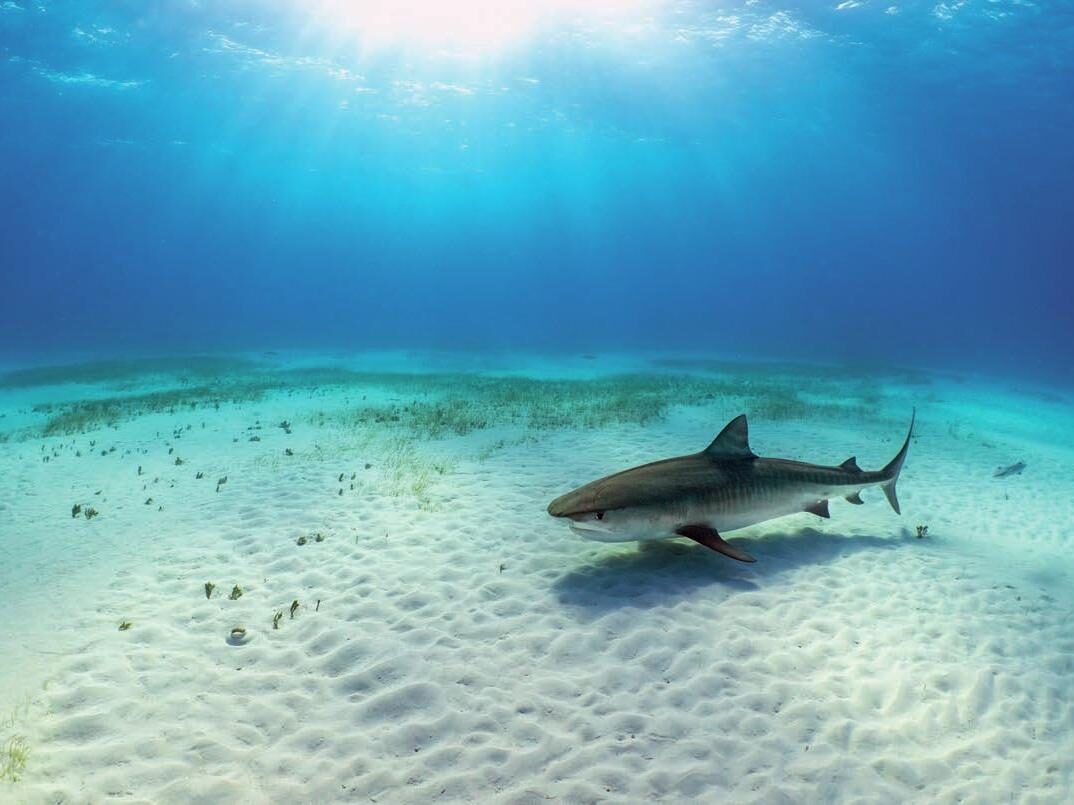
Then pick the shark using Subject Selection and make some further White Balance tweaks, drop the Saturation and increase the Whites, which has the effect of looking like flash. Just don’t overdo the sliders on the selection and make the shark totally black and white, as it will just look like you stuck in on the picture!
Flash will give the images more of a kick, but be prepared to get backscatter at times when the sharks or the divers get excited and stir up the sand. Fortunately, the new Backscatter Exterminator magically eats this type of image for breakfast. I’ll tell you more about this groundbreaking software in next month’s column. If you get some rainy days then these are perfect for working in long exposures with flash, switching to front curtain flash and using accelerating panning, to create a movement-streaked background behind the shark. When it is sunny you just can’t get down to the required shutter speeds (slower than 1/15th sec).
At Tiger Beach, divers are typically lined up either side of the guide who is managing the bait. At the start of the trip divers all want to be close to the feeder chasing the most action, but over time realise that the ends of the lines are the best spot. Here you won’t get as regular or as close passes, but you will get the chance for cleaner more natural feeling pictures. When I first starting photographing sharks the ‘Skin Diver Magazine’ look, or ‘shark-porn’, was what everyone was chasing. This was a shot showing man dominating beast, with shark mouth agape and baring teeth. But just as the divers as Tiger Beach migrate to the more-naturalistic opportunities with experience, so I think the photographic goals of our community have matured.
Increasingly, photographers are chasing images that place these predators in their environment. And rather than wanting to show sharks being fed, photographers are aiming to create shots that communicate that sharks are part of thriving marine ecosystems. As Sylvia Earle says “if you are lucky enough to see sharks, it means you’re in a healthy ocean. You should be afraid when you are in the ocean and you don’t see sharks.”
Find out more at Alex Mustard
