PT Hirschfield chats to South Australian scuba instructor, award-winning underwater photographer and writer Chelsea Haebich
Photographs by Chelsea Haebich and Jayne Jenkins
Chelsea Haebich almost didn’t tune into the announcement that she’d won the Guru Award Portfolio Prize for the Underwater Tour of 2020: ‘I nearly missed it, just tuning in at the end to see who the winners were.
When I saw who was winning the categories, I thought my images were not up to scratch for competitions at this point. You could have knocked me over with a feather when my name was announced.’
It was just six months after she’d upgraded from her first compact camera, and a long way from where she’d started as a high school student who despised learning photography: ‘If you’d told me ten years ago that my images would win competitions or be published in a magazine, I would never have believed you.’
Chelsea lived in Mount Gambier as a child, her stepfather having been a keen cave diver. In 2009, snorkelling in a Point Turton rock pool quickly fast-tracked her to a career in diving: ‘I walked into Adelaide Scuba to buy my own mask, snorkel and fins to continue snorkelling and walked out having signed up to an open water course. I was a dive instructor 11 months later.’
‘Through teaching, I enjoyed taking people from fear and trepidation through to their final dive, giving them a whole world that was otherwise unreachable for them. I also enjoyed the friendships and sense of community that came through that.’
Her passion to show non-divers what she’d seen underwater marked a dramatic turning point in Chelsea’s relationship with image making: ‘The desire to communicate how amazing that world was took me from my teenage mentality of having no interest in photography to ‘I need to get an underwater camera!’
I started with a little Panasonic and attached every possible thing you could attach to it. I enjoyed the storytelling that came with it and was lucky to come back with a few great shots.’

Chelsea is fascinated by marine life dynamics: ‘I constantly find so much humour, character and life down there. I feel fortunate to be able to do that so freely in South Australia, gearing up in a carpark and diving for a couple of hours.
I dive in a lot of manmade ecosystems beneath jetties, in three to five metres depth. I get a real kick out of bringing that world to the surface for people through photos.’
‘A lot of people only get to engage with the life beneath jetties through fishing. I see some pretty horrific things, including a whale that had lost its tail and was dying between the old and new jetties at Rapid Bay.
If I can bring up images that change perceptions and get people to think about that underwater space in a different way, that’s my contribution.’ Early in her dive life, Chelsea received life-changing encouragement from British wildlife photographer and TV presenter of ‘Last Chance to See’, Mark Carwadine, who told her during a whale-watching trip in Baja, ‘You’ve got some really good shots here.
You’ve got an eye and that’s not something you can teach people. I really hope you keep doing what you’re doing.’ That changed everything for me.’
Even so, Chelsea’s growing passion for underwater photography found itself on the back-burner while she worked as a full-time instructor. However, her ten-year career screeched to an abrupt halt a decade ago, courtesy of a ruptured eardrum: ‘Bubbles came out of my ear while I was pool training.
I had an ear reconstruction followed by a very nervous six to nine months, waiting. That experience made me rethink my diving. What I was missing most was underwater photography.’
As an instructor, Chelsea missed having the opportunity to ‘dive for herself’, reclaiming underwater photography as a form of therapy after exiting a relationship where she’d ‘lost herself’ and her identity: ‘I had to do something to move forward, so I booked onto a dive boat.
There were several faces I hadn’t seen for years because I’d become quite isolated. My sense of self and who I was came racing back. I threw myself into doing the one thing that truly made me happy – diving with my camera.’
But in October 2021, Chelsea was knocked out of the water by a life-threatening health crisis. While diving, she experienced the sudden onset of a raft of severe, interrelated health issues (acute pancreatitis, organ failure, septicaemia, diabetes and blood clots).
She was put into intensive care on life support, too sick to operate on, the odds stacked against her survival.
Spending a month in hospital, then a month at home rehabilitating, she was told it was unlikely she would ever return to diving. Chelsea has spent the last year regaining her health and is steadily finding her fins again, finally crossing exotic dive destinations like Anilao in the Philippines from her bucket list.

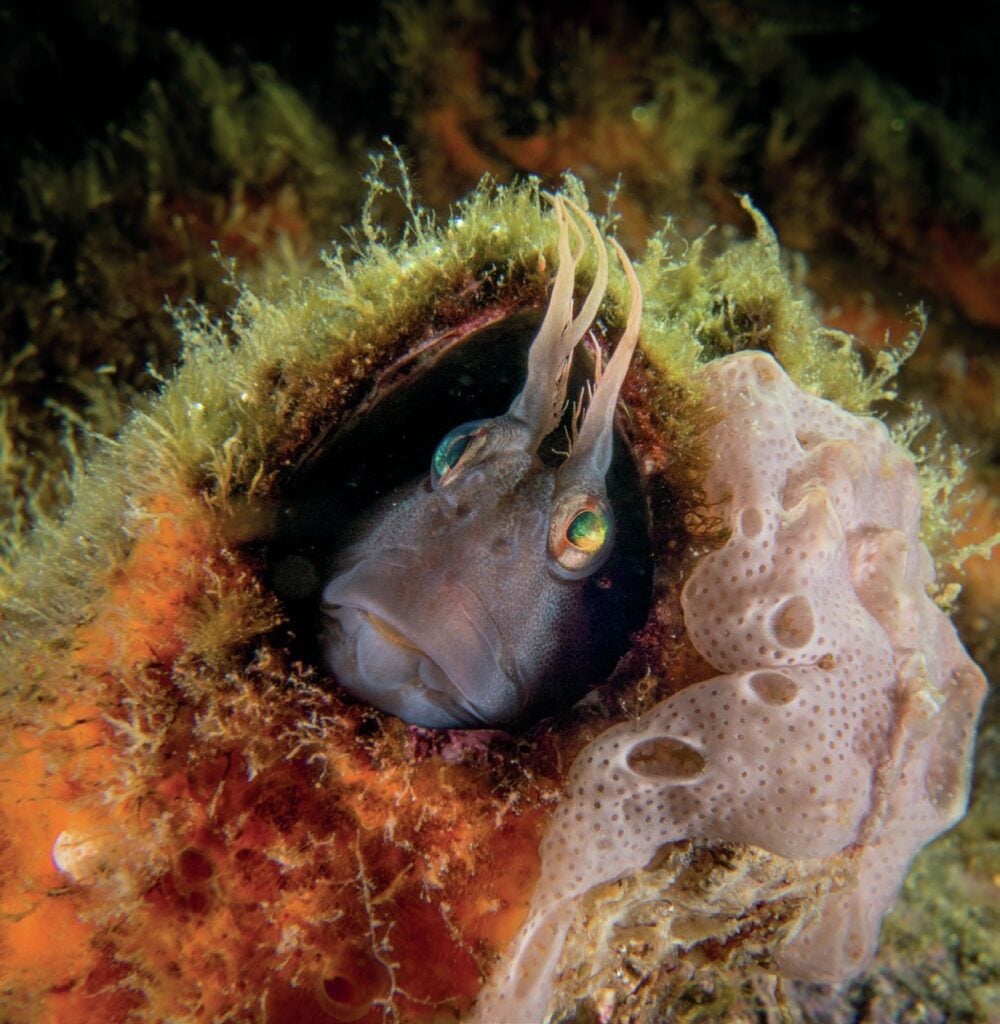
Once again, diving and photography have proved a powerful incentive for recovery, and a potent form of therapy.
After being one of the first citizen science divers to survey, map and species-count South Australia’s HMAS Hobart with Reef Life Survey, Chelsea now has a growing interest in photographing and writing about wrecks: ‘That experience was magical.
I understood the wreck differently, as a living thing encrusted with invertebrates, sponges and ascidians, with fish life everywhere. Now I’m fascinated by how these man-made reef structures come to life over time.’
Chelsea began to contribute articles to Scuba Diver ANZ during the pandemic where diver focus necessarily shifted from exotic destinations to what is in their own blue backyard: ‘Before Covid I’d dived Bali, Croatia, the GBR and the San Diego kelp beds.
It’s great to be able to plan trips again. But we’ve all rediscovered that, while It’s not always the easiest diving, there’s a phenomenal amount to see here in Southern Australia.
There are highly endemic species that can be unique to specific sites. Encounters with giant cuttlefish and sea lions are amazing. The colours beneath the jetties just blow me away.’
You can connect with Chelsea’s vibrant macro and wide angle underwater imagery at 34south.com.au

CUSTOMER TESTIMONIAL
“KUBI Dry Gloves are our first choice for the most-reliable cuff system on the market. Streamlined, simple, dependable and reliable. We’ve dived them across the world on some of the biggest, deepest wrecks, walls and beyond“
MATT MANDZIUK | DAN’S DIVE SHOP, INC. | ONTARIO, CANADA
This article was originally published in Scuba Diver ANZ #60
Subscribe today with promo code DIVE1 — enjoy 12 months for just £1!