To clear up any confusion divers may have about diving with a PFO (patent foramen ovale), Douglas Ebersole MD shares how he explains the condition to patients
What is a Patent Foramen Ovale (PFO)?
The heart has four chambers: two on the top (right and left atria) and two on the bottom (right and left ventricles). As our heart is forming before we are born, the wall between the two bottom chambers is solid, but the wall between the two top chambers is not.
One wall grows up from the bottom, while the other grows down from the top. Where they overlap is a flap — not a hole, as some people have described. The reason for this structure is that once we are born, the purpose of the right side of the heart is to pump blood to the lungs to get oxygen, and then the blood returns to the left side of the heart, where it is pumped to the body.
As a fetus, however, we don’t use our lungs; they are collapsed and full of fluid. Oxygenated blood comes from the placenta, empties into the inferior vena cava, and then goes to the right atrium. In the fetus, the right side of the heart tries to pump blood to the collapsed, fluid-filled lungs, which is difficult and results in higher pressures in the right atrium than in the left atrium. This differential pushes open the flap between the two top chambers and allows the oxygenated blood from the placenta to bypass the right side of the heart and enter the left atrium. From there, the oxygenated blood goes to the left ventricle and is pumped to the body.
How a PFO Is Diagnosed – The Bubble Study Explained
When we are born, the lungs open, which makes pumping blood to them much easier. This results in lower pressure in the right atrium compared with the left atrium and slams the flap shut. In about 75% of people, this flap between the two atria will seal within the first year or so of life and make a solid wall. In about 25% of people, however, it never seals and is called a patent foramen ovale. The presence of a PFO is a normal variant in humans and not a disease.
In the 25% of divers who have this flap between the atria, bubbles that the lungs normally filter can cross from the right atrium to the left atrium under certain loading conditions, resulting in decompression sickness (DCS).
When doing a bubble study, we inject agitated saline into a vein, which results in tiny bubbles that reflect the ultrasound. This mass of bubbles enters the right atrium and should go to the right ventricle and then to the lungs. In people with a PFO, however, the bubbles will cross from the right atrium to the left atrium. We determine the PFO’s size by observing how many bubbles go across and if they cross at rest or require a manoeuvre, such as a Valsalva, to cross.
How Diving With a PFO Can Raise DCS Risk
As best we can tell, a PFO increases the risk of DCS by about fivefold. While that may sound bad, remember that it is a relative risk. The absolute risk of DCS in a diver with a PFO is quite small. For recreational diving, the risk of DCS is about two episodes per 10,000 dives. Therefore, a diver with a PFO could expect about 10 DCS episodes per 10,000 dives or one episode per 1,000 dives, which is a small absolute risk.
When a diver with a PFO gets DCS, we have to determine if the PFO is a contributing factor. Research indicates that four types of DCS are related to a PFO: cerebral, spinal, inner ear, and cutaneous (skin).
Practical Dive Modifications for Divers With a PFO
Whether or not a diver with DCS has a PFO, the options are always to either stop diving or dive more conservatively. The issue is the inert gas load, not the PFO itself, so anything that limits inert gas loading will decrease the likelihood of recurrent DCS. We recommend diving shallower, staying within no-decompression limits, making fewer dives per day, using nitrox with your computer set to air, performing long safety stops, and not engaging in any strenuous activity for several hours after diving.
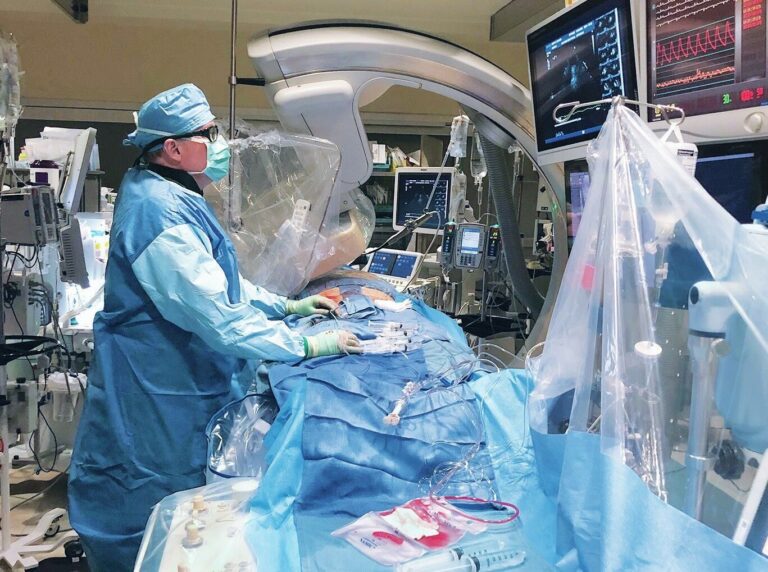
If a diver has recurrent DCS of any of the four types related to a PFO despite using conservative dive practices, we may offer a PFO closure, which is an outpatient procedure that takes less than an hour. After the procedure, the diver takes aspirin and clopidogrel (Plavix) for three to six months and then has a repeat echocardiogram with a bubble study. If that shows no right-to-left shunting, the diver can return to diving without restrictions.
For an extensive range of diving health and safety information and downloadable resources, research studies, incident summaries, and free e-Learning courses, take the time to explore the DAN website.
Frequently Asked Questions
What is a patent foramen ovale (PFO)?
A PFO is a small flap-like opening between the heart’s upper chambers that failed to seal after birth. It’s a common anatomical variant present in ~25% of adults.
How does a PFO increase decompression sickness (DCS) risk?
A PFO allows venous bubbles to bypass the lung filter and enter arterial circulation. This right-to-left shunt raises relative DCS risk (~5×) for certain DCS types (cerebral, spinal, inner-ear, cutaneous).
How is a PFO diagnosed?
Diagnosis is via echocardiography with a bubble study (contrast ultrasound). Agitated saline is injected and ultrasound checks whether bubbles cross from the right to left atrium at rest or during a Valsalva manoeuvre.
Should I stop diving if I have a PFO?
Not automatically. Most divers with a PFO can continue by adopting conservative profiles: shallower dives, fewer dives per day, longer safety stops, nitrox-with-air-settings, and avoiding strenuous post-dive exercise.
When is PFO closure recommended for divers?
Closure is considered after recurrent DCS of PFO-linked types despite conservative diving. It’s an outpatient catheter procedure; return-to-dive follows confirmation of no residual shunt and physician clearance.

Been there, done that and subsequently had my PFO closed. Apart from diving normally thereafter I had a real step change in my CV performance. Having participated in sport all my life I really noticed improved performance post closure. Funnily enough I have never worn bed-socks since either!!