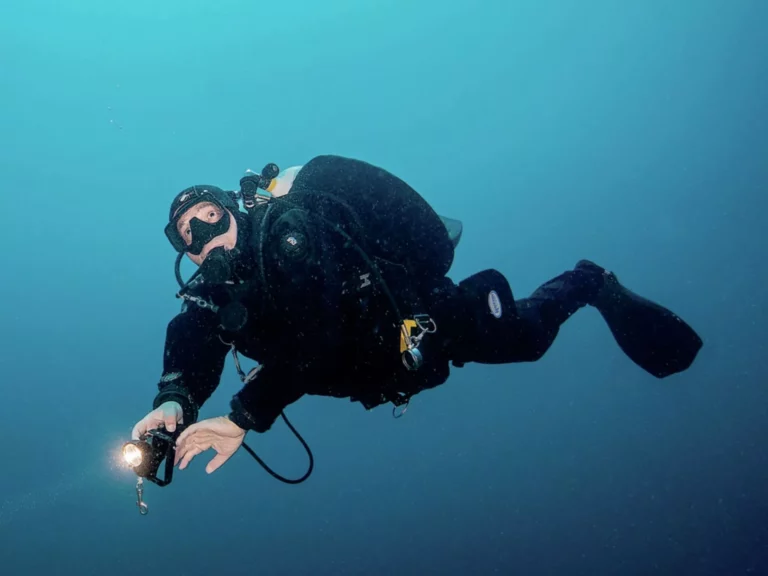
Laura Walton takes a closer look at one of the most-primitive of human emotions – fear – and discusses the essential psychology of managing fear while diving.
The Biology of Fear: Why Our Bodies React Underwater
Fear is the cold wave of emotion that can feel like a solid barrier against forward movement. One of the most primitive of human emotions, fear forms part of an adaptive reaction to danger in the environment. When threatened, our biological system offers up a range of states to support survival: freeze – flight – fight – fright – flag – faint (Schauer and Elbert, 2010). All are of only limited use underwater and can tend to create more problems that they solve. Combining these psycho-physiological reactions with depth can stimulate further issues and physiological drivers of fear, for example due to the impact of gas density, narcosis and hypercapnia, see Fear and Loathing in Scuba Diving by Klaus Stiefel. And of course, the risks of the fight/ flight state are fairly clear to any diver with a basic grasp of diving physiology, with rapid ascent being one of the most-frequently reported incidents.
Identifying Common Triggers for Scuba Diving Panic
In diving, there are plenty of potential sources of immediate fear. From the various issues that can arise with equipment, through to the occasionally aggressive marine life encounter or boats getting too close for comfort. Beyond the array of threats offered by the underwater environment there are the pre-existing issues that divers may bring. Phobias of sharks, fish, snakes, submerged objects, enclosed spaces, heights, dark and open water – all mean a risk of a strong reaction when the feared object is encountered. Triggers of prior unresolved trauma can sometimes, though not always, be found in the water too. As well as those solid threats to safety are the less tangible human fears of failure, rejection and loss of control.
About the author
Laura Walton is a clinical psychologist and scuba diving instructor bringing together psychology and scuba diving to help people with their diving. She provides specialist psychological services for scuba divers and accessible courses. Laura has been guiding and teaching scuba diving in the UK since 2012, and is currently a PADI Master Instructor. www.fittodive.org
So, is fear to be avoided?
Well, yes and no. The physiological effects of the threat response for example in changing breathing pattern to rapid and shallow, or even breath holding, and the racing heart can cause problems when diving. Underwater this can quickly escalate into panic. Plus, the way that fear grips and steers attention can make it hard to think and problem solve. However, the concern does not come from fear alone, but the cascade reaction to the threat. Walking through the defence reactions, you can see where trouble forms.
The Six Stage Defense Cascade: From Freeze to Faint
The initial reaction – freeze – to stop and become more alert, is adaptive and can help us underwater. It’s the point that we can be aware of a problem and consider what we will do about it. STOP-THINK-ACT. Similarly, a little bit of fight/flight can be useful in providing energy for action, but it’s a state that can soon get out of control underwater. This can happen for physical reasons, such as the fast shallow breathing heightens stress, and from psychological sources such as the thoughts about what will happen and the resistance to feeling the emotion.
All can send the diver towards the panic cycle, and they lose the ability to think and act clearly. Where fight or flight is not an option, the next stage is fright. This is where the emotion of fear will be most intense, because in this state a person is effectively paralysed, and still conscious of the threat. From there, the person begins to disconnect and numb out from emotion, they have no energy (flag) or even fall into unconsciousness (faint). Clearly these latter stages have a negative impact in diving situations.

Although fear may be experienced within these reactions, fear is only one aspect. Fear is an emotion, it’s the wave of energy moving through the body in a natural progression. The middle part of that wave is physiological processes, such as the release of stress hormones. This can be an issue, but it’s really the cascade reactions that lead to incidents.
Harnessing Fear: Using Anxiety as a Safety Signal
Fear alone is not the problem. We feel anticipatory fear when stimulated to perceive a source of threat. That could be an actual threat, but also our own thoughts can set off the defence reaction. “What if I run out of air?!” and “I don’t think I am ready for this deep dive”. Fear is often a signal that something may be wrong and a reminder to take effective action. Fear reminds us where our limits are and encourages a pause to reflect on whatever we are doing. “If you don’t embrace your fear, you will spend your entire life running from it”
“Although fear may be experienced within these reactions, fear is only one aspect. Fear is an emotion, it’s the wave of energy moving through the body in a natural progression”
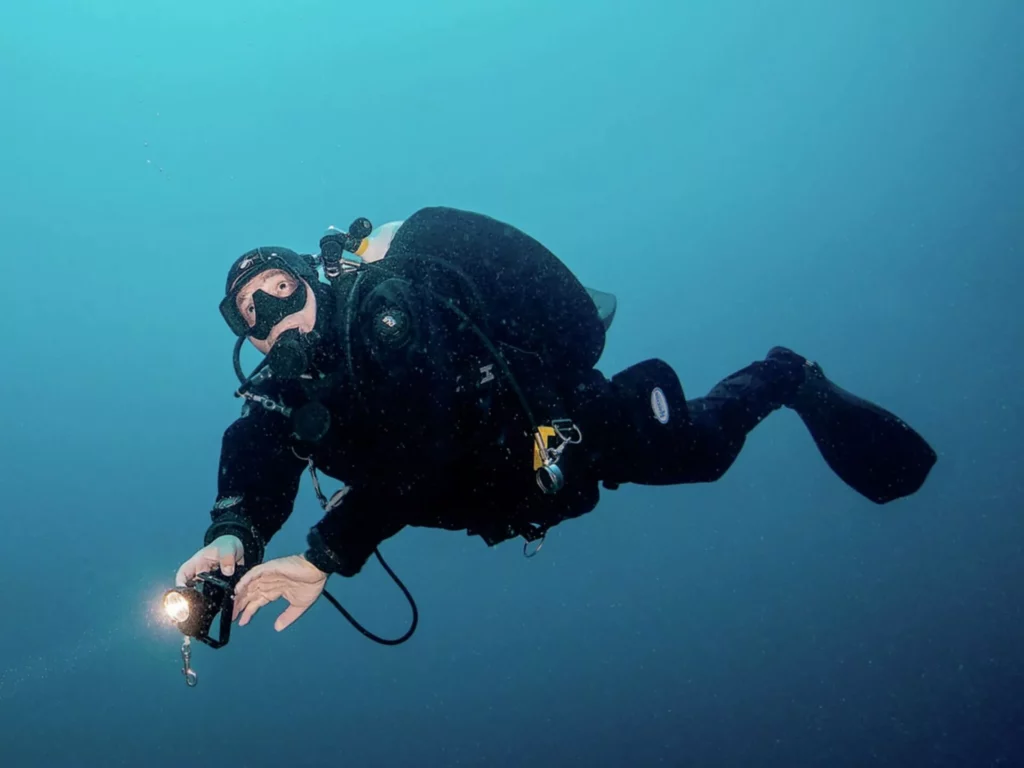
The Essential Skills for Managing Fear Underwater
If anything, as divers we need to have fear. We also need the ability to regulate emotion and attention in the face of fear. What we do not need is the reactive, energetically-demanding and unthinking state that fear can drive us to when we resist it. The way we resist fear can cause more problems than the emotion of fear. Firstly, not heeding valid fear can mean a diver going into a situation that they are not prepared for. Secondly, the unwillingness to feel strong emotions like fear can stimulate panic in itself. By this I mean a diver has an issue and, rather than notice the fear and do something about the problem, they turn in the other direction, running from the fear and taking attention away from the problem. Given that this will tend to create more problems, the panic escalates out of control. Thirdly, ego-defences can make it hard to call a dive on feeling fearful. Fourthly, avoidance behaviours that do not lead to improved safety and increase risk, because the intention is focused on avoiding fear (rather than addressing the problem).
Understanding the Schauer and Elbert Defense Sequence (2010)
These researchers postulate that the cascade ‘Freeze-Flight-Fight-Fright-Flag-Faint’ is a coherent sequence of six fear responses that escalate as a function of defence possibilities and proximity to danger during life-threat. These are the six responses.
• Freeze: an initial orienting response to pause and scan for threat and sources of help.
• Flight/Fight: a physiological state of high arousal that aids an organism to escape the threat. (Similar state, different behaviours).
• Fright: where fight/flight are not available, or unsuccessful, a physiological state of being frozen in fear.
• Flag: the physiological arousal level falls and there is disconnection, reduction in ability to think and emotional numbness.
• Faint: a state of immobility and, often, unconsciousness.
References
Schauer, M., & Elbert, T. (2010). Dissociation Following Traumatic Stress Etiology and Treatment. Zeitschrift Fur Psychologie-journal of Psychology, 218, 109-127. n
DAN Membership
Before taking the plunge make sure your DAN membership is still active. If it isn’t, join DAN or renew your membership at: www.daneurope.org Your DAN membership ensures the services of the biggest international network for assisting divers anywhere, during any emergency.
FAQs
What are the common physiological reactions to fear while diving?
When a diver feels threatened, the body undergoes a “defense cascade.” This includes the Freeze-Flight-Fight-Fright-Flag-Faint sequence. Physically, this often manifests as rapid, shallow breathing (hyperventilation), a racing heart, and the urge to ascend quickly, which can lead to decompression illness.
Is it normal to feel fear during a scuba dive?
Yes. Fear is a primitive, adaptive emotion designed to keep you safe. In diving, fear acts as a signal to respect your limits and perform essential safety checks. The goal is not to eliminate fear, but to regulate your reaction to it.
How does the “Freeze” response help divers?
The “Flight” response often triggers a rapid ascent to the surface, which is the most frequent cause of diving accidents. These states prioritize survival movement over rational problem-solving, which is essential for managing equipment or gas issues.
How can I prevent fear from turning into panic while diving?
Prevention starts with recognizing the physical signs of stress early. By practicing emotional regulation and mindfulness, divers can prevent the “cascade” from escalating into a state of “Fright” or “Flag,” where the ability to think clearly is lost.
This article was originally published in Scuba Diver Magazine
Subscribe today with promo code DIVE1 — enjoy 12 months for just £1!
